

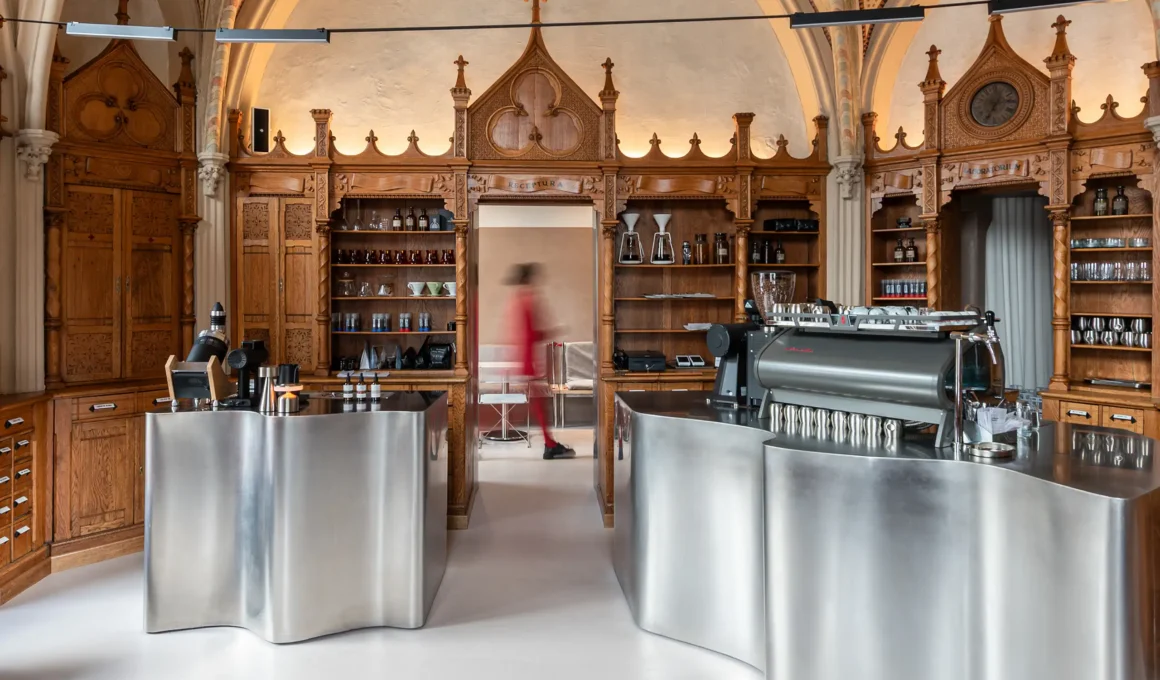
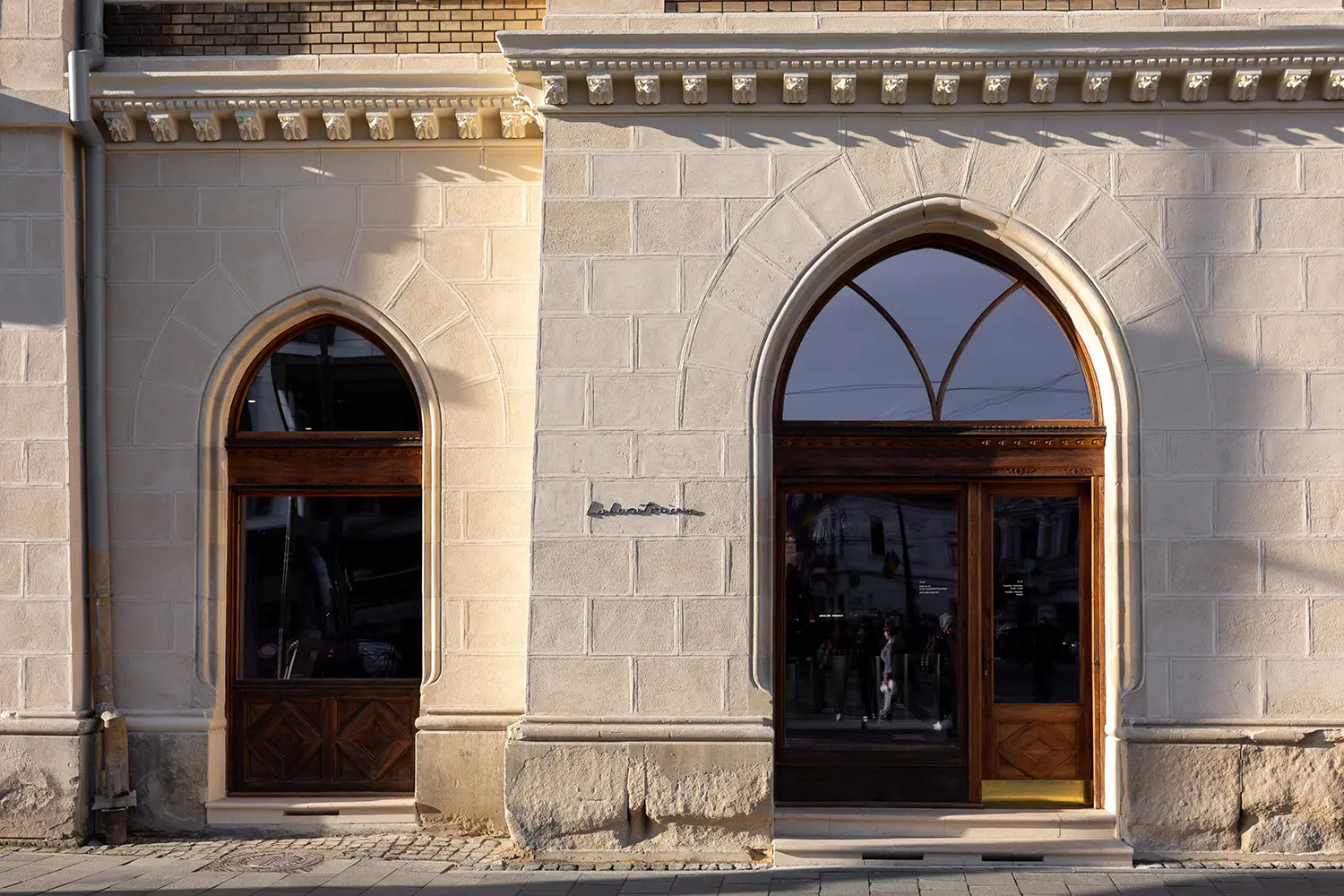
In the heart of Cluj-Napoca, Ektra Arhitectura and Fain Design have breathed new life into the 19th-century Matia Corvin Pharmacy, transforming the neo-Gothic landmark within Palatul Széki into Laboratorium, a specialty coffee destination that balances rigorous historical restoration with sharp, clinical minimalism.
A legacy of precision. The building, originally realized in 1893 by architect Pecz Samu, was once the domain of Miklós Széki—a pharmacist and professor whose visionary spirit is still palpable in the structure’s DNA. By stripping away decades of superficial layers, the design team has reconnected the street-level pulse of Cluj-Napoca with a space that was once a private sanctum of pharmaceutical science. The intervention proves that heritage is not a static burden but a functional foundation for urban revitalization.
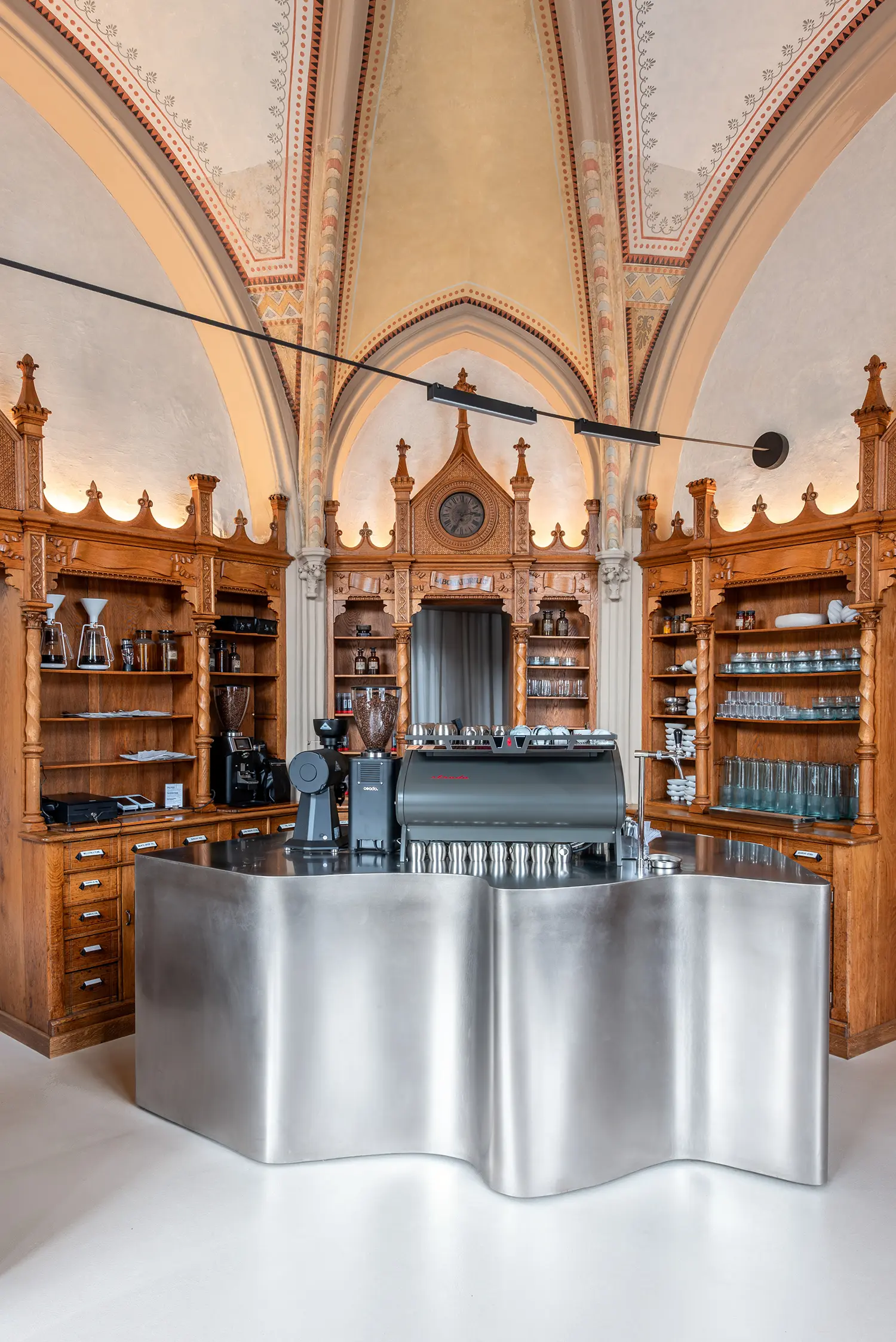
The art of recovery. At the core of the project is the meticulous restoration of the original solid wood cabinetry, crafted by the legendary cabinetmaker B. Bak Lajos. Adorned with Gothic arches and delicate fleurons, the dark timber carapaces have been treated not as museum pieces, but as active participants in the new narrative. Under the guidance of specialist restorers, the woodwork now frames a different kind of alchemy, where medicinal herbs have been replaced by the meticulous calibration of high-altitude beans.
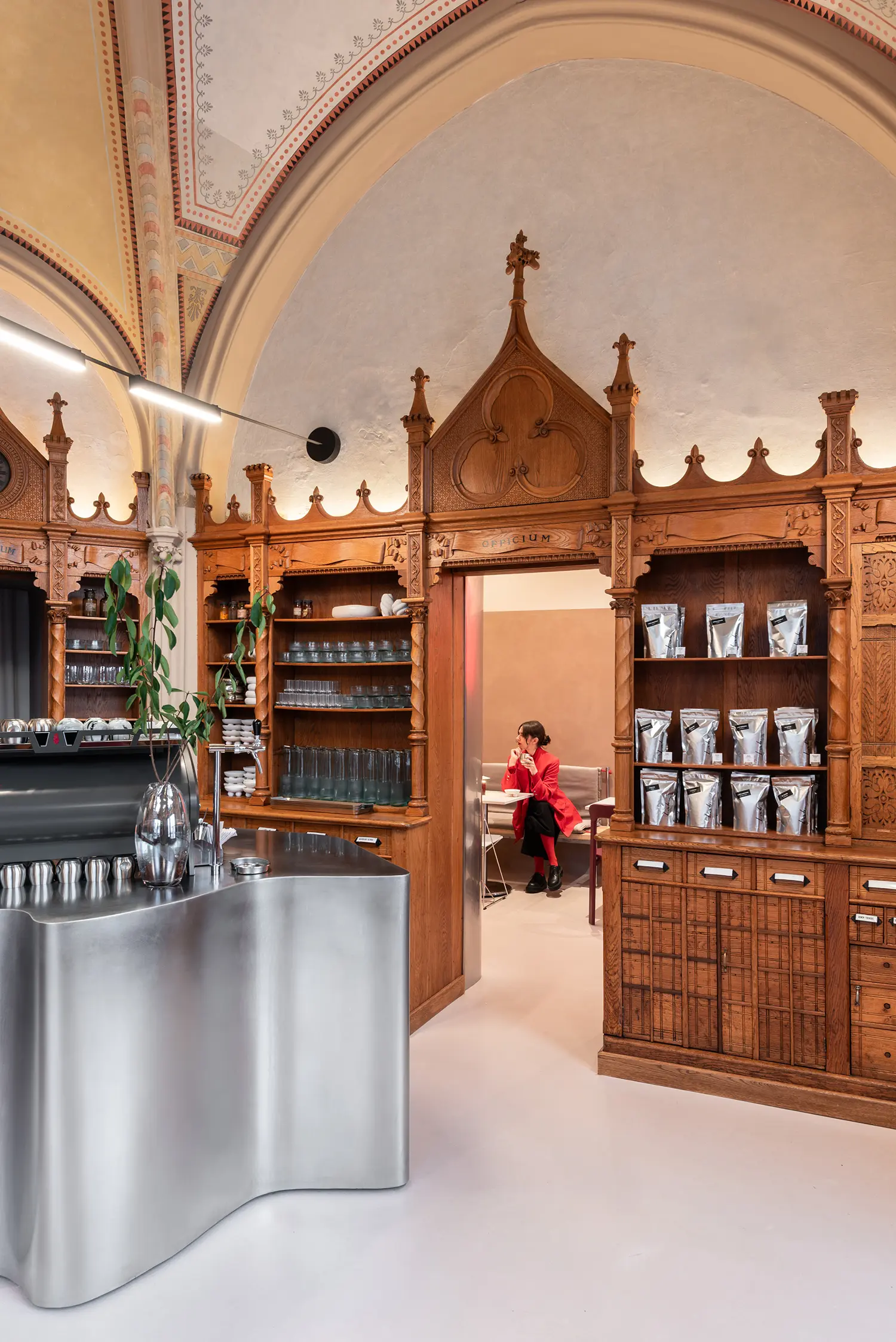
Material dialogue. Rather than mimicking the weight of the past, Fain Design introduced a visual language of high-tech contrast. The primary workspace is dominated by two sculptural coffee bars crafted from curved stainless steel. These brushed metal volumes act as light-reflective anchors, mirroring the natural luminescence that filters through the ogival arched windows. This tension between the ornate, hand-carved history and the sterile, industrial present defines the sensory experience, emphasizing a laboratory-like focus on the craft of brewing.
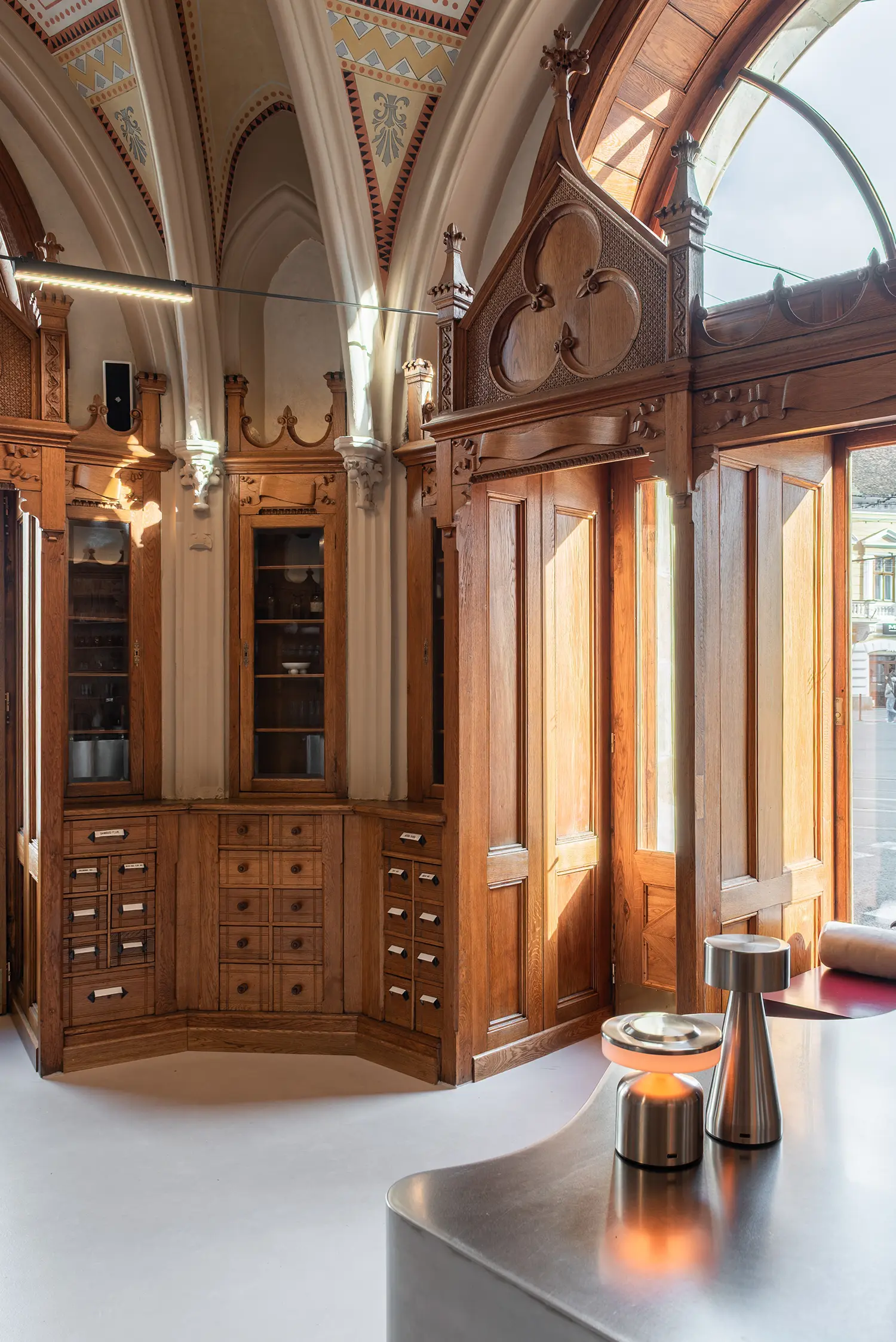
Scenographic illumination. Moving deeper into the former laboratory room, the volume opens upward toward original skylights that flood the seating area with vertical light. Here, the restoration team uncovered and reconstituted the original mural paintings on the vaulted ceilings, revealing muted hues that had been lost to time. To bridge the gap between the centuries, opaline red lighting fixtures were suspended throughout, casting a contemporary glow that accentuates the subtle textures of the reclaimed surfaces and stained glass.
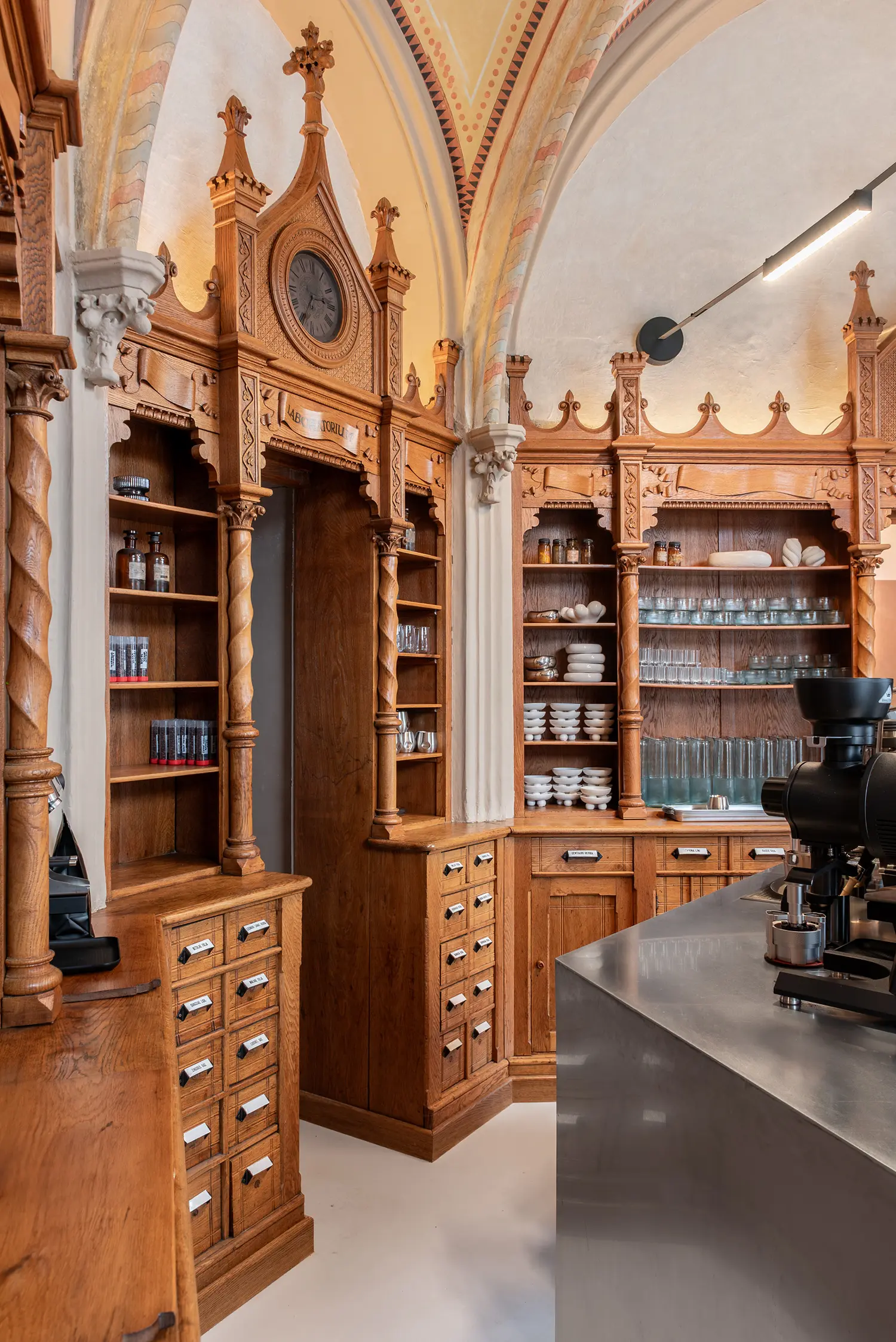
Experimental identity. The transition from pharmacy to coffee lab is mediated by a branding strategy that shuns historical clichés. Every detail, from the metal inserts to the modular furniture, feels intentional and calibrated. This is a space that respects the adaptive reuse philosophy, ensuring that the new function “listens” to the room’s history rather than shouting over it. The result is an atmosphere of quiet intensity, where the click of a portafilter feels right at home among the shadows of 19th-century drawers.
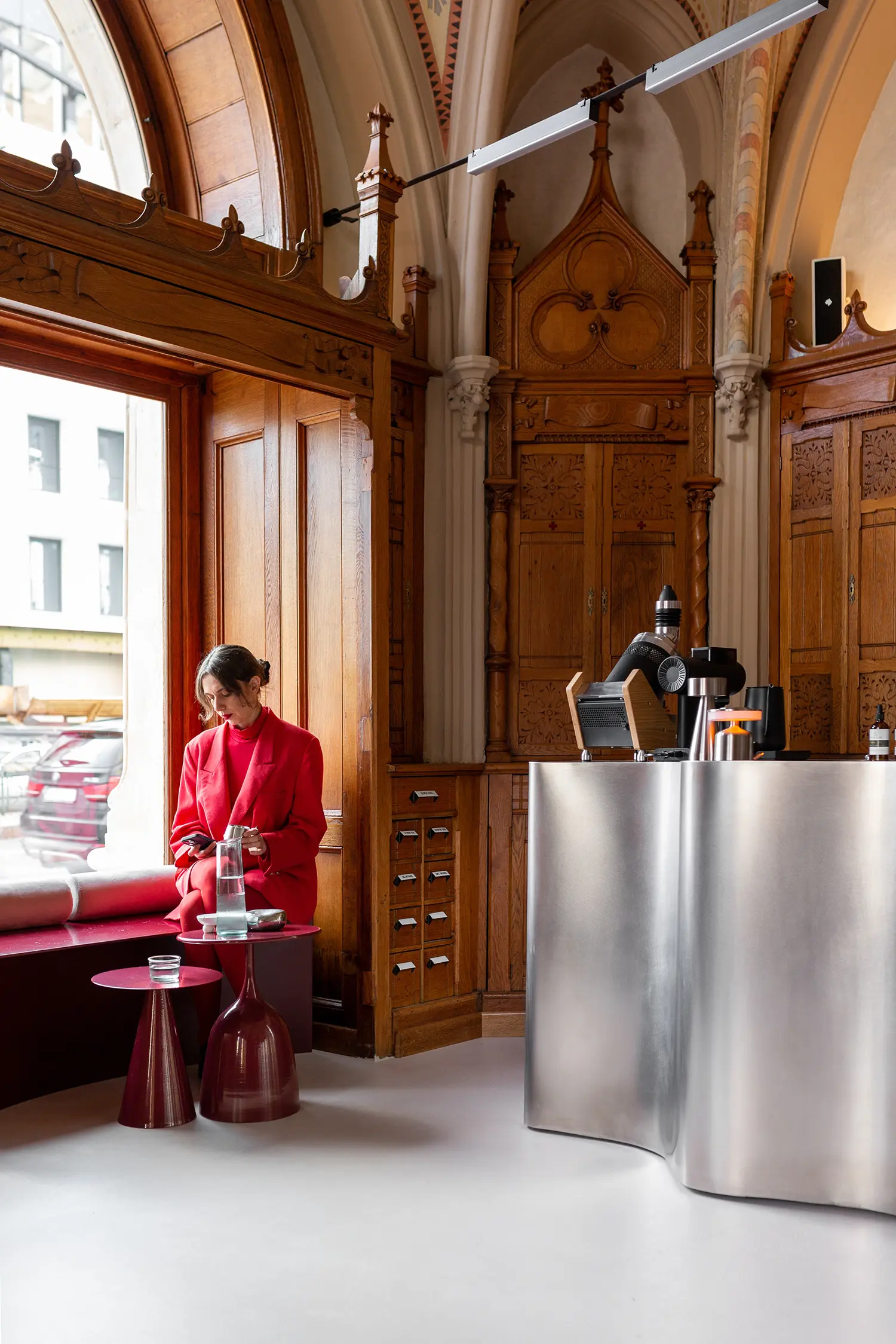
Sensory storytelling. The experience at Laboratorium is driven by a commitment to traceability and origin. Much like the pharmacists who once occupied these halls, the baristas operate with a focus on precision and chemical balance. Each lot of coffee is selected through personal relationships with farmers, ensuring that the liquid in the cup matches the integrity of the environment. It is a place of substance where the product is the protagonist, and the environment serves as its sophisticated stage.
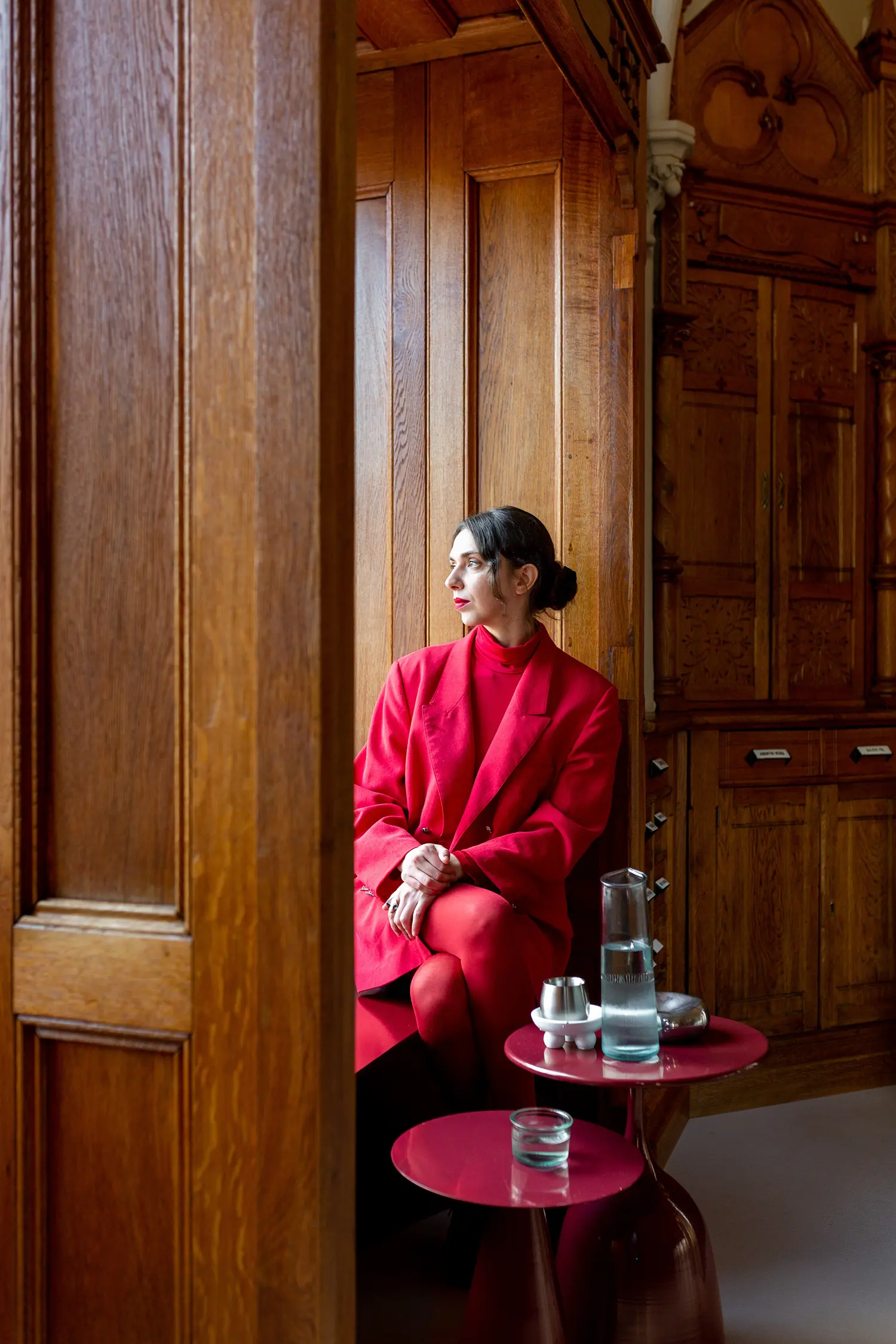
A cultural act. Beyond the technical success of the renovation, the project serves as a model for how the private sector can engage with architectural heritage. By keeping the original spiral metal staircase and preserving the flow of the 1893 floor plan, the designers have maintained the soul of Palatul Széki while making it accessible to a new generation of city dwellers. It is an act of continuity that celebrates the ritual of the morning coffee as a moment of conscious observation.
The evolution of the third space. Laboratorium joins a global cohort of projects redefining the café as a site of rigorous sensory engagement rather than a transient pitstop. This commitment to narrative-driven environments is echoed in the Atelier L-Kurasu pop-up in Beijing, where temporal design fosters a fleeting yet profound connection to the craft, and the maritime-inspired Bluo Café by Gur Studio, which employs thematic abstraction to transform a standard interior into a layered voyage. In these spaces, the focus shifts from mere consumption to a deliberate immersion in the intersection of history and modern ritual.