



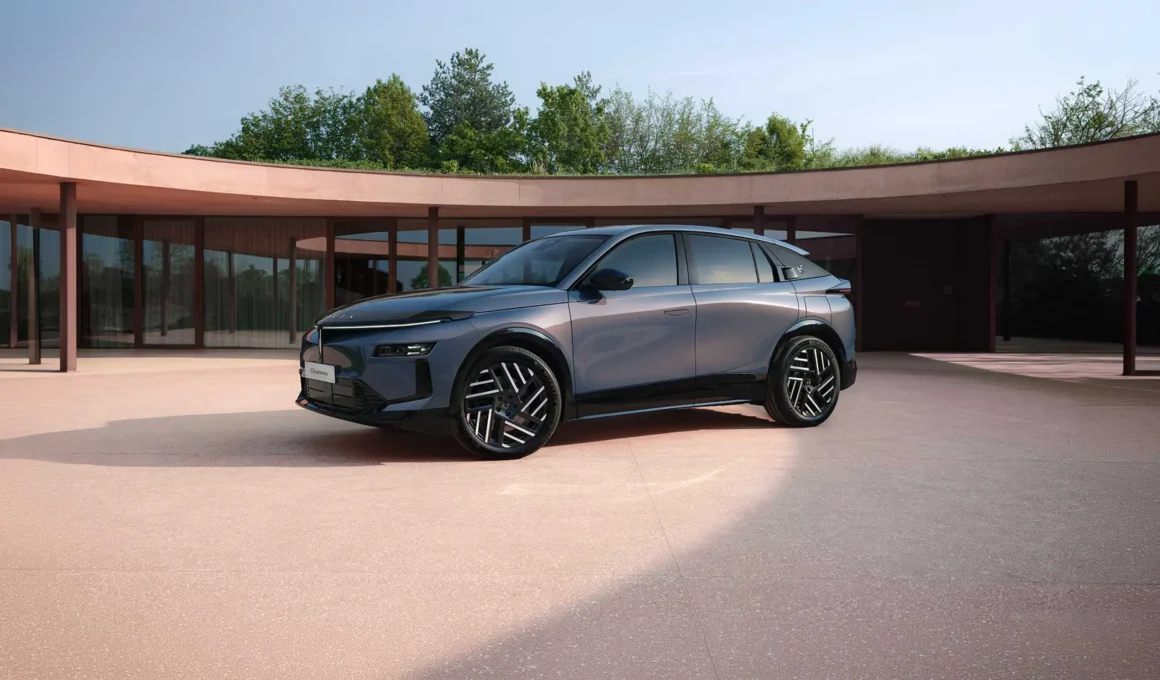
While Ferrari’s Luce dominates every conversation in the automotive world today, Lancia has quietly released the first images of the New Gamma — and the timing is not a coincidence.
The New Lancia Gamma arrives today as a teaser — three images, a press release, and a set of specifications precise enough to understand what Lancia is building, but restrained enough to keep the market waiting until after the summer. It is a deliberate communication strategy from a brand that has learned, across 119 years of history and a painful decade of near-disappearance, that anticipation is a form of luxury. The Gamma is not yet here. But it is close enough to read.

What the images reveal is a crossover fastback with a silhouette that takes the brand’s neo-classical revival seriously. At 4.67 meters in length, 1.89 meters wide and 1.66 meters tall, the Lancia Gamma sits in a segment — premium European fastback crossover — that is crowded but rarely occupied with genuine formal conviction. The tapered rear and sleek roofline suggest a car that prioritizes visual coherence over the aggressive surfacing that dominates most competitors in this class. It is a proportionally calm object, and in 2026 that is a rarer achievement than it sounds. Designed, engineered and developed in Italy, produced at the Stellantis Melfi plant — one of the group’s most advanced manufacturing facilities — the Gamma is built on the STLA Medium platform, the same architecture underpinning some of Stellantis’ most technically ambitious vehicles.
The powertrain strategy is where Lancia makes its most consequential statement. Rather than committing exclusively to electric — as Ferrari did this week with the Luce, Maranello’s first fully electric production car — Lancia offers a comprehensive range that covers multiple use cases and market realities. A 145 HP hybrid version delivers over 1,000 km of range for customers who are not yet ready to commit to pure electric infrastructure. The fully electric lineupis structured across three levels: 230 HP with over 540 km of range, 245 HP with over 740 km, and a 375 HP AWD all-wheel drive version reaching up to 675 km. It is a portfolio that acknowledges the European market’s heterogeneity — different customers, different infrastructures, different relationships with the transition — without hedging on ambition at the top of the range.

The Gamma is the third act of Lancia’s ten-year renaissance plan, following the Ypsilon and the Lancia Delta, and it represents the brand’s most significant model in terms of market reach and commercial weight. Where the Ypsilon reestablished the brand’s visual language and the Delta reaffirmed its performance heritage, the Gamma must do something harder: prove that Lancia’s return is sustainable at volume, in a competitive segment, against established players with far greater resources. The fact that it is produced in Italy, at Melfi, is not merely a logistical detail — it is a positioning statement directed at a European customer increasingly attentive to provenance and manufacturing identity.
May 26, 2026 will be remembered as a singular day in Italian automotive history. Two brands, two different answers to the same question — what does a premium Italian car mean in the electric era? Ferrari answered with the radical, the bespoke, the half-million-euro statement. Lancia answers with the considered, the accessible, the everyday Italian elegance that the brand has embodied since the Aurelia and the Flaminia. Neither answer is wrong. Together, they suggest that Italian automotive culture is not converging on a single model of the future — it is expanding into several, simultaneously.
Order opening is scheduled after the summer. Further details will follow in the coming months. In the meantime, the Gamma exists as a promise — and on the evidence of these first images, it is a promise worth watching.