

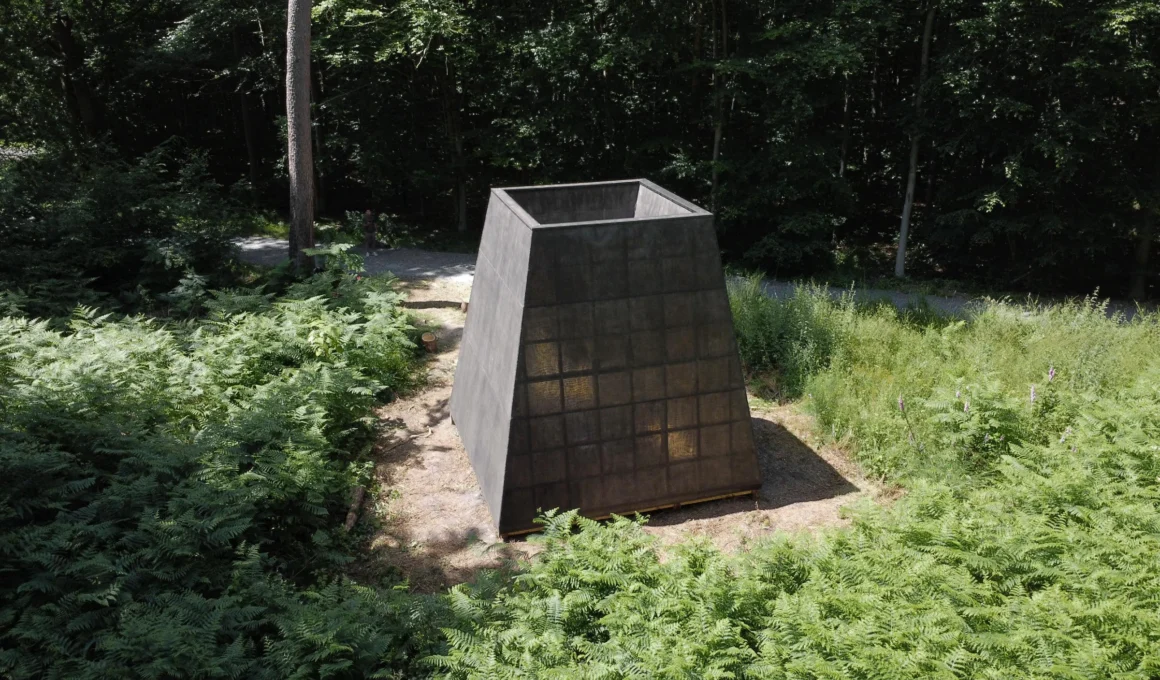
Compluvium Pavilion, located in the rain-soaked Forêt de Roumare near Canteleu, Seine-Maritime, France, is the latest work by P+S Estudio de Arquitectura that challenges the notion of shelter. The architectural design is conceived not as a refuge from water, but as a deliberate allegory to it, consciously highlighting the heavy, characteristic rainfall of the Rouen environment. This spatial artefact uses a pure, recognizable geometry to contrast with its natural setting while simultaneously attempting to dissolve into it.

The structure achieves this paradox through a subtle layering of skins: linen and fibreglass. These materials, particularly when touched by shifting light and moisture, transform the pavilion’s appearance, blurring the lines between built form and landscape. The ultimate aim is to create an immersive, internal architectural experience that forces an awareness of water’s presence, sublimating its material condition. The building itself is simply the necessary support for this contemplation to occur.

The central operation is geometric and rooted in history. P+S Estudio de Arquitectura articulated a central void based on a virtual five-by-five-by-five-metre cube. The roofs slope inwards—a move that echoes the ancient Roman atrium and the traditional dwellings of the Diola community in southern Senegal—funnelling rainwater into the centre. The structure’s only function, once activated by the collected water, is one of contemplation, linking it to a timeless human need to frame and observe natural elements.

Material minimalism defines the sensory experience. Only three elements are employed: a framework of pinewood forms the structure for this ‘water shelter’; a resin-infused fibreglass acts as a waterproof yet light-transmitting membrane; and 100 per cent locally manufactured linen provides the internal and external surfaces. This careful selection ensures the architectural design maximizes perception with the minimum number of resources.

The application of the linen skin creates a powerful duality. The exterior is treated with a black stain, giving it a protective, stark shell, while the interior retains the natural, undyed expression of the fibre. This layering establishes a complex dialogue between the ‘skins’ of different natures, profoundly nuancing the spatial atmosphere and forging a precise, powerful link between the interior and the outside world.

Crucially, the chosen materials ground the abstract geometry in a specific local context. The use of wood and linen directly references Normandy’s cultural and constructive memory, linking the pavilion to the region’s traditional colombage timber-framed houses and its textile production heritage. The Compluvium Pavilion thus resolves itself as an experiment in contemporary form that consciously integrates local territory, architecture, and memory into a single, cohesive experience.