



In Rome’s refined Flaminio district, local architecture office STUDIOTAMAT has completed the interior renovation of Casa Continua, a 115-square-meter apartment where historical layers and contemporary fluid lifestyles seamlessly merge.
A contemporary rewriting of history. The apartment is located within an elegant residential building whose rationalist entrance hall immediately sets a tone of structured geometric rigour. Purchased by the owner more than three decades ago, the domestic layout had slowly lost touch with the changing rhythm of its inhabitant. The original floor plan, typical of its era, was defined by fragmented rooms and rigid partitions that no longer supported a daily life shaped by modern movement, spontaneity, and joint experiences. Central to this misalignment was the kitchen, which had previously been relegated to a minor, isolated position. To resolve this, the design team initiated a comprehensive interior renovation project, transforming the home’s layout into a narrative of open visual thresholds.

The kitchen as a social engine. The new structural organization centers around this key culinary zone, which has been reimagined as the conversational core of the entire dwelling. It acts as a primary focal point that anchors daily routines and hosts shared moments.
“The key focus of the project was to correct what the client described as ‘the most significant mistake’ of the house’s previous life: the downsizing of the kitchen. We reversed that logic, transforming it into the engine of conviviality — a dynamic volume from which movement can be observed and the life of the house can be joined without ever feeling apart from it,” says Valentina Paiola, STUDIOTAMAT.

Material continuity and open thresholds. Enclosed by custom-made burgundy glazed partitions, the kitchen functions as a semi-transparent pavilion. The rich glaze of the metal framing establishes a bold chromatic statement, while the textured glass screens control views without isolating the cook. Flowing outward from this central volume, the main living area occupies the combined footprint of three former rooms. The partition walls were removed to foster a generous sense of scale, yet each functional area retains its individual character. This delicate spatial balance is reinforced by a shared material palette: the original panelled parquet flooring was meticulously restored to run uninterrupted underfoot, while a thin burgundy line is traced high along the walls, visually aligning the different zones.

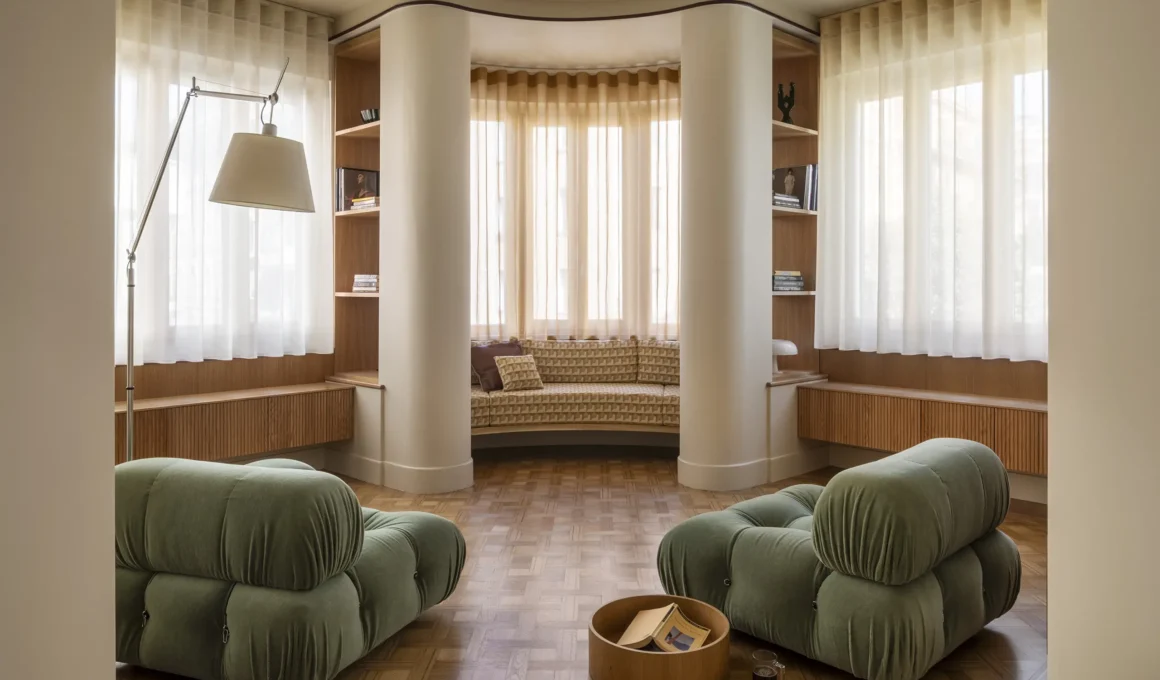
Tailored joinery and iconic design. The structural columns of the building have been seamlessly integrated into custom oak joinery, housing tailored bookshelves and cozy integrated benches. This bespoke wooden system wraps around the structural skeleton, transforming a physical constraint into a highly functional space-saving design. This thoughtful setting hosts iconic pieces such as Mario Bellini’s Camaleonda sofa in green velvet, alongside bespoke benches upholstered in l’Opificio’s Relief fabric. These textiles mirror the geometric patterns of the custom terrazzo flooring, establishing a quiet dialogue between hard and soft surfaces.

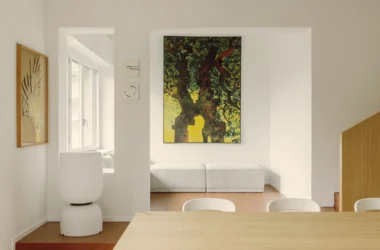
Filtering light through glass partitions. Serving as a transition zone, the dining room features a vintage glass-topped dining table paired with Giovanni Carini’s elegant Libellula chairs. Positioned behind the reeded glass and burgundy metal screens, the dining area remains visually permeable, allowing natural light from the large windows to filter deep into the floor plan while preserving a sense of structural definition.

A secluded, tactile retreat. A more intimate atmosphere defines the reading room, where the interior styling transitions toward a quiet, tactile space of thought. Built-in oak shelving hosts the owner’s extensive collection of literature, accompanied by integrated reading niches. Here, the color tones deepen and the acoustic qualities of the fabrics help foster a peaceful space for quiet contemplation.
“The challenge was to give a home to thousands of accumulated books. We were not interested in creating an undifferentiated open-plan space, but rather a tailored sense of fluidity. From the custom terrazzo to the oak joinery embracing the structural columns, every detail was conceived as a prototype allowing the memory of Flaminio to coexist with a new everyday dynamism,” continues Valentina.

Rigour in the private quarters. The private sleeping area continues this clean, tailored approach. Large, floor-to-ceiling custom oak wardrobes wrap around the bedroom, featuring central panels upholstered in Filigrana fabric by l’Opificio. This structured woodwork is contrasted by the rear headboard wall, which is finished in Harlequin’s Elsworthy Wide Width wallpaper with its soft, organic pattern. A plush Flou bed in ochre velvet provides a warm chromatic accent that references the earthy tones of the main social spaces.

A legacy of Roman transformations. With this project, STUDIOTAMAT continues to build on its reputation for sensitive, site-specific transformations across the Italian capital. This signature approach is evident in several of their previous works featured on urdesignmag, including the restoration of a modernist villa in Castelli Romani, where 1960s Usonian-inspired architecture was updated for a contemporary family, and the revival of a 19th-century Liberty-style villino in Trastevere, which transformed a compact caretaker’s cottage into an airy urban retreat. Similarly, their House on Track project near Termini Station demonstrated the studio’s skill in uncluttering historic interiors, revealing original brick vaulted ceilings to establish a contemporary open-plan layout. Across all these residential renovations, the Rome-based practice demonstrates how historical structures can be mindfully adapted to support modern lifestyles, ensuring that historical heritage remains active, functional, and deeply lived.