


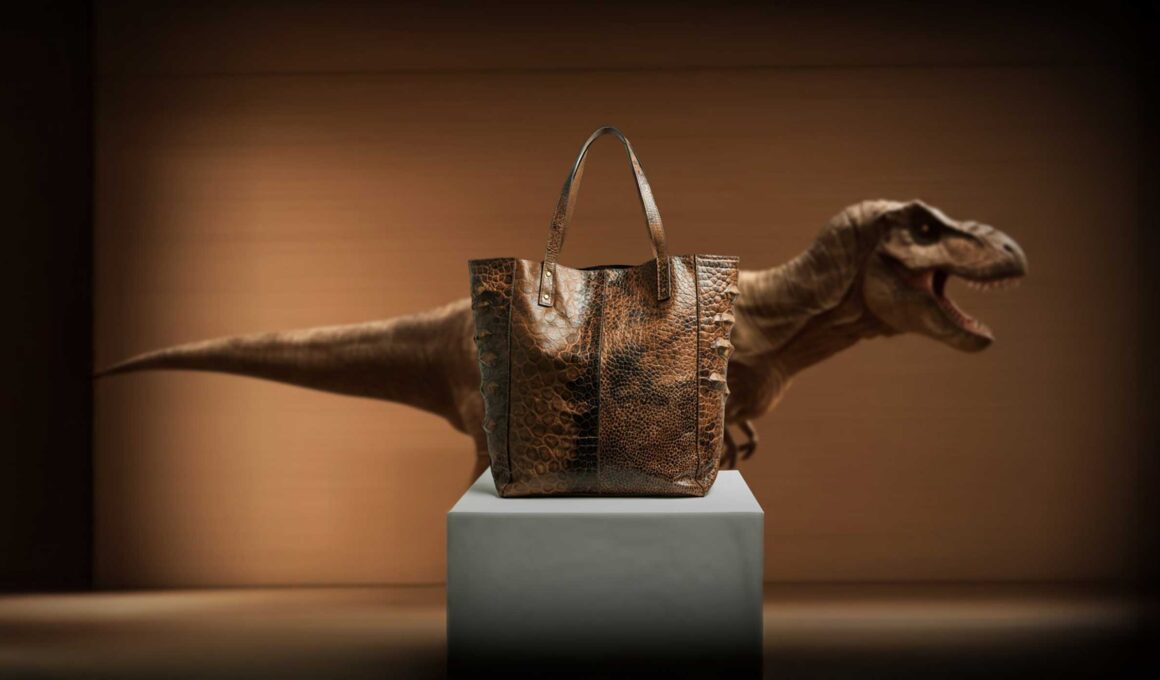
In a world where sustainable materials and ethical fashion are no longer optional but imperative, a groundbreaking collaboration is rewriting the rules of luxury design. Creative agency VML, genomic engineering leader The Organoid Company, and biotech innovator Lab-Grown Leather Ltd. have joined forces to develop the world’s first T-Rex leather—a cruelty-free, eco-friendly alternative to traditional leather crafted from the DNA of one of history’s most formidable predators.
This biotech breakthrough merges advanced tissue engineering, synthetic biology, and creative innovation to produce a material that could revolutionize the luxury fashion industry. Unlike conventional leather, which relies on resource-intensive livestock farming and toxic tanning processes, lab-grown T-Rex leather is cultivated using fossilized collagen as a blueprint. The result? A high-performance biomaterial that mimics the durability, texture, and repairability of animal leather—without the environmental or ethical cost.
How T-Rex Leather is Made: A Feat of Bioengineering
The process begins with The Organoid Company reconstructing T-Rex DNA sequences, which are then engineered into a custom cell line. These cells are integrated into Lab-Grown Leather’s Advanced Tissue Engineering Platform (ATEP™), where they self-assemble into a scaffold-free leather structure. Unlike other bio-based alternatives that rely on synthetic scaffolds, this method allows cells to form their own natural matrix, resulting in a material that is structurally identical to traditional leather—only stronger and more sustainable.
Dinosaurs evolved to thrive in extreme conditions, and as climate change accelerates, their biology offers unexpected solutions for modern material science. T-Rex leather isn’t just an imitation—it’s a next-gen biomaterial designed for resilience, biodegradability, and luxury craftsmanship.
Why This Could Change Fashion Forever
The environmental impact of traditional leather is staggering: deforestation, water pollution, and carbon emissions plague the industry. Lab-grown leather, however, eliminates these issues by cutting out livestock farming and chromium-based tanning. With T-Rex leather, the team is pushing boundaries even further, proving that ancient biology can inspire future-proof materials.
Initial applications will focus on luxury accessories, with plans to debut a high-end fashion productby late 2025. If successful, the material could expand into automotive interiors, furniture, and beyond. As Professor Che Connon of Lab-Grown Leather Ltd. explains, “This venture showcases the power of cell-based technology to create materials that are both innovative and ethically sound.”
A New Era of Ethical Luxury
For VML, this project is part of a broader mission to productize creativity—turning bold ideas into tangible innovations. Following their Mammoth Meatball project, the agency is once again proving that biotechnology and design can intersect to solve global challenges.
As Thomas Mitchell, CEO of The Organoid Company, puts it: “This project is a remarkable example of how we can harness cutting-edge genome and protein engineering to create entirely new materials.”
With T-Rex leather, the past and future collide, offering a glimpse into a world where sustainabilityand luxury are no longer at odds. As consumer demand for ethical alternatives grows, this biotech leather could soon become the gold standard for high-performance, planet-friendly fashion.