


The Victoria and Albert Museum in London hosts “Schiaparelli: Fashion Becomes Art,” the first major UK retrospective dedicated to the Italian-born visionary Elsa Schiaparelli, charting her subversive influence from the 1920s Surrealist movement to the contemporary red-carpet dominance of creative director Daniel Roseberry.
A legacy of creative defiance defines the exhibition, which opens its doors this Saturday, 28 March 2026. By positioning dressmaking not as a trade but as a fine art, Elsa Schiaparelli dismantled the rigid boundaries of the interwar period. The showcase at the V&A serves as a rigorous analytical journey through over 400 objects, weaving together a narrative that spans from her early trompe l’oeil knitwear to the sculptural, gold-infused couture that defines the Maison today under Roseberry’s leadership.

The conceptual vision of the exhibition is rooted in Schiaparelli’s ability to find beauty in the unconventional. Curators Sonnet Stanfill, Lydia Caston, and Rosalind McKever have structured the experience into four distinct chapters that mirror the designer’s evolution from a sportswear pioneer to a Surrealist icon. Visitors are first introduced to her 1927 debut, where a simple black sweater featuring a knitted white bow challenged the era’s perceptions of reality and artifice.

Technical innovation and tailored radicalism take center stage as the narrative moves into the 1930s. The exhibition highlights her “Pour la Ville” collections, which introduced sharply tailored skirt suits and trouser sets that were daringly progressive for the modern urban woman. The inclusion of unusual buttons—shaped like insects or acrobats—demonstrates how Schiaparelli used functional details as canvases for wit, ensuring that even the most practical garment possessed a sense of performative flair.

The intersection of disciplines is most vividly felt in the “Creative Constellations” section. Here, the dialogue between Schiaparelli and the Surrealist elite is rendered physical. Salvador Dalí’s Lobster Telephone (1938) sits in conversation with the legendary Lobster dress, while Jean Cocteau’s drawings are realized in silk and gold thread. This segment emphasizes that her work was not merely “inspired” by art; it was a collaborative extension of the movement, challenging the tactile limits of fashion through shared subversion.

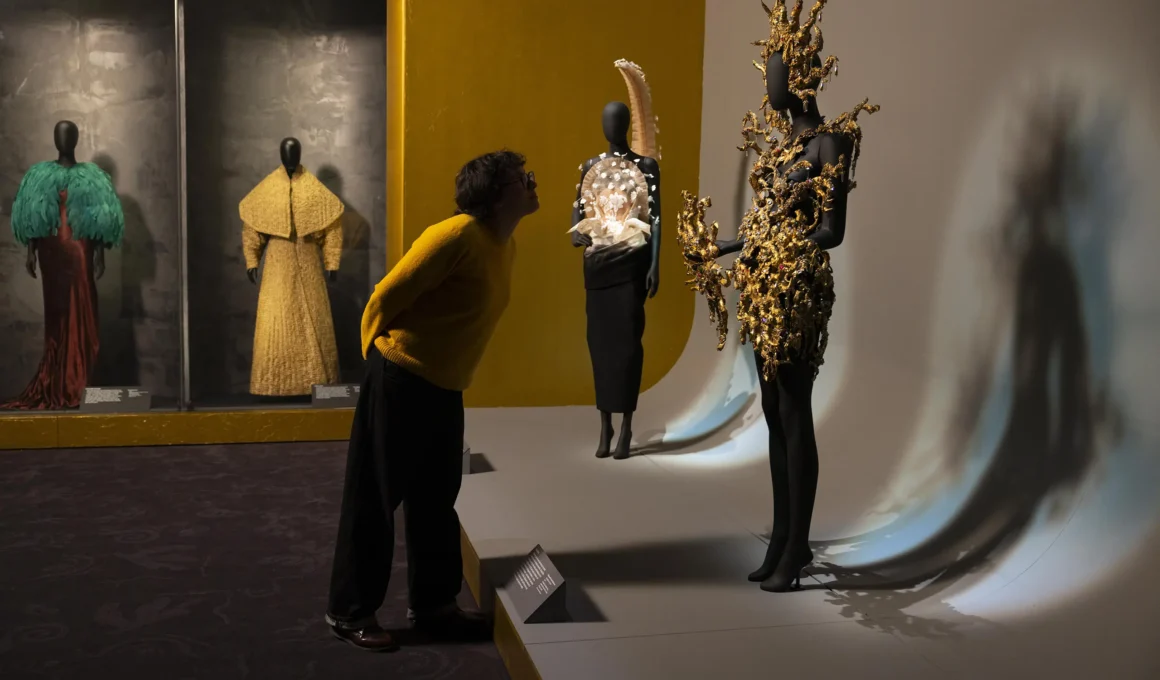
Sensory and archival depth is provided by the display of the 1938 Skeleton dress, a hauntingly beautiful piece from the V&A’s permanent collection that uses trapunto quilting to mimic the human anatomy. Seen alongside the “Tears” dress and the infamous “shoe hat,” these pieces evoke a visceral reaction, reminding the viewer that Schiaparelli’s work was often designed to unsettle as much as it was to adorn. The exhibition design by Nebbia enhances this atmosphere, creating a spatial rhythm that balances historical reverence with contemporary edge.

A London-centric perspective adds a layer of fresh research to the exhibition, focusing on the Schiaparelli salon in Mayfair. Opened in 1933, this satellite location became a hub for the British Surrealist movement. Rare garments bearing the London label, such as a burgundy velvet suit and an oyster-colored crinkled rayon wedding dress, illustrate how her aesthetic was adapted for a sophisticated UK clientele, ranging from Lady Mount Temple to the artistic elite of the 1930s.

The cinematic influence of the Maison is further explored through its impact on the silver screen. Schiaparelli’s ability to craft a persona through clothing is showcased via costumes for Mae West and the personal wardrobe of Marlene Dietrich. These pieces highlight a mastery of silhouette that understood the camera’s eye, a quality that remains a cornerstone of the brand’s identity as it continues to dress the world’s most prominent performers and cultural figures.

A contemporary metamorphosis occurs in the final section, “A Golden Thread.” Since 2019, Daniel Roseberry has revitalized the house by reclaiming its surrealist spirit for a digital age. The exhibition displays his most spectacular recent creations, including the bedazzled robot baby from the Spring/Summer 2024 collection and the modern Skeleton dress worn by Dua Lipa. Roseberry’s work acts as a bridge, proving that the founder’s “fearless imagination” is a living, breathing methodology rather than a static historical footnote.

Spatial storytelling in fashion has seen a remarkable evolution in recent years, with institutional exhibitions becoming increasingly immersive and analytical. This V&A retrospective follows a global trend of high-caliber fashion curation, reminiscent of the scenographic precision seen in OMA’s recent scenography for Dior in Seoul, or their traveling narrative for Louis Vuitton’s visionary journeys. In each instance, the architecture of the exhibition itself becomes a vital tool for decoding the complex heritage of a luxury house.

The exhibition at the V&A succeeds by refusing to treat fashion as a vacuum. Instead, it presents Schiaparelli as a nexus point where haute couture, social history, and the avant-garde collide. By the time visitors reach the final display, the distinction between the wearer and the work of art has dissolved, leaving a lasting impression of a woman who didn’t just design clothes, but defined a new way of seeing the world.