


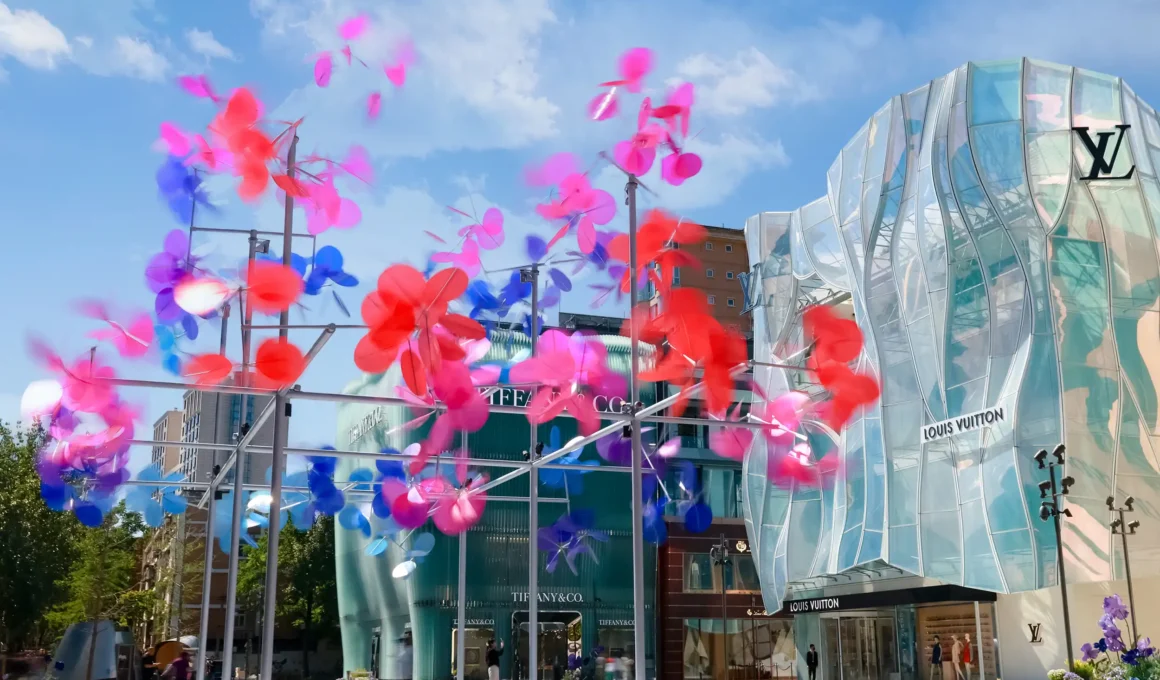
Vincent Leroy’s latest kinetic installation, Point Cloud, suspended over the bustling plaza of Taikoo Li Sanlitun for Beijing’s 2026 Fashion Festival, redefines urban public space by transforming transient wind currents and ambient sunlight into a shifting, monumental chromatic cloud of translucent discs.
A Choreography of Air. The work functions less as a static sculpture and more as a meteorological phenomenon captured within an urban grid. By releasing color from rigid structures, the French artist allows shades of electric blue, violet, pink, and red to ripple continuously across the sky. The physical boundaries of the public space dissolve as each individual element rotates independently with the slightest movement of air, subverting the heavy permanence typically associated with commercial plazas.
Tactile Transparency. The sensory experience of this kinetic installation relies on a delicate balance between weightlessness and high visibility. As viewers move beneath the suspended mass, the work constantly shifts between density and transparency, forming ever-changing compositions against the sky. The material choices allow light to arrive like a rumor, filtering through the translucent colored discs to project vibrant chromatic shadows across the ground below. This interaction extends the physical presence of the piece, anchoring it directly to the pavement and the bodies walking over it.
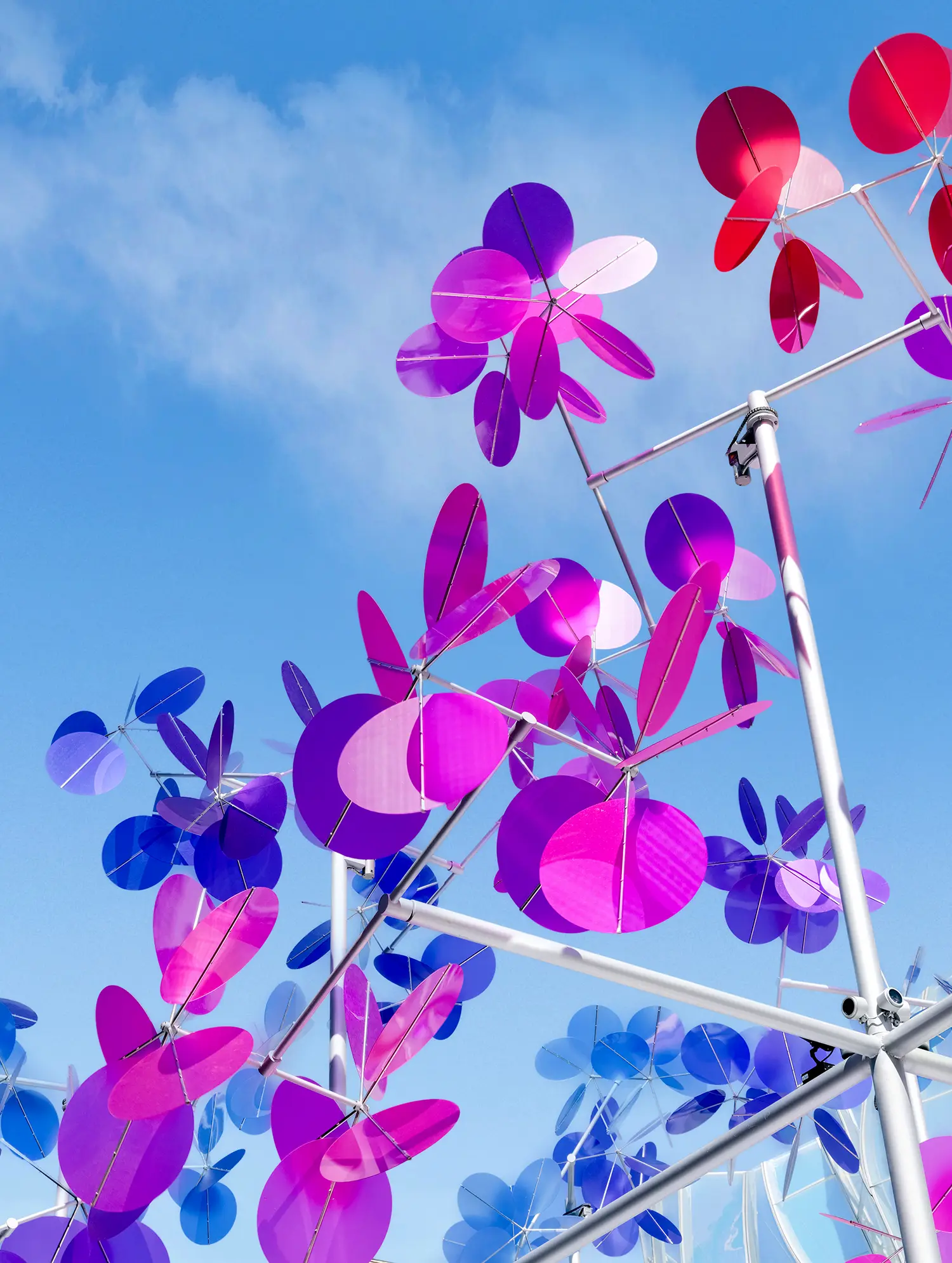
Atmospheric Perception. From a distance, the work reads as a cohesive, vibrant floating mass, a singular intervention in the city’s skyline. Closer inspection, however, reveals a delicate choreography of reflections and motion where the micro-movements of individual components dictate the macro-experience of the viewer. It explores color not as a fixed property, but as a living phenomenon shaped by air, light, and time. The environment becomes an immersive piece of contemporary art, drawing the gaze upward and altering the rhythm of everyday urban transit.
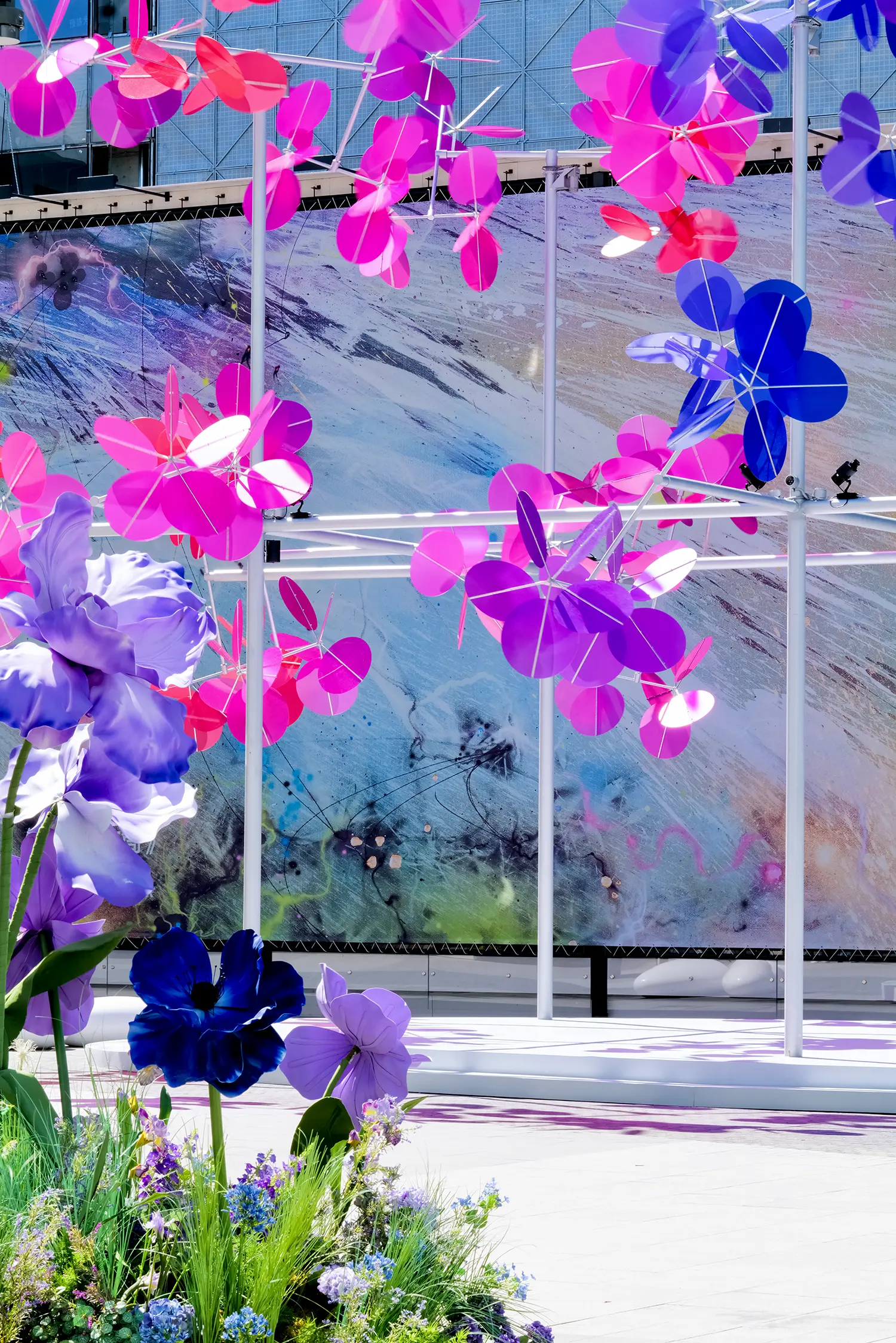
Spatial Metamorphosis. The choice of Taikoo Li Sanlitun as a canvas creates a stark juxtaposition between consumer architecture and ephemeral visual art. Where commercial facades demand attention through static branding, this chromatic installation offers an undulating, unpredictable landscape. Throughout the day, the shifting angles of the sun recalibrate the saturation of the discs, meaning the work is never experienced the same way twice. It functions as a temporal clock, marking the passage of hours through color gradients.
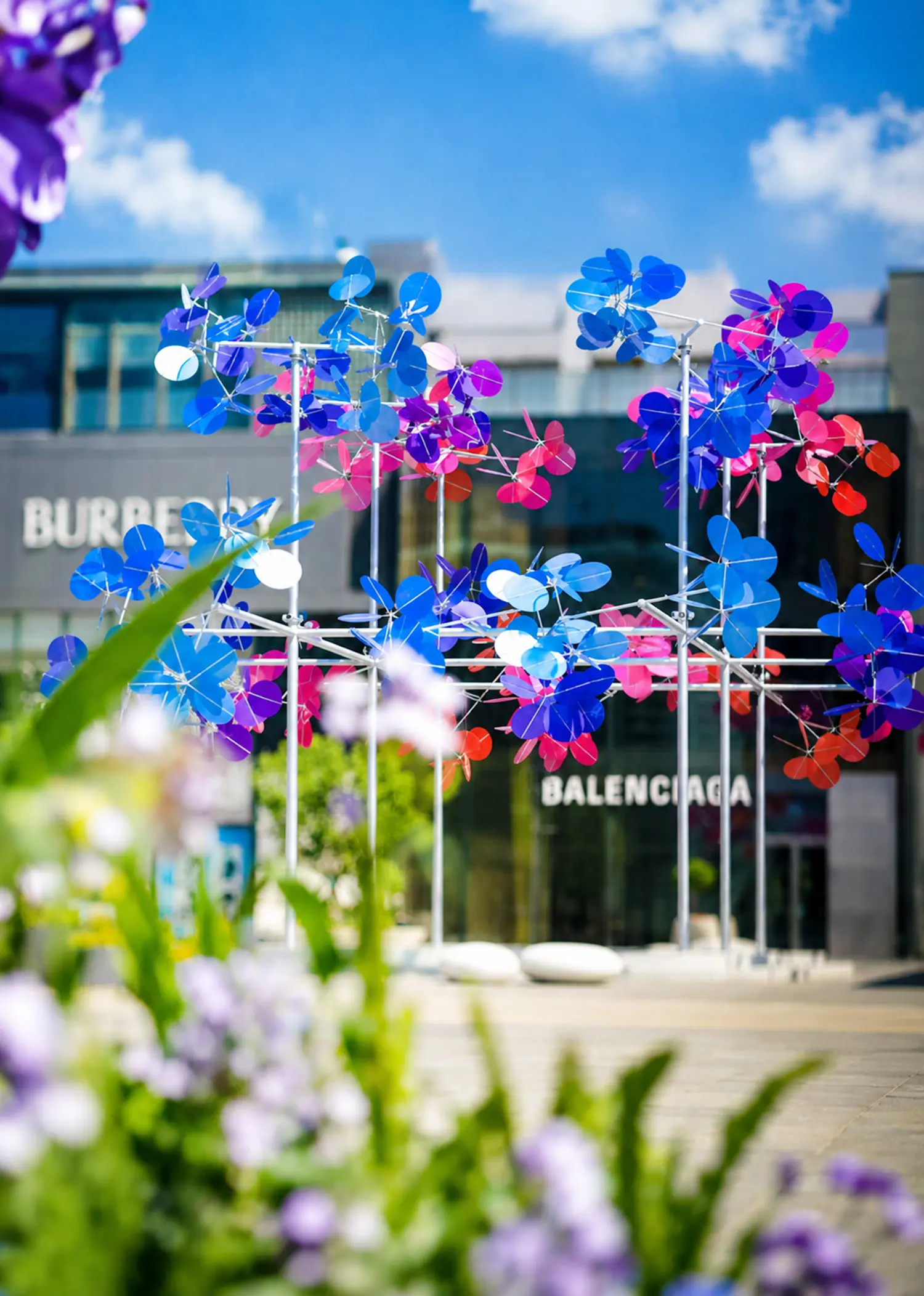
Kinetic Realism. Mechanically, the brilliance of the piece lies in its reliance on natural forces rather than motorized automation. By allowing the wind to dictate the rotation and alignment of the translucent fragments, the artist surrenders control to the environment. This choice injects a sense of organic vulnerability into a highly structured metropolitan setting, reminding observers of the invisible atmospheric currents that constantly wrap around the built environment.
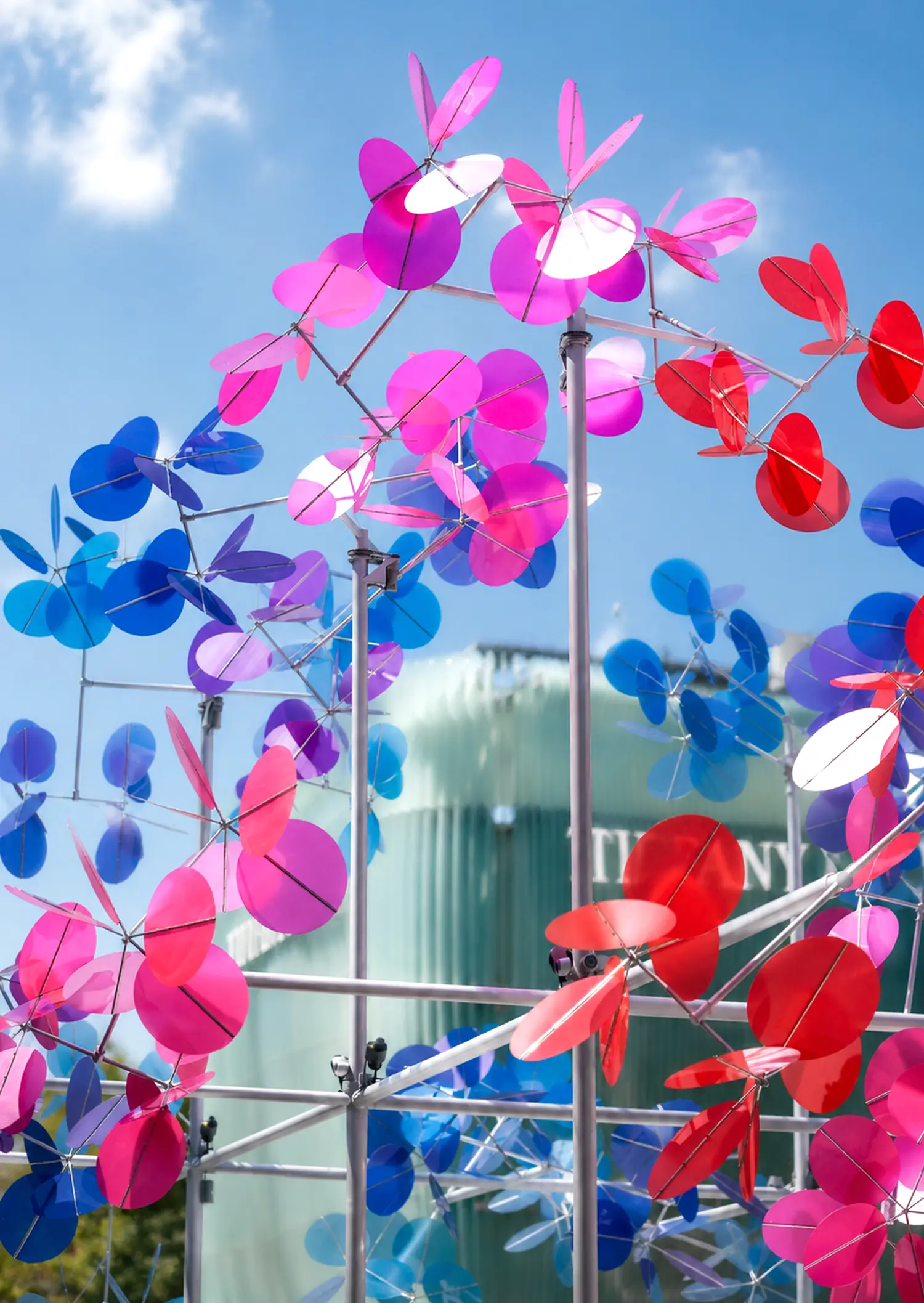
The Multi-Sensory Urban Frame. Rather than imposing an artificial narrative onto the site, the installation amplifies what is already there—the wind, the sun, the collective movement of the crowd. The floating flight of petals acts as a visual filter, softening the hard edges of the surrounding architecture and inviting a slower, more contemplative engagement with the city. It becomes a catalyst for shared observation, pausing the frantic pace of the fashion festival.
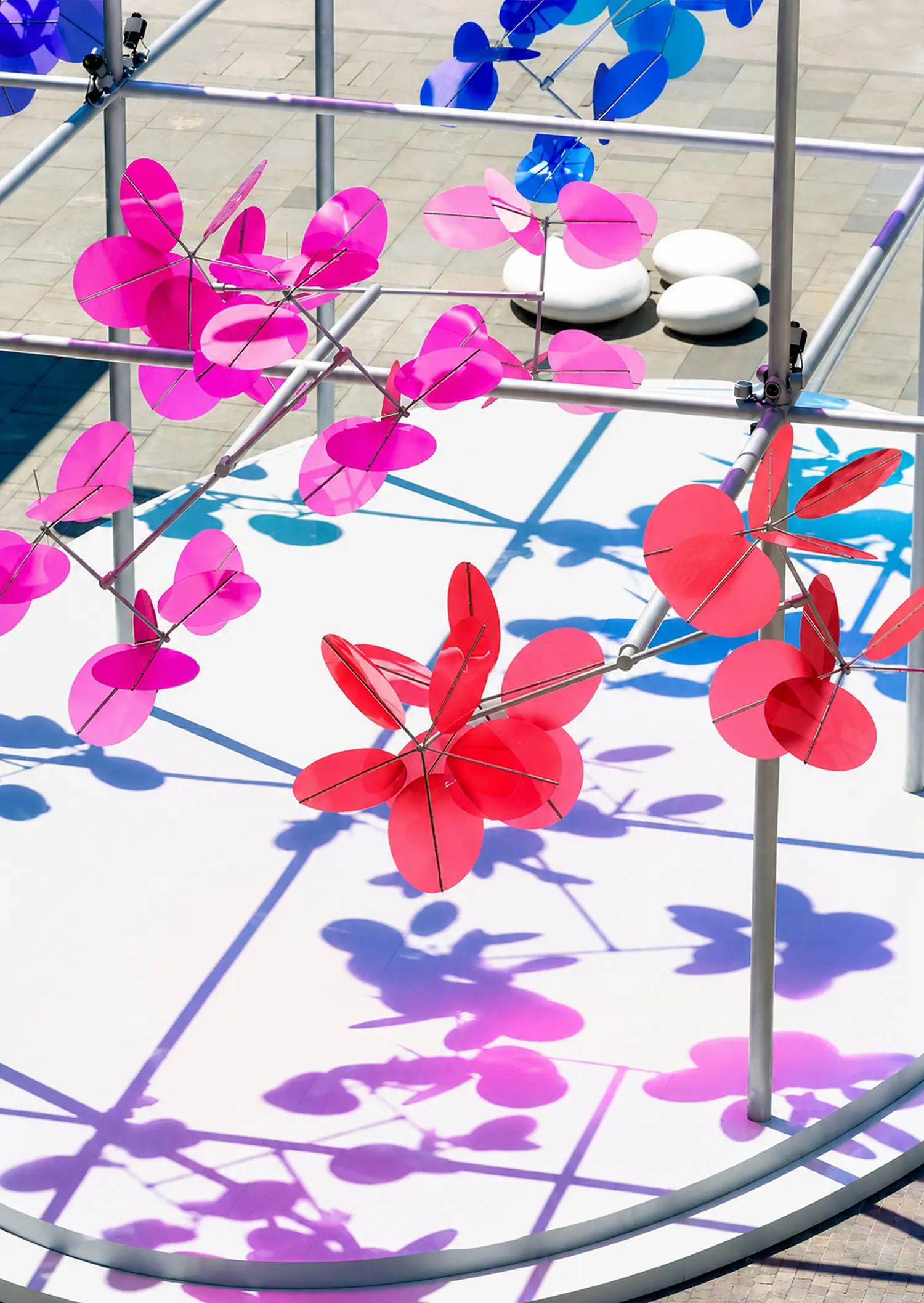
A Continuing Exploration. This latest intervention represents a clear evolution in the artist’s ongoing dialogue with weightlessness, geometry, and public scale. Point Cloud carries forward a distinct lineage of site-specific investigations into how geometric repetition can alter landscape perception. This trajectory is evident in previous works, such as the rhythmic, mesmerizing patterns of Fractal Swarm in Tanzania, where the artist tested the boundaries of optical illusions against vast natural horizons.
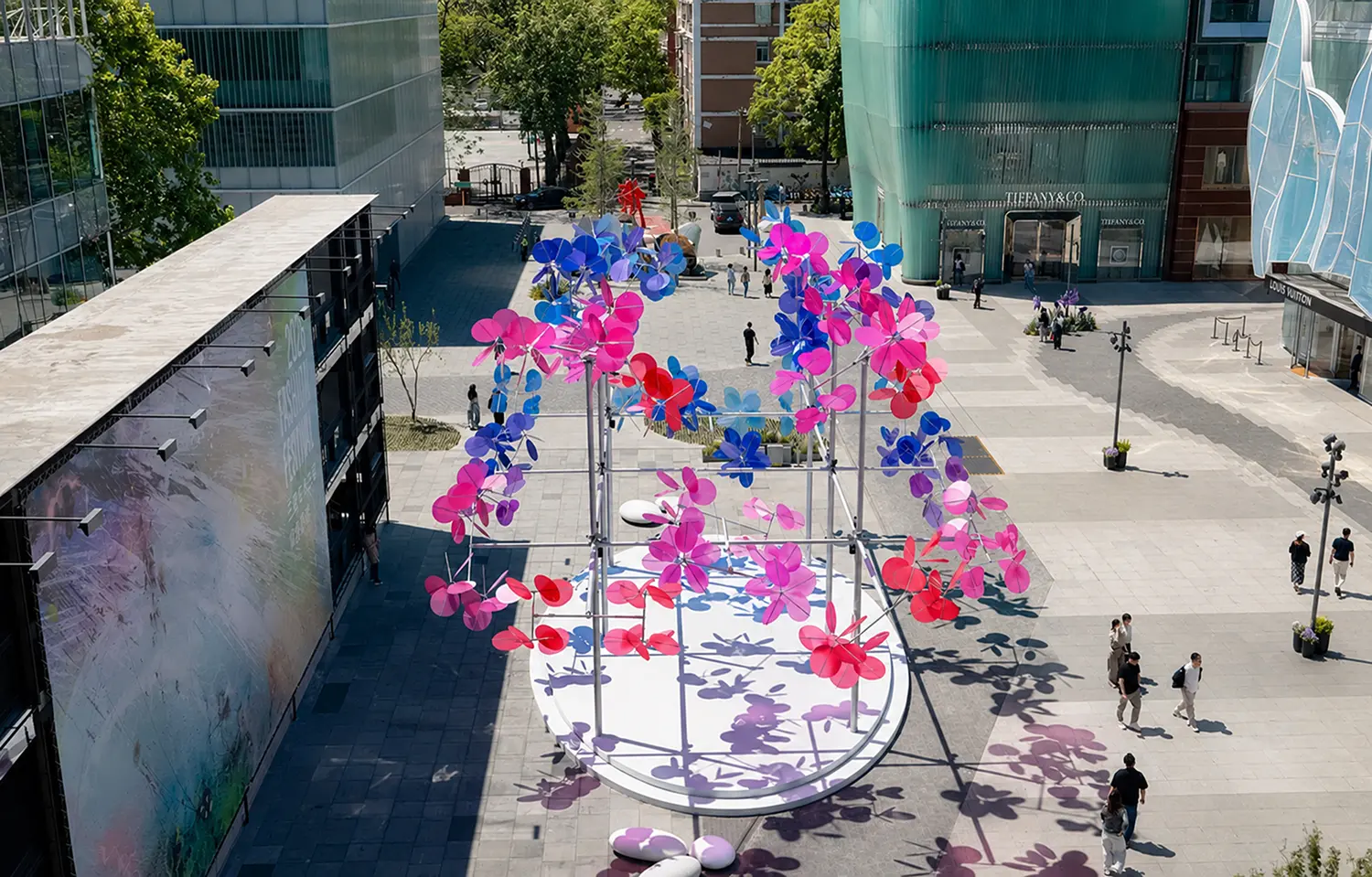
The Evolution of the Cloud. Similarly, the thematic preoccupation with floating, interconnected elements recalls the gentle, site-responsive geometry of Molecular Cloud in Normandy, which contrasted organic rural backdrops with synthetic forms. The dialogue between synthetic color and hyper-urban density was also explored deeply in Molecular Cloud at the DDP in Seoul. In Beijing, this conceptual journey reaches a cinematic peak, proving that the simple intersection of light, wind, and color can fundamentally rewrite the emotional landscape of a global metropolis.