




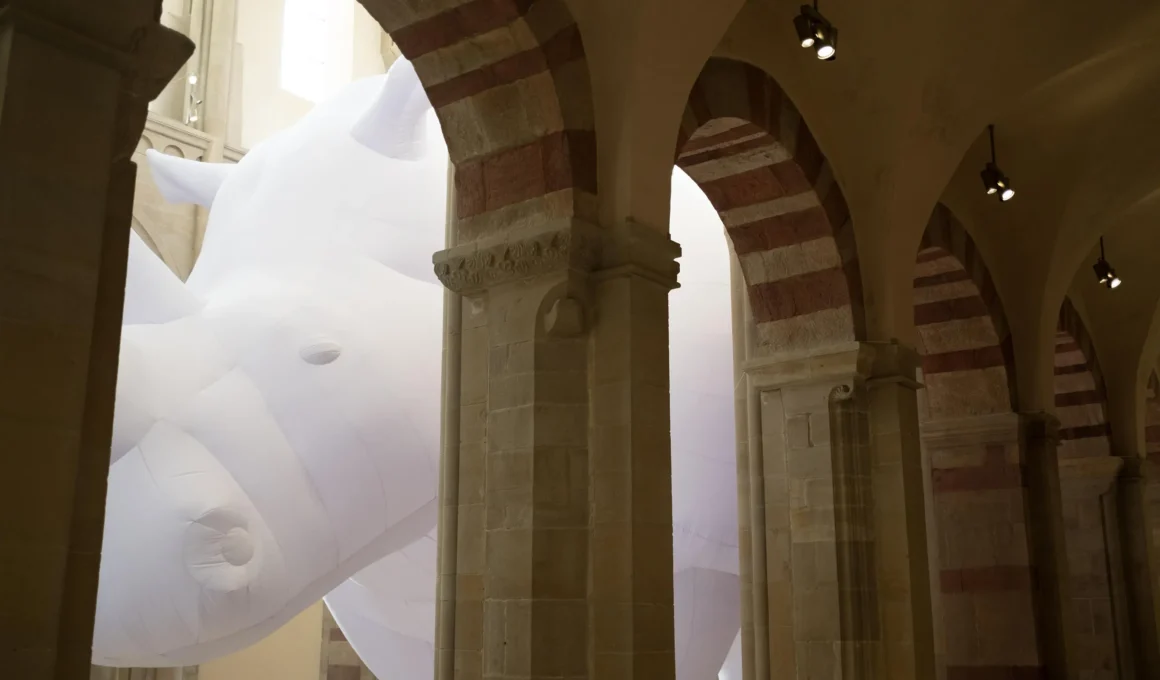
The encounter between medieval austerity and contemporary absurdity finds a staggering physical manifestation in Magdeburg, Germany. Within the 11th-century walls of the Kunstmuseum Magdeburg, artist Itamar Gov has unleashed a monumental presence that challenges the very boundaries of empirical reality and historical memory. Open to the public until July 5, 2026, the installation, titled The Rhinoceros in the Room. Or: A Tale of Banality of Evil, serves as a visceral exploration of conformity and the silent creep of authoritarianism, occupying the nave of the Romanesque church with an impossible, inflated weight.
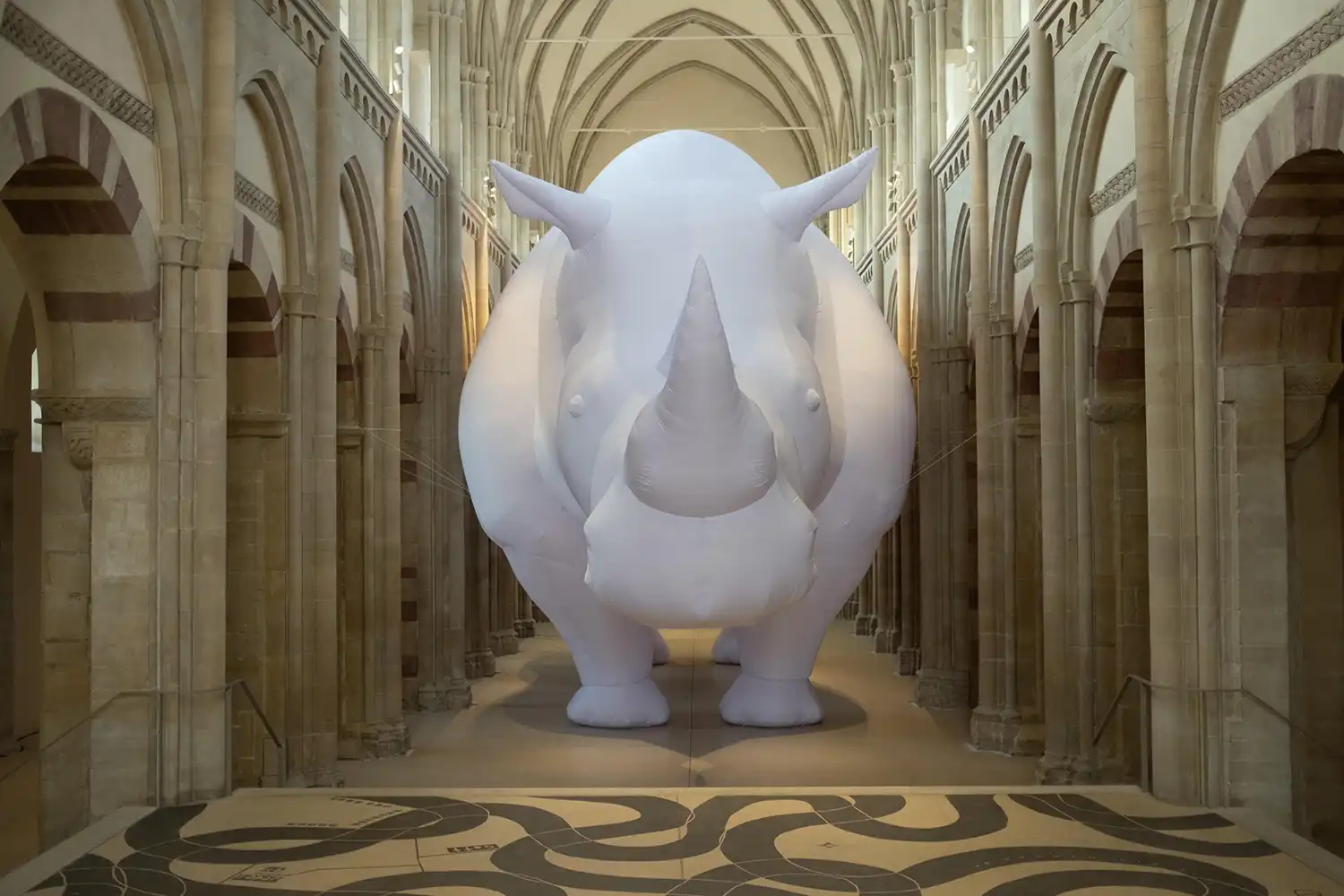
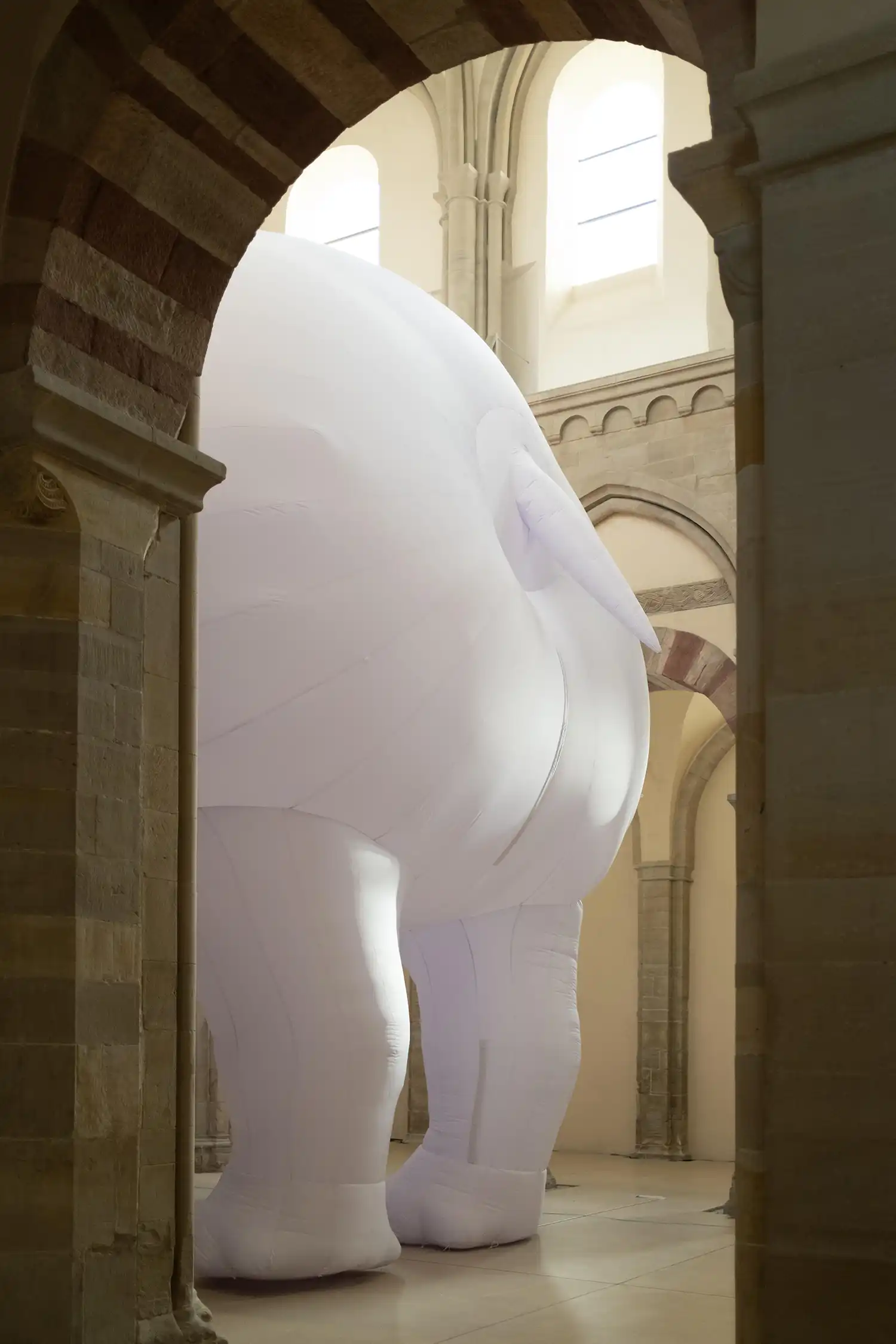
A monumental intrusion of white polyester defines the visual experience of the space. Measuring 10 meters in height and 17 meters in length, the hand-sewn Northern White rhinoceros acts as a literal barrier, physically blocking visitors from accessing the historic nave. While we have previously explored the power of air-filled volumes—ranging from the monolithic “Softpower” sculpture by Gregory Orekhov in France to the more functional, inflatable modules of the Lorenzo Archive store in Los Angeles—Gov’t’s work departs from pure aestheticism. Here, the inflatable medium is not used for comfort or sleek retail utility, but as a metaphor for an uncomfortable truth: a massive, unignorable entity that is, at its core, nothing but a coating filled with hollow air.
The linguistic roots of “rhinocerisation” provide the intellectual scaffolding for this intervention. Inspired by Eugène Ionesco’s 1959 absurdist play, the work examines the process by which societies succumb to destructive nationalistic currents. In Hebrew, the verb lehitkarnef (to rhinocerise) describes the terrifying ease with which individuals become indifferent to the atrocities committed in the name of collective movements. By placing this “beast” within a sacred, historical setting, Gov highlights the “banality of evil”—a nod to Hannah Arendt—suggesting that the transformation into a monster is often a quiet, domestic, and disturbingly peaceful transition.
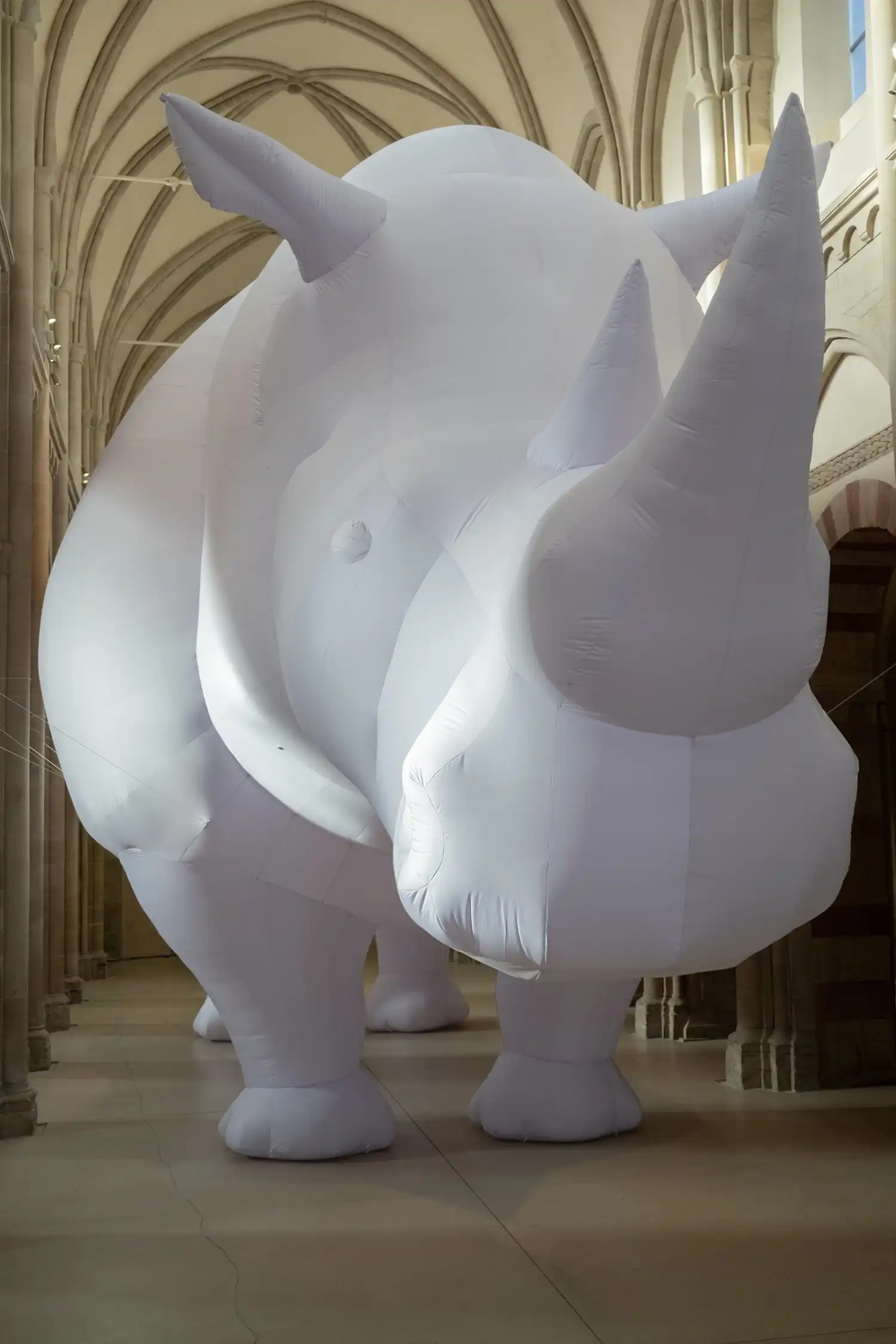
A haunting polyphonic soundscape breathes life into the static sculpture, transforming the church into a sensory chamber of unease. Composed by Bruno Delepelaire, Principal Cellist of the Berliner Philharmoniker, the audio features the voices of contralto Noa Beinart and cellist Moritz Huemer. The composition weaves together medieval church chants with Goethe’s Erlkönig and the 1935 Hebrew lullaby Hitragut. This auditory layering blurs the lines between a soothing dream and a looming nightmare, forcing the viewer to oscillate between the wonder of a circus attraction and the dread of an urgent alarm.
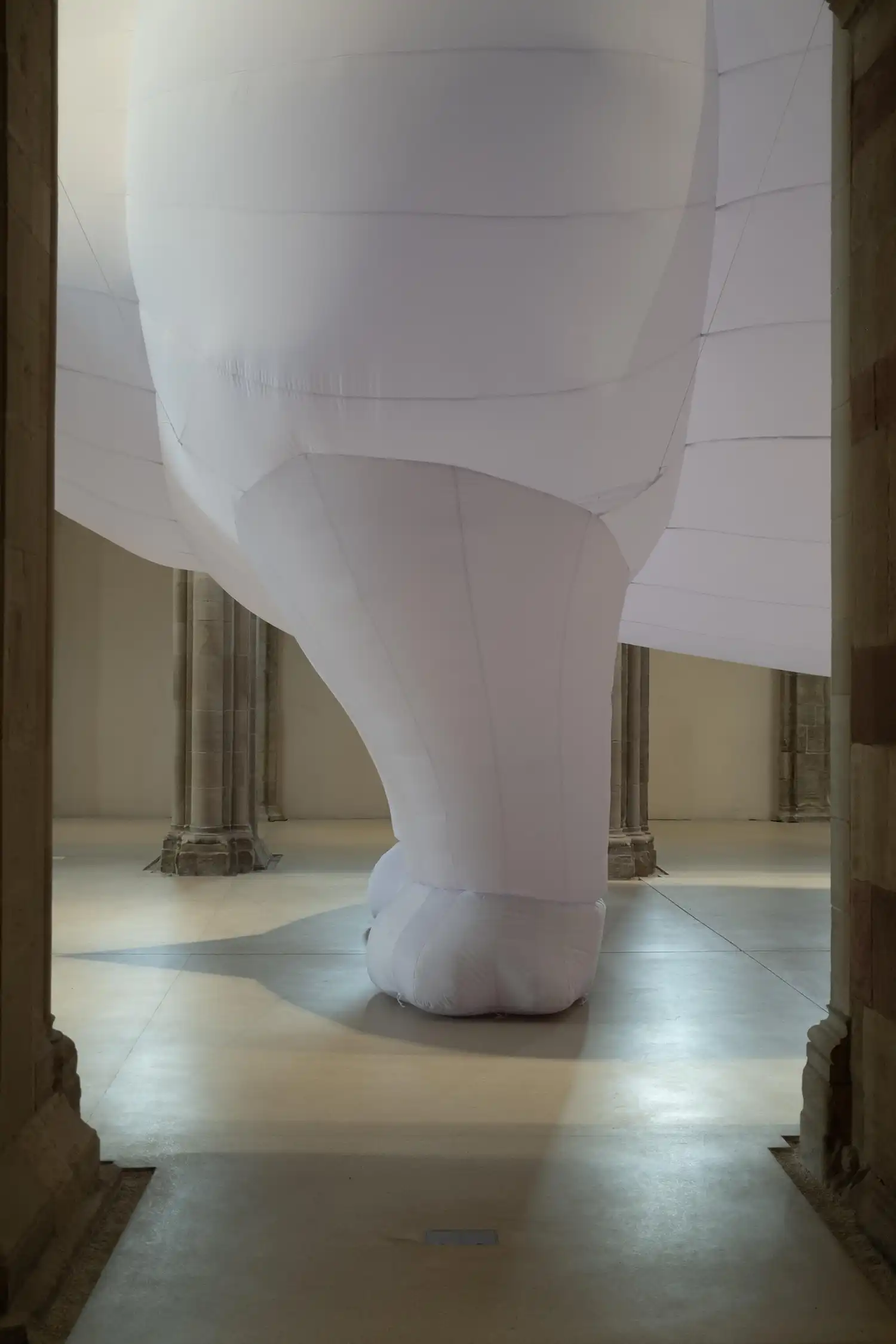
The intersection of myth and philosophy further enriches the narrative within the museum’s walls. The installation references the local legend of the Guericke-Einhorn—the “Unicorn of Magdeburg”—a 17th-century attempt to reconstruct a mythical creature from disparate skeletal remains. Simultaneously, it evokes Bertrand Russell’s famous challenge to Ludwig Wittgenstein to prove that there was not a rhinoceros in the room. By synthesizing these episodes of scientific error and philosophical skepticism, Gov questions the limits of human perception and our frequent failure to acknowledge the obvious dangers standing directly in front of us.
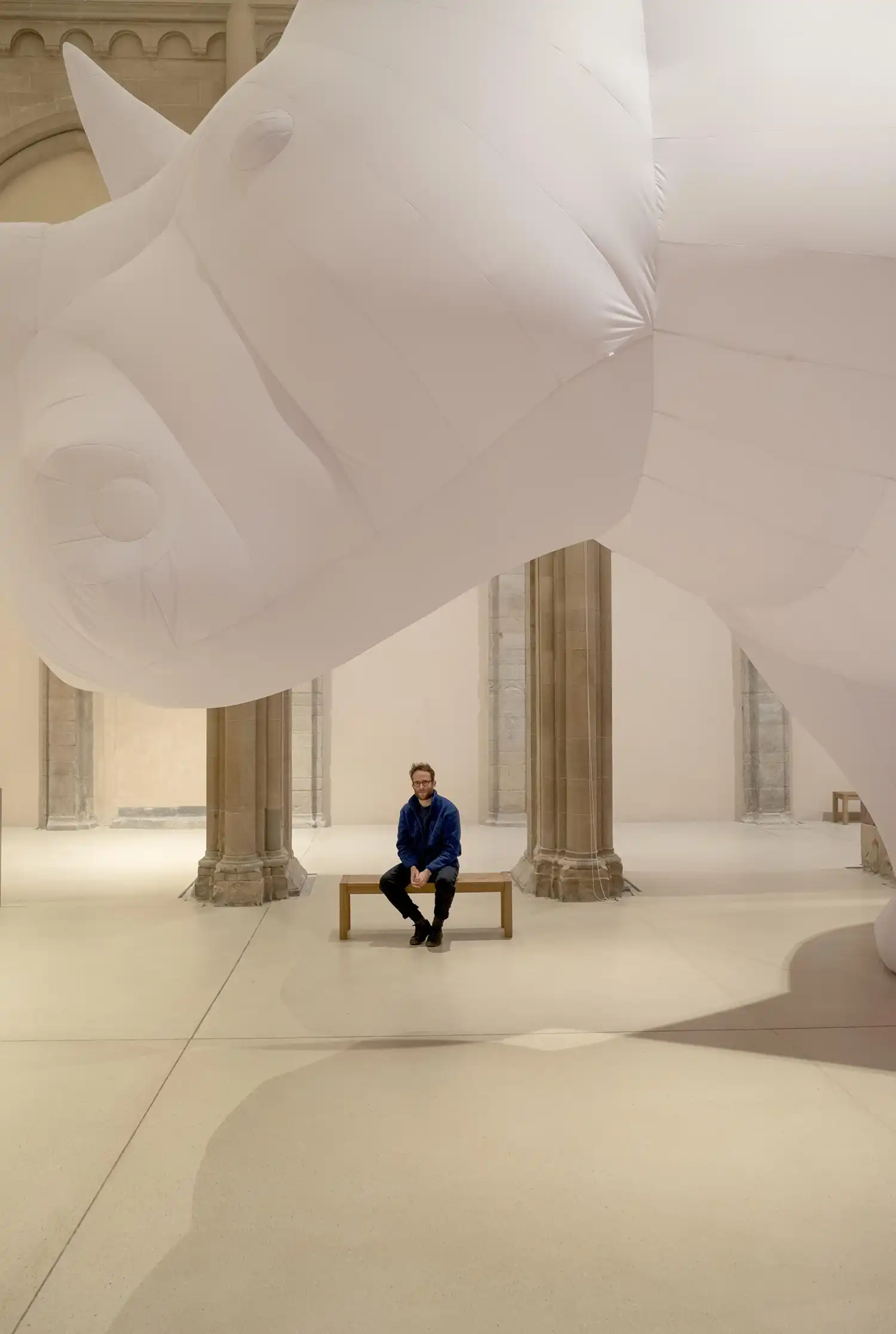
The contextual impact of the installation lies in its ability to turn a place of worship and history into a mirror for contemporary society. As the white rhinoceros looms over the stone arches of Magdeburg, it reminds us that the most dangerous threats are often those we have grown accustomed to, or those we have “rhinocerised” into our daily lives. This is not merely an exercise in large-scale sculpture; it is a profound meditation on individual responsibility and the fragile nature of morality when faced with the overwhelming pressure of the crowd.