


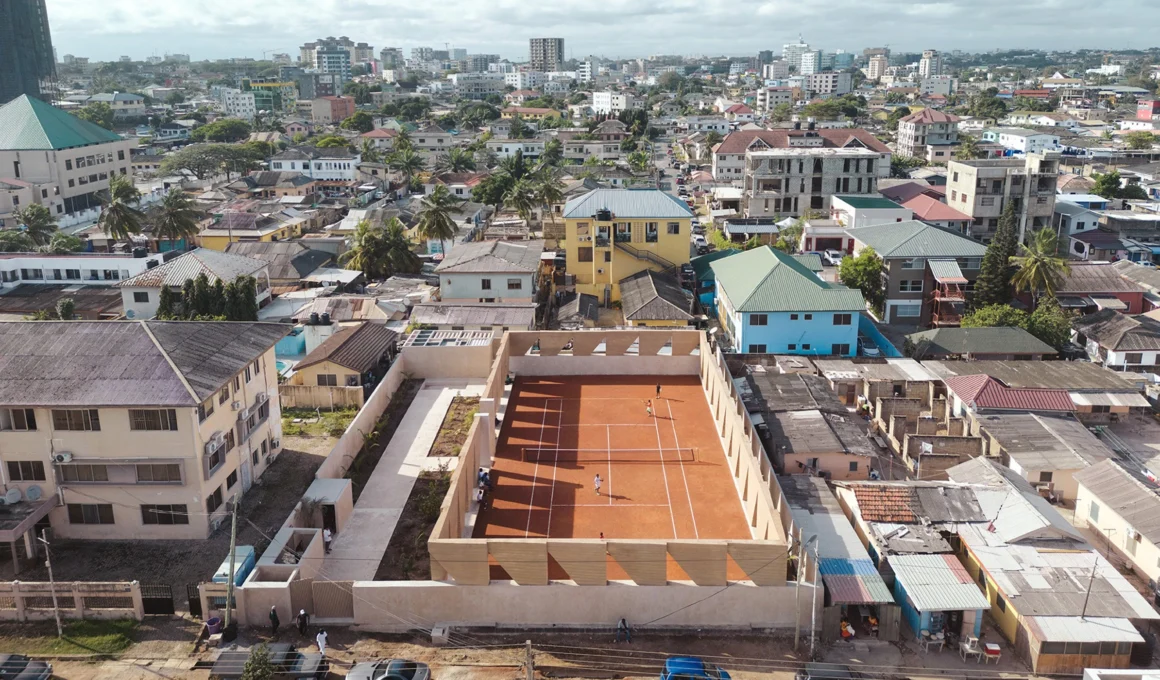
DeRoche Projects has completed the Backyard Community Club in Osu, a dense neighbourhood in Accra, Ghana, using a pioneering precast rammed earth system to frame a new kind of civic space centered on a clay tennis court. In a city where public investment in recreational areas and green spaces is limited, the project demonstrates how contextual architecture and design can deliver a highly functional, socially regenerative, and sustainable construction model.

The facility is more than just a community sports facility. It is established as a youth hub where training, learning, gathering, and cultivation occur side by side. By blurring the lines between these functions, the Backyard Community Club offers a much-needed alternative to conventional typologies of public space. It sets a benchmark for creating inclusive environments that support both social exchange and environmental responsibility through the thoughtful use of resources and materials.

Crucially, the complex introduces Ghana’s first application of a precast rammed earth system. Developed by DeRoche Projects, this method reimagines the ancestral, clay-based material for contemporary, scalable use. The use of rammed earth is a core sustainability strategy, championing a local, low-carbon building material. By adopting off-site fabrication, the process overcomes the traditional constraints of rammed earth—such as being slow and weather-dependent—allowing for quicker delivery, better quality control, and less waste, proving the material’s structural and environmental potential as a replicable prototype.

The main design feature is the rhythmic, four-metre-high enclosure of precast rammed earth panels that wraps the professional-level tennis court. This sculptural envelope provides both privacy and porosity. The composition is designed to maintain visual connectivity while casting a subtle pattern of shadows and reducing crosswinds. The central clay tennis court is built to international standards, providing an elite environment for young athletes to engage in physical activity and improve their fitness. A shaded, floating bench is integrated into the lining, allowing players and spectators to rest or observe.
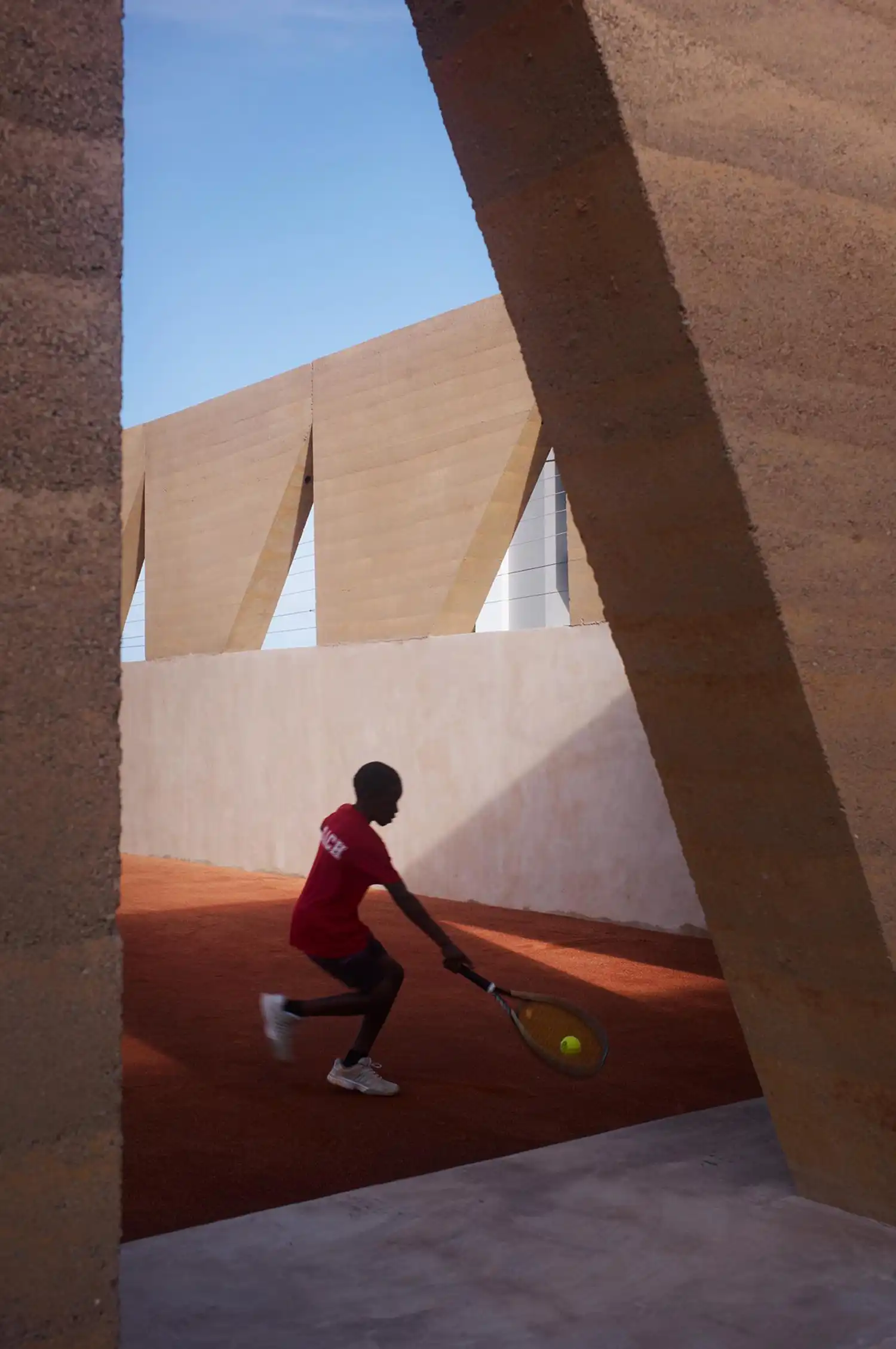
Flanking the court is a 230-square-meter sustenance garden. This is not a decorative element, but a functional space cultivated with over 20 species of medicinal plants and edibles. This feature embeds crucial ecological awareness into the daily routine: as youth train on the court, they learn to tend the land, harvesting ingredients for fresh juices and post-practice snacks. The act of growing becomes intrinsically linked to the rhythm of sport, teaching self-reliance and the sustainable use of resources to the Osu community.

Furthermore, the design integrates a range of passive sustainability measures. For the water-intensive clay court, a borehole system and redirected stormwater runoff provide irrigation, reducing reliance on the municipal supply. The low-lying ancillary structures, which include changing rooms and showers, are designed to function without air conditioning. Instead, they rely on the stack effect for passive ventilation and abundant natural light, minimizing energy demand and solidifying the Backyard Community Club’s status as a pioneering example of resilient and environmentally responsible architecture in West Africa.