



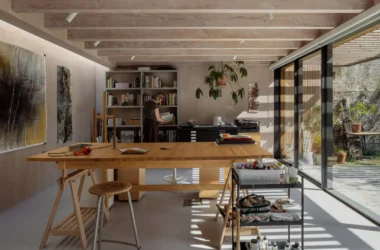


Raw land is one of the few purchases where the object itself tells you almost nothing. A plot has no facade, no floor plan, no finishing materials — only a set of conditions that will either support or constrain whatever you intend to build. Before any transaction, the work of evaluation is essentially the work of architecture: reading a site, understanding its logic, and stress-testing your brief against its limits. Whether you are a developer assessing residential development potential or a private buyer looking for a site that can accommodate a specific vision, the criteria that matter most are rarely the ones listed on a property sheet.
Start with zoning — but do not stop there
Zoning classification is the first filter, but it is a coarse one. A plot zoned residential may carry density restrictions, height limits, setback requirements, or heritage overlays that dramatically shrink the buildable envelope. Floor area ratio (FAR) and maximum site coverage are the two numbers that translate zoning intent into actual square footage. Pull both from the local planning authority before doing any further analysis.
Beyond current zoning, check the municipal master plan for the next 10 to 20 years. A plot in a corridor targeted for infrastructure investment or densification may be significantly undervalued. Conversely, land adjacent to a protected natural area or flood-risk zone may face restrictions that are not yet reflected in the asking price.
Overlay maps for flood plains, wildfire risk, landslide probability, and soil contamination are usually available through national or regional planning portals, and reviewing them takes less time than a site visit. Do it first.
Read the topography as a design brief
Slope, orientation, and natural drainage patterns are not obstacles to a good site — they are its latent design logic. A steeply sloped north-facing plot in a temperate climate is a genuinely difficult site for low-cost residential construction. The same slope facing south, with views and natural shelter from prevailing winds, may support a project of considerable architectural quality at comparable build cost.
Topography also determines earthwork costs, which are among the most underestimated line items in land development. A seemingly affordable plot requiring significant cut-and-fill, retaining walls, or deep foundations can rapidly erode the savings relative to a flat, serviced alternative. Ask for a geotechnical report before making any offer, or make one a condition of purchase.
Solar access is a related variable with direct implications for energy performance, daylighting quality, and — in densely built environments — future shadow rights disputes with neighbouring developments. A quick sun-path analysis using freely available tools will confirm whether the site can support the glazing ratios and passive solar strategies your brief requires.
Infrastructure and services: the cost that hides in plain sight
Serviced land — connected to municipal water, sewage, electricity, and road infrastructure — commands a premium for good reason. The cost of extending services to an unserviced plot can easily exceed the land value itself, particularly in rural or peri-urban contexts. Before evaluating land acquisition options, confirm the exact location of the nearest service connection points and obtain indicative quotes for extension works. This single step eliminates the majority of post-purchase surprises.
Telecommunications infrastructure — fibre connectivity in particular — has become a material factor in residential land value, especially since the normalisation of remote work. In some markets, the absence of high-speed connectivity has a measurable negative impact on resale values for residential developments.
Road access and ownership of access rights deserve equal attention. A plot may be physically accessible without the buyer holding a formal right of way across adjacent land — a situation that can make financing, insuring, and eventually selling the completed project substantially more difficult.
Soil and subsoil: what lies beneath changes everything
Foundation type is largely determined by soil bearing capacity and the depth to competent strata. Clay soils with high plasticity are prone to seasonal movement; loose sandy soils may require piled foundations; rocky ground can mean expensive excavation but excellent load-bearing. None of these conditions is a disqualifier, but each has a cost implication that belongs in the financial model before the land is purchased, not after.
Contamination history is a separate issue. Former industrial sites, agricultural land with a history of pesticide use, or plots adjacent to petrol stations or dry cleaners may carry residual contamination that triggers remediation requirements under local environmental law. A Phase 1 environmental assessment — essentially a desk study of historical land use — is inexpensive relative to the liability it can uncover.
Neighbourhood trajectory matters as much as current condition
The architectural and residential quality of a completed project is partly a function of its context. A well-designed building in a declining or poorly maintained neighbourhood will underperform in value relative to the same building in a neighbourhood on an upward trajectory. Gentrification indicators — new food and hospitality openings, independent retail, recent planning approvals for design-led residential schemes — are imprecise but useful proxies.
For architecturally ambitious projects, the quality of the surrounding built environment is also relevant to the planning authority’s receptivity. Municipalities with a track record of approving innovative residential design — visible in the calibre of recently completed projects in the area — are considerably lower-risk than those with conservative planning committees and no precedent for contemporary architecture. Reviewing local planning decisions from the past five years is time well spent.
The relationship between site selection and material strategy is equally direct. A site in a temperate European climate favours heavy, breathable construction — hempcrete, clay block, rammed earth — while a humid Southeast Asian plot calls for lightweight ventilated bio-based systems. These are not decisions that can be retrofitted after purchase. For a detailed overview of how material choice maps onto climate zone and building typology, low-carbon material selection for residential construction is a useful starting point before any site offer is placed.
The evaluation sequence in practice
- Zoning and planning constraints — FAR, height limits, setbacks, overlays, master plan trajectory.
- Topography and orientation — slope, solar access, drainage, earthwork cost estimate.
- Infrastructure audit — service connection points and extension costs, road access and right of way.
- Geotechnical and environmental assessment — soil bearing capacity, contamination history, foundation implications.
- Neighbourhood and planning context — recent development trajectory, local planning authority track record.
Run these five filters before a detailed financial model and before any offer is placed. Land that passes all five at an acceptable cost basis is a genuinely good site. Land that fails one or more is not necessarily a bad purchase — but it requires a clear-eyed understanding of what those failures will cost, and whether the upside justifies carrying them.
Evaluating land for its residential and architectural potential is a discipline that sits between real estate analysis and design thinking. The buyers who do it well treat the site not as a product to be transacted but as the first and most consequential design decision in any building project. Get the site right, and the architecture has a fighting chance. Get it wrong, and no amount of design quality will fully recover the position.