



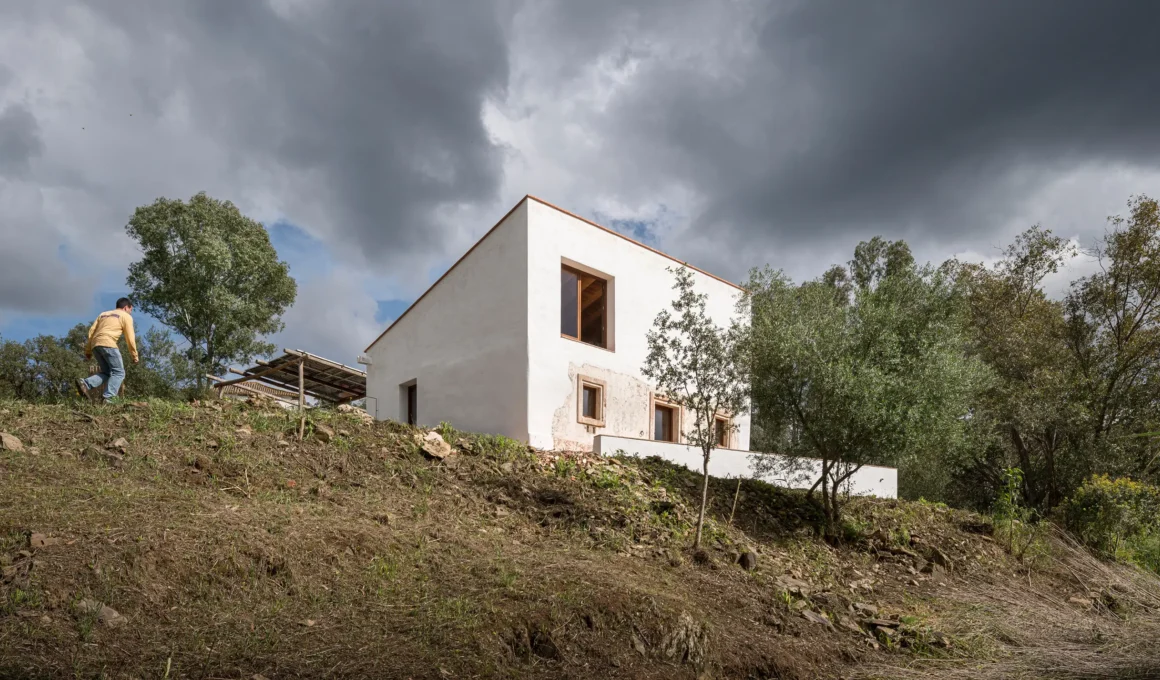
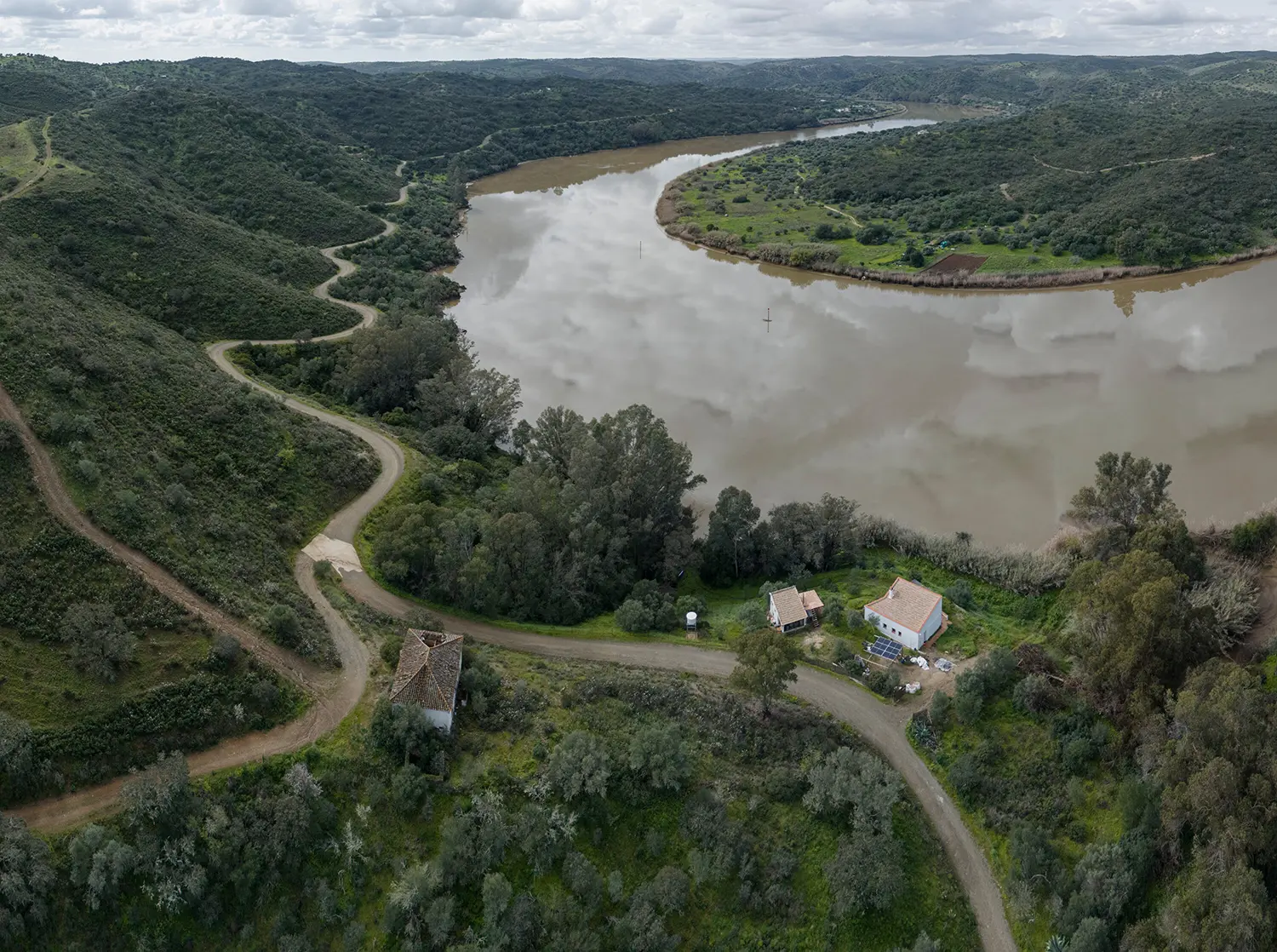
Zurita Studio and Kalibra Arquitectura treat a ruined 19th-century border outpost not as a historical object to restore, but as a structural device to build inside of, letting the existing stone perimeter dictate the geometry, thresholds, and atmosphere of the new house. Stone and Water occupies the consolidated remains of a former Spanish Civil Guard post above the Guadiana River in Sanlúcar de Guadiana, a village of just over 420 people where sailors have long stopped, stayed, and sometimes never left. The result treats reuse not as a sustainability gesture layered onto the design, but as the design method itself.
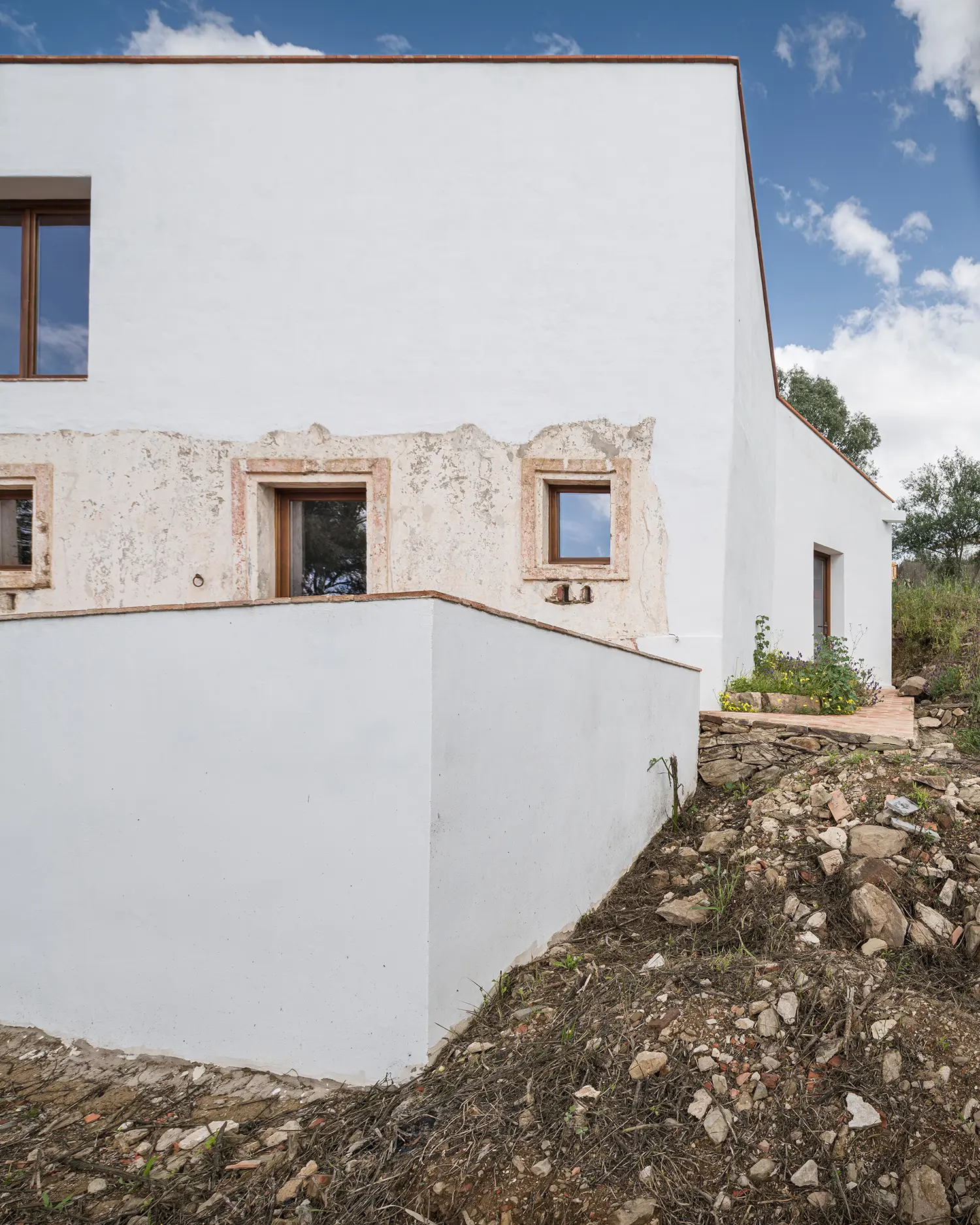
That border history is still legible in the building. The loopholes beneath the windows once formed part of a river surveillance system monitoring smuggling between Spain and Portugal — a detail the project keeps rather than smooths over, letting the house carry its own institutional past instead of erasing it into a blank historical shell.
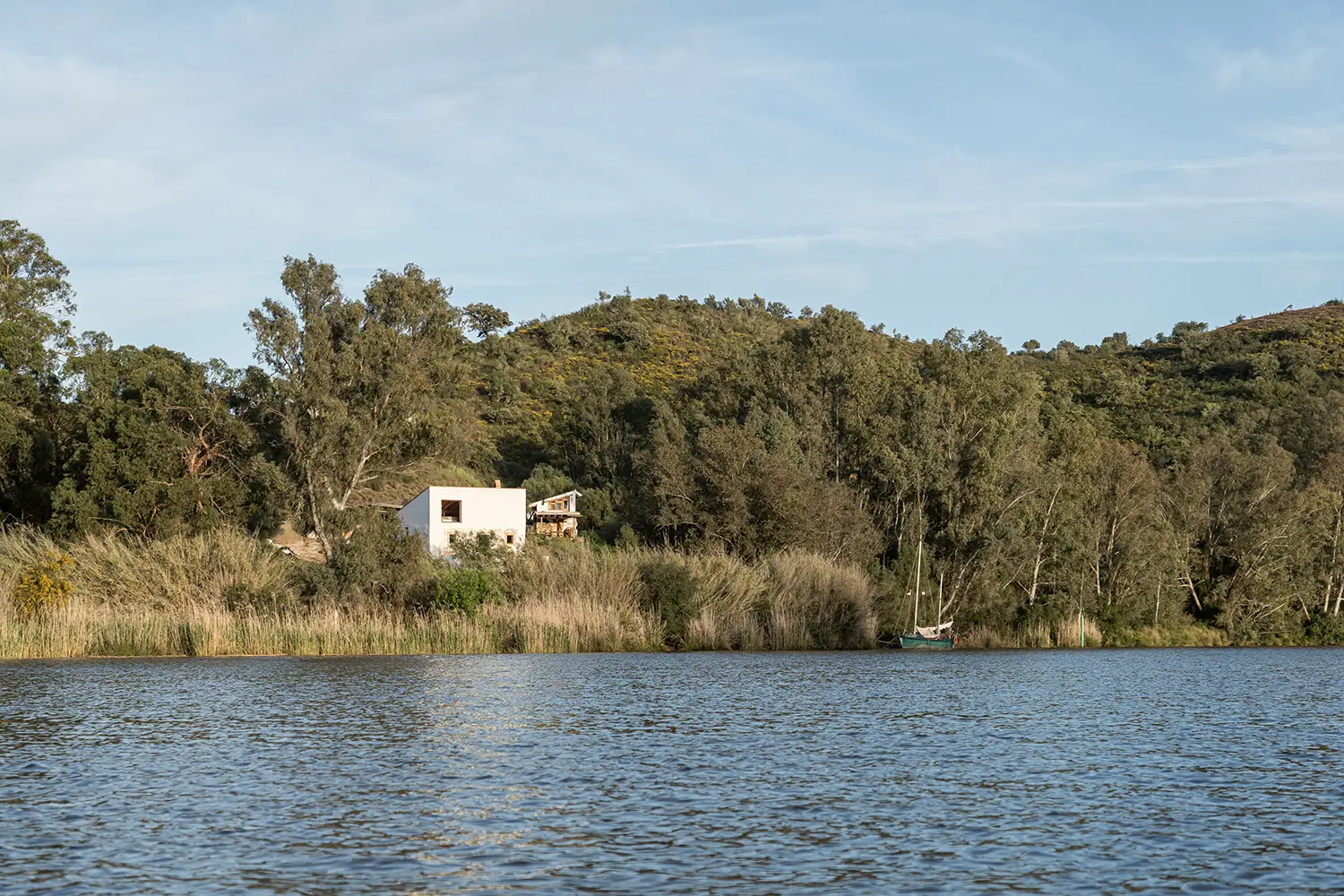
The client’s connection to Sanlúcar runs decades deep, beginning with temporary stays on boats and in friends’ houses before she purchased the ruin with her then partner, an Argentine sailor and artist. The architect, a friend of her son’s, has known the river and the village through this same family since childhood — the kind of long, informal relationship to a site that rarely survives contact with a commissioning brief intact.
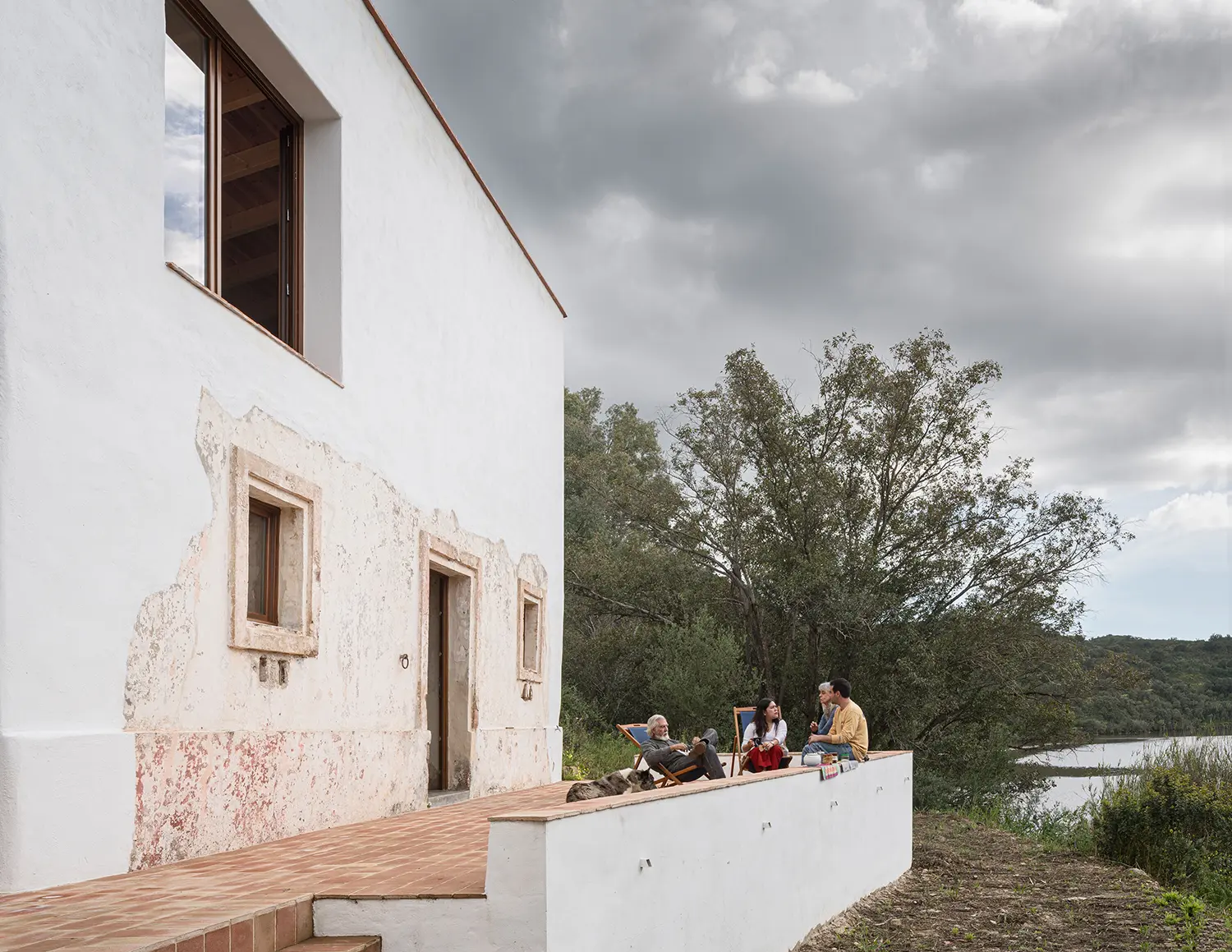
A compact construction consolidates what was already standing and adds only a discreet extension, rather than expanding outward to claim more territory from the ruin. Externally, the house reads as a stratified continuity: the original whitewashed masonry sits beside newly applied white renders, old and new distinguished by finish rather than concealed behind a uniform surface.
The roof carries two responsibilities at once, sloping against the terrain to shield the house’s privacy from the access path, then rising toward the river to cut a single, precise aperture that frames the water below — one gesture doing the work of both enclosure and view.
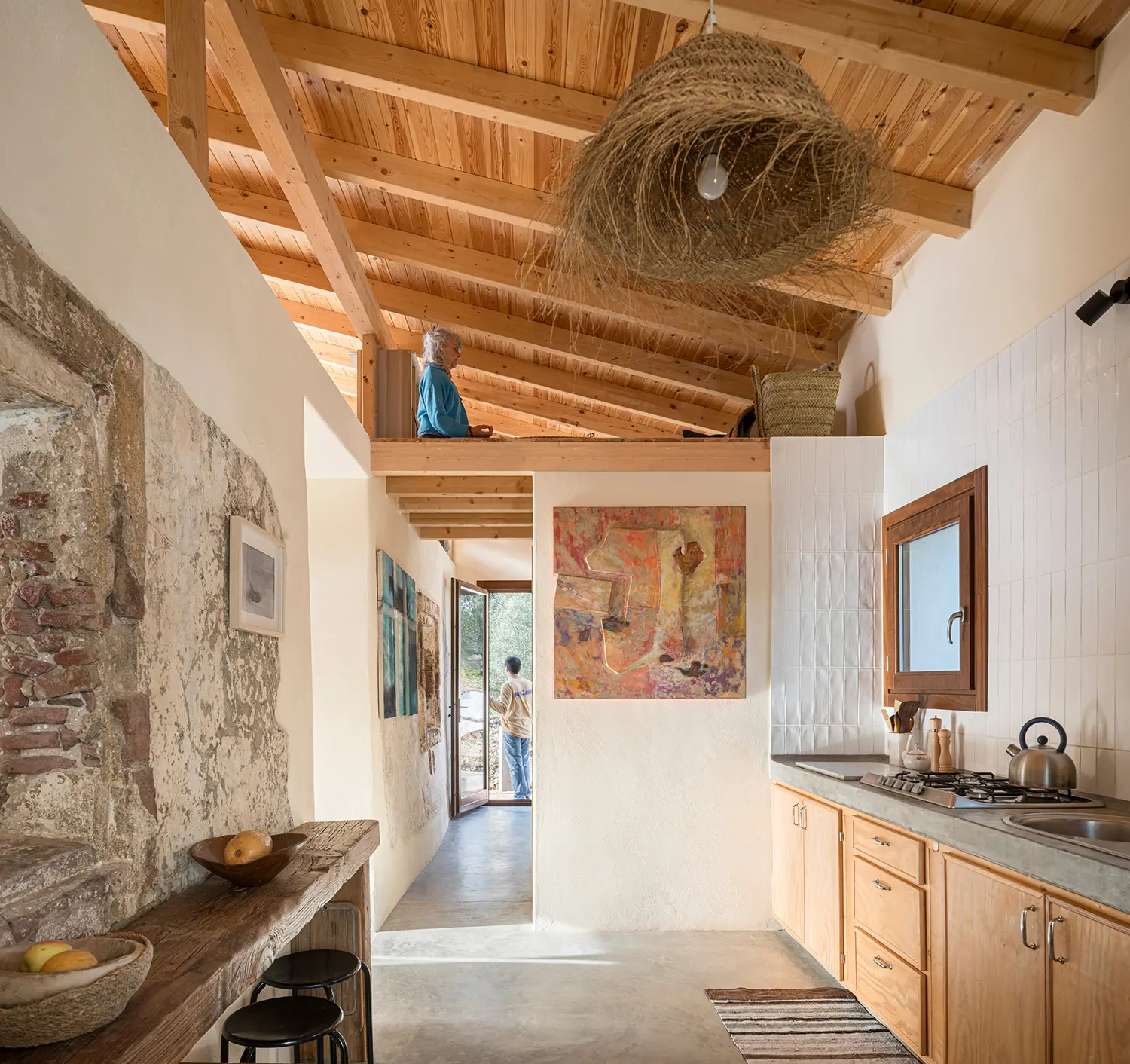
The interior has no doors, and privacy is handled by geometry instead — wall thickness, the angle of a sightline, where one space bends into the next. For a client who lives alone in the countryside, that arrangement is tuned toward feeling secure, while the house still opens outward on three of its four façades, so shelter and exposure end up sharing the same plan rather than competing for it.
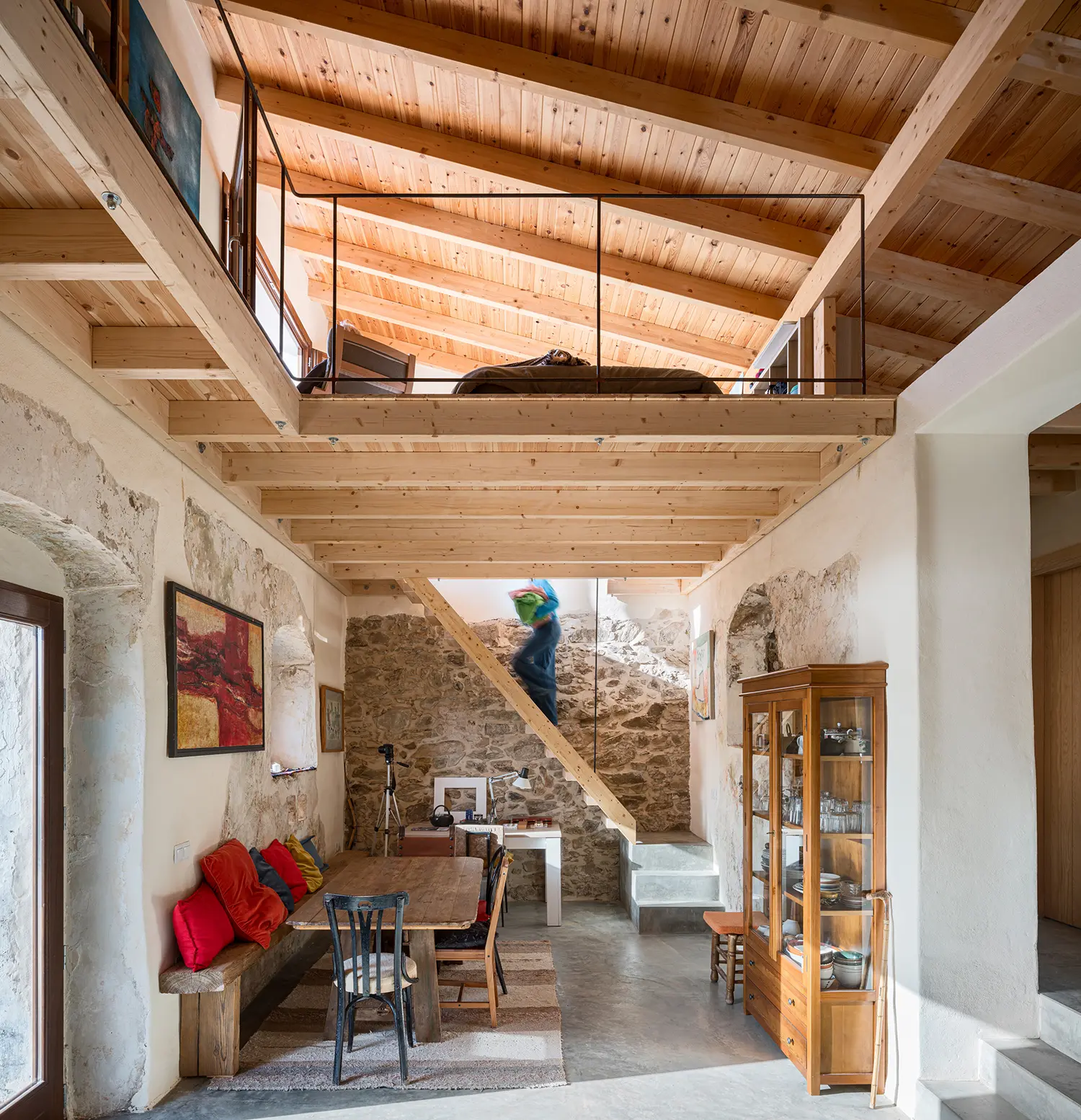
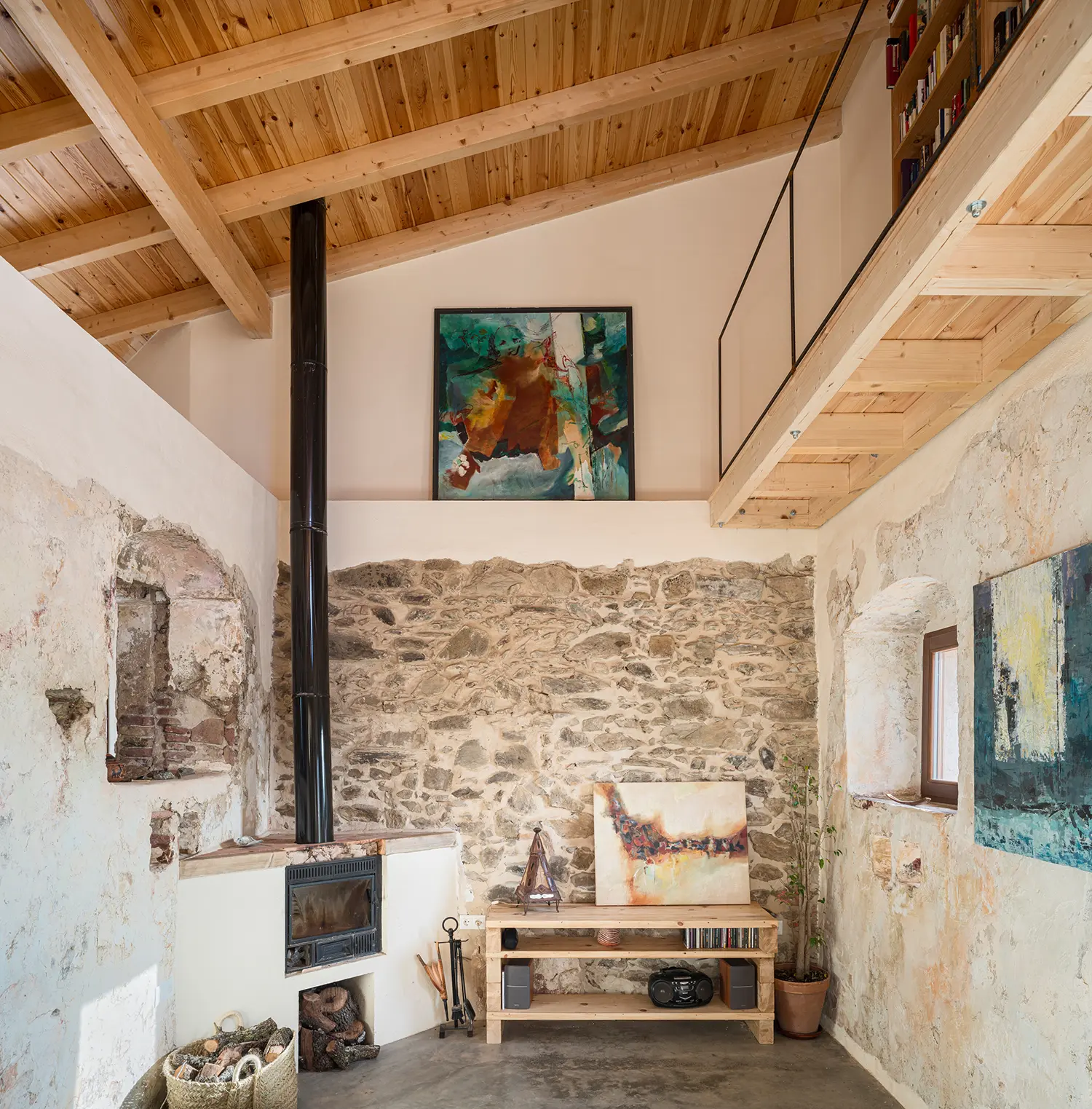
With a limited budget and difficult site access, reuse became the only viable construction method, not a stylistic preference layered on afterward. The stove, an old cupboard that was simply found, the sink, the fireplace, and leftovers from previous construction all made it into the finished house. The same roof beams appear in the staircase and parts of the kitchen; the same flooring material resurfaces as countertops, showers, and washbasins — continuity functioning as structural logic rather than decorative motif.
A comparable discipline — treating reclaimed and found material as the primary design language rather than a budget concession — shaped Spolia Office’s House for Rural Habits in Siero, where reuse similarly operates as method, not aesthetic. Stone and Water pushes that same instinct further by relinquishing what the project itself calls total control, treating the house as adaptable infrastructure open to appropriation by whoever lives in it.
This resistance to mechanical cooling sits inside a broader shift already visible across urdesign’s coverage of passive cooling architecture — houses choosing thermal mass, orientation, and ventilation over compressors, on the bet that a well-built envelope can do what a machine usually gets credit for.”
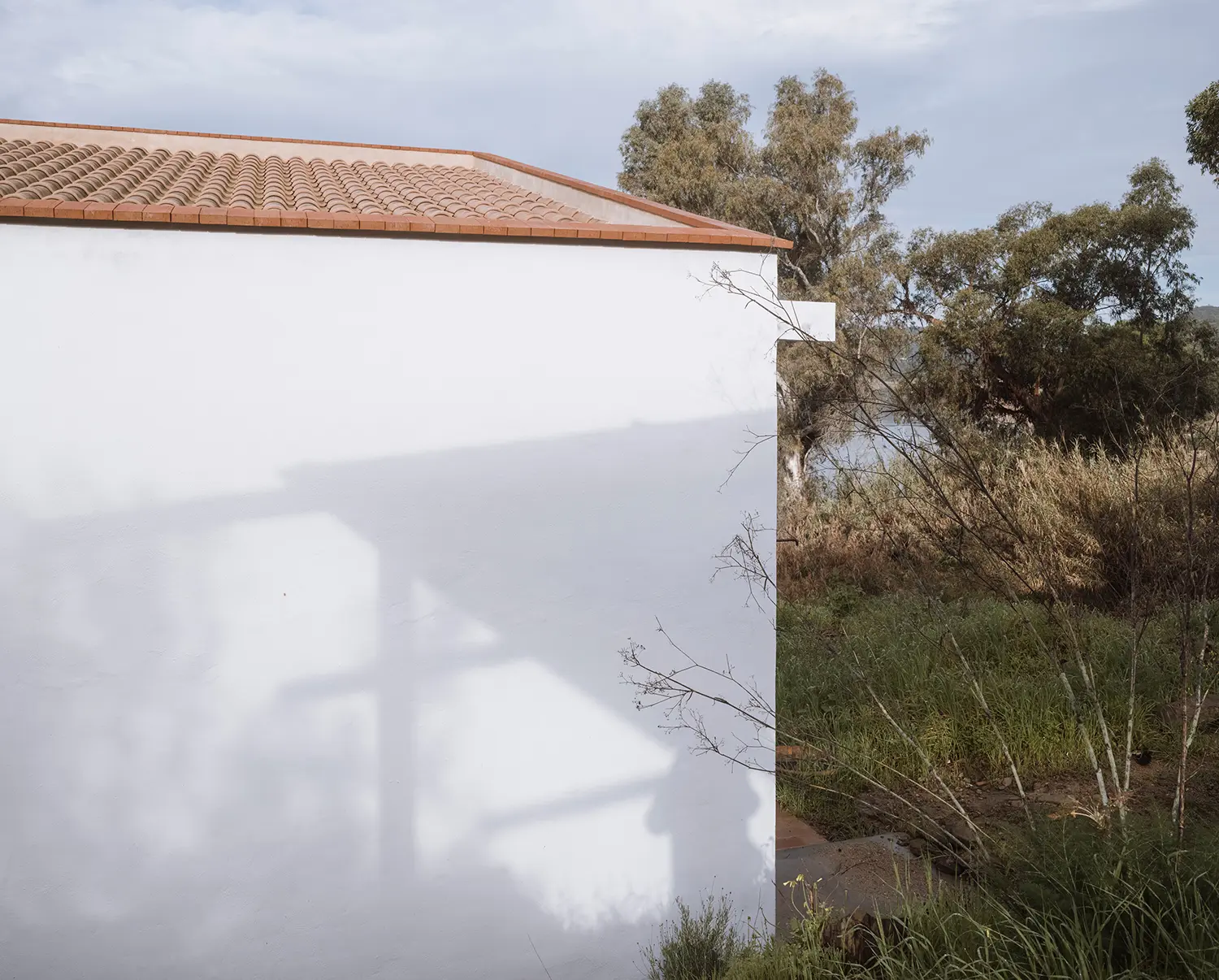
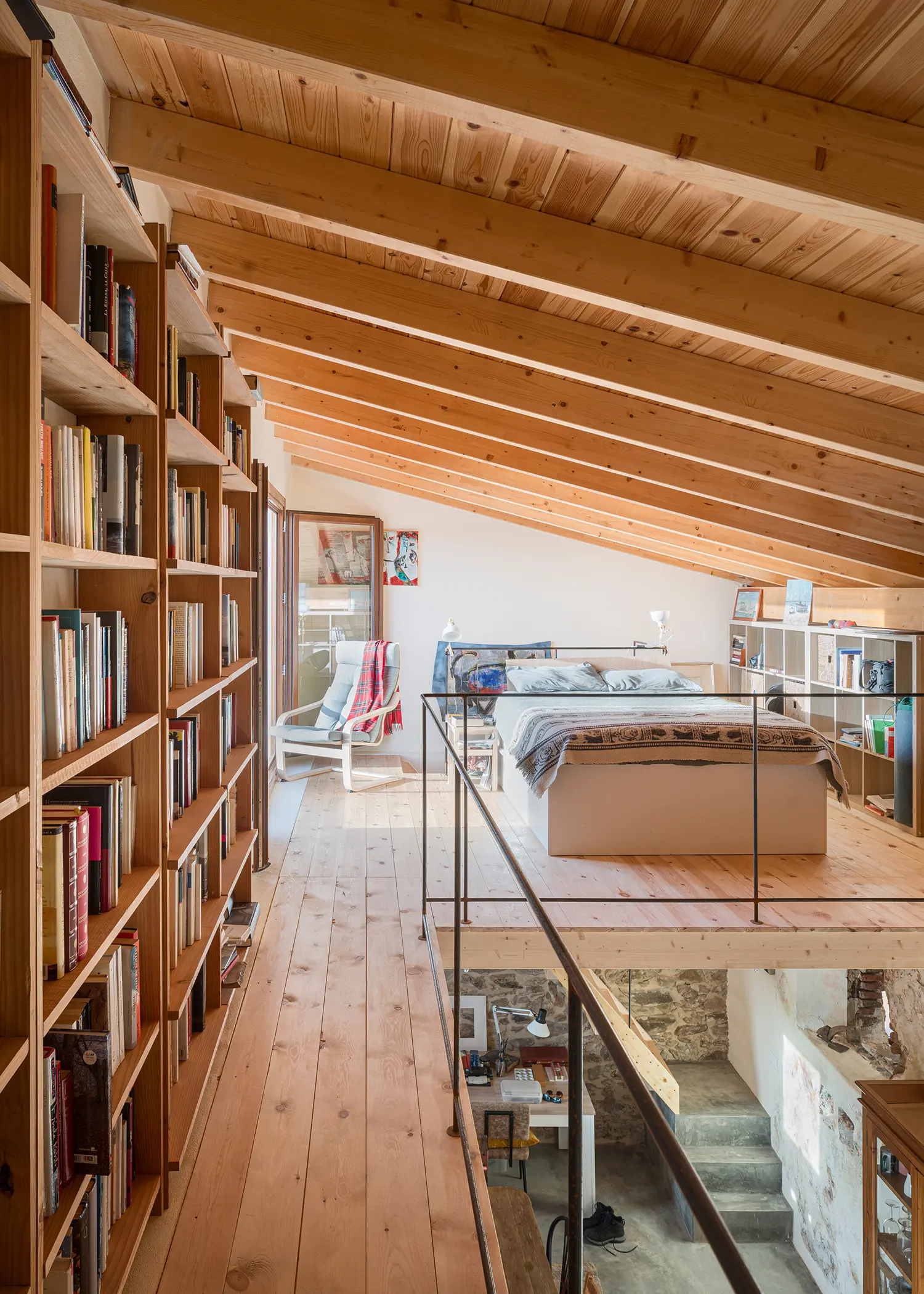
No air conditioning runs through any of it. Thermal inertia from the stone walls and floor, cross ventilation through the façade openings, a roof orientation that avoids late-afternoon solar radiation, and air stratification enabled by the double-height space do the environmental work instead, backed by photovoltaic energy installed on a nearby structure that doubles as shaded parking — a full passive strategy built on traditional constructive logic rather than mechanical compensation.
A house that refuses air conditioning in southern Spain is making a case whether it means to or not: that comfort built from thermal mass, shade, and cross ventilation is not a compromise relative to a conditioned interior, but a different and arguably more honest way of inhabiting heat than most contemporary southern architecture is currently willing to try.
Stone and Water by Zurita Studio + Kalibra Arquitectura | Location: Sanlúcar de Guadiana, Huelva, Spain — Year: — Key materials: existing stone masonry (preserved), white lime render, reclaimed timber roof beams, photovoltaic panels