



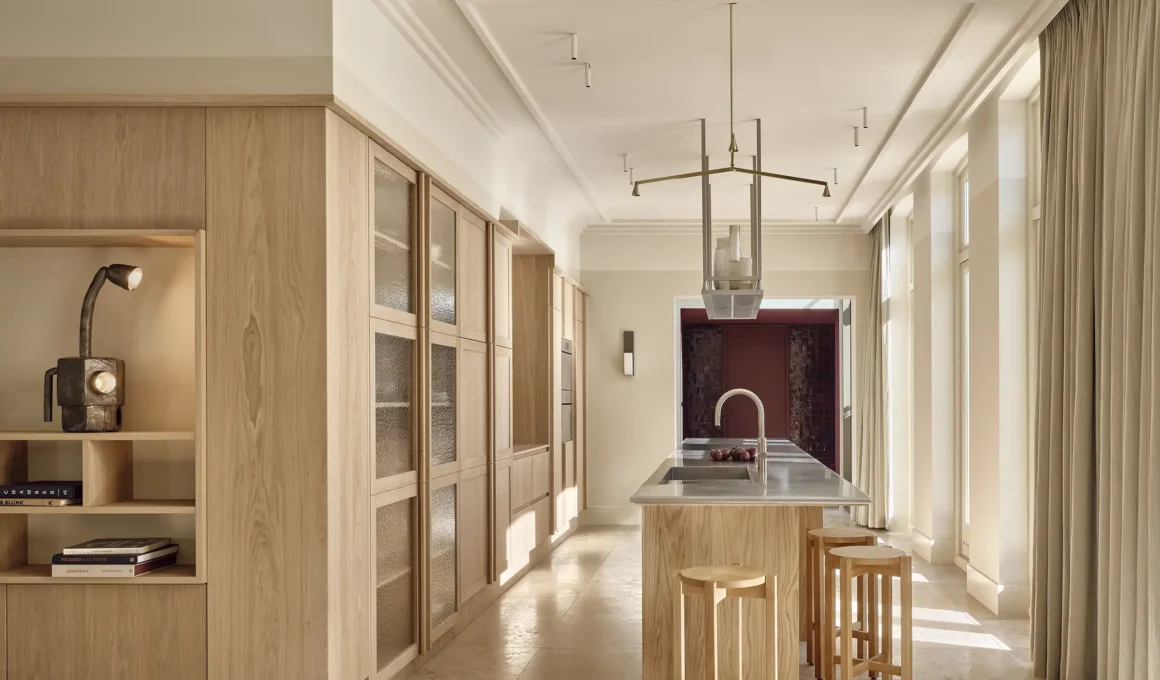
A protected early-twentieth-century house on the banks of the Rijn presented Amsterdam-based Studio Modijefsky with a challenge that goes beyond conventional renovation: how to absorb a sequence of entirely new programmatic volumes — a bar, a wellness suite, a wine room, a boathouse — without dissolving the historical identity that makes the original structure worth preserving. The answer, across 405 square metres of interior and 105 of exterior, is a material grammar so precisely controlled that every new addition reads as a continuation of the same sentence the house began a century ago.
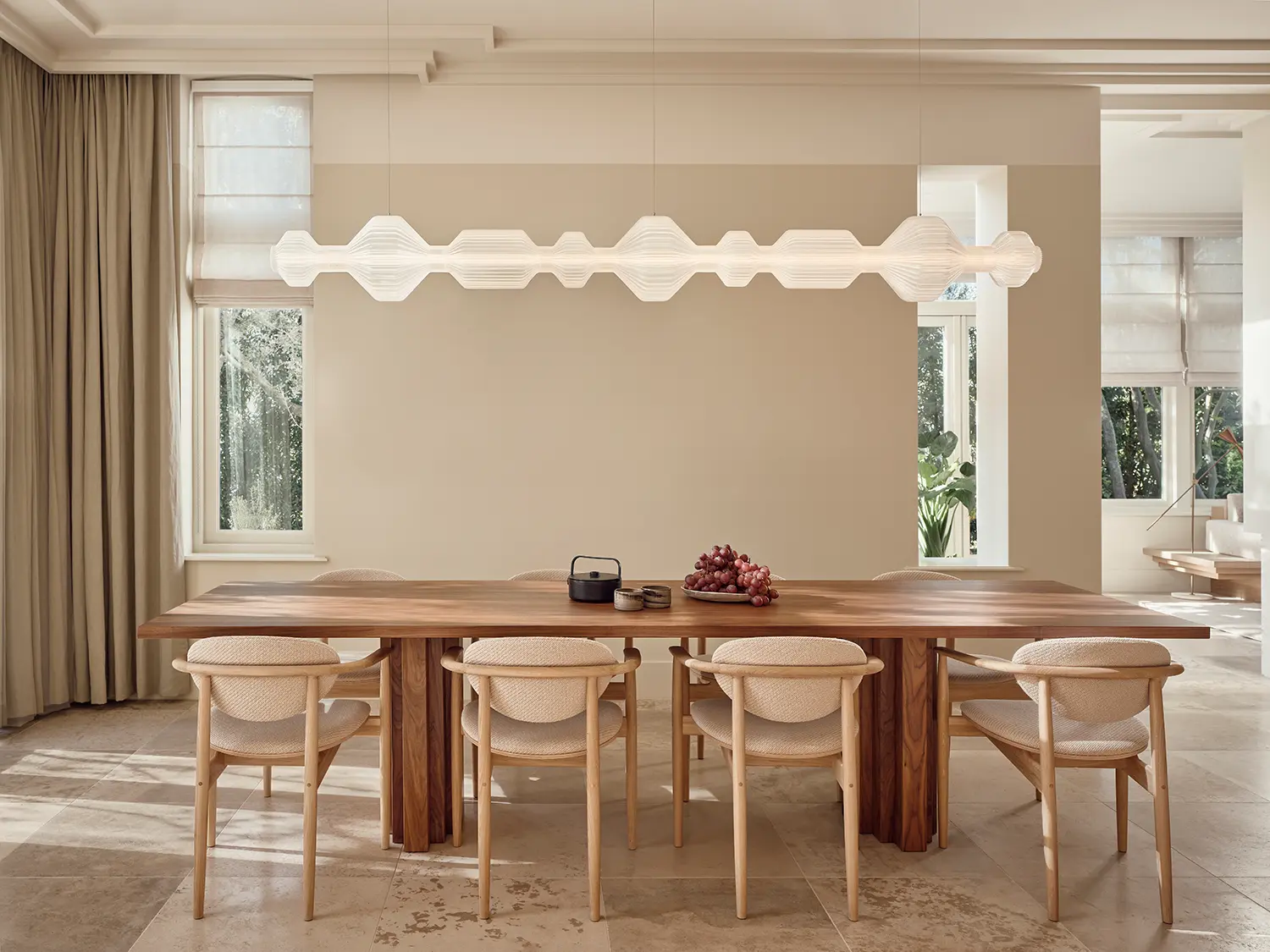
Rerouting the domestic spine. The original floor plan arrived fragmented — an oversized hallway, disconnected rooms, a circulation logic that had accumulated rather than been designed. Studio Modijefsky’s first move was structural and spatial simultaneously: a complete reconfiguration of the ground floor plan that turns the hallway into the genuine spine of the house. From this central corridor, sightlines open in multiple directions, and a bespoke staircase — illuminated by a rooflight that drops natural light into the core of the building — becomes the architectural punctuation mark that everything else organises around. One of the two original serres now houses a small atelier, where light enters from all angles and custom-built furniture sits at the precise threshold between functional object and sculptural presence.
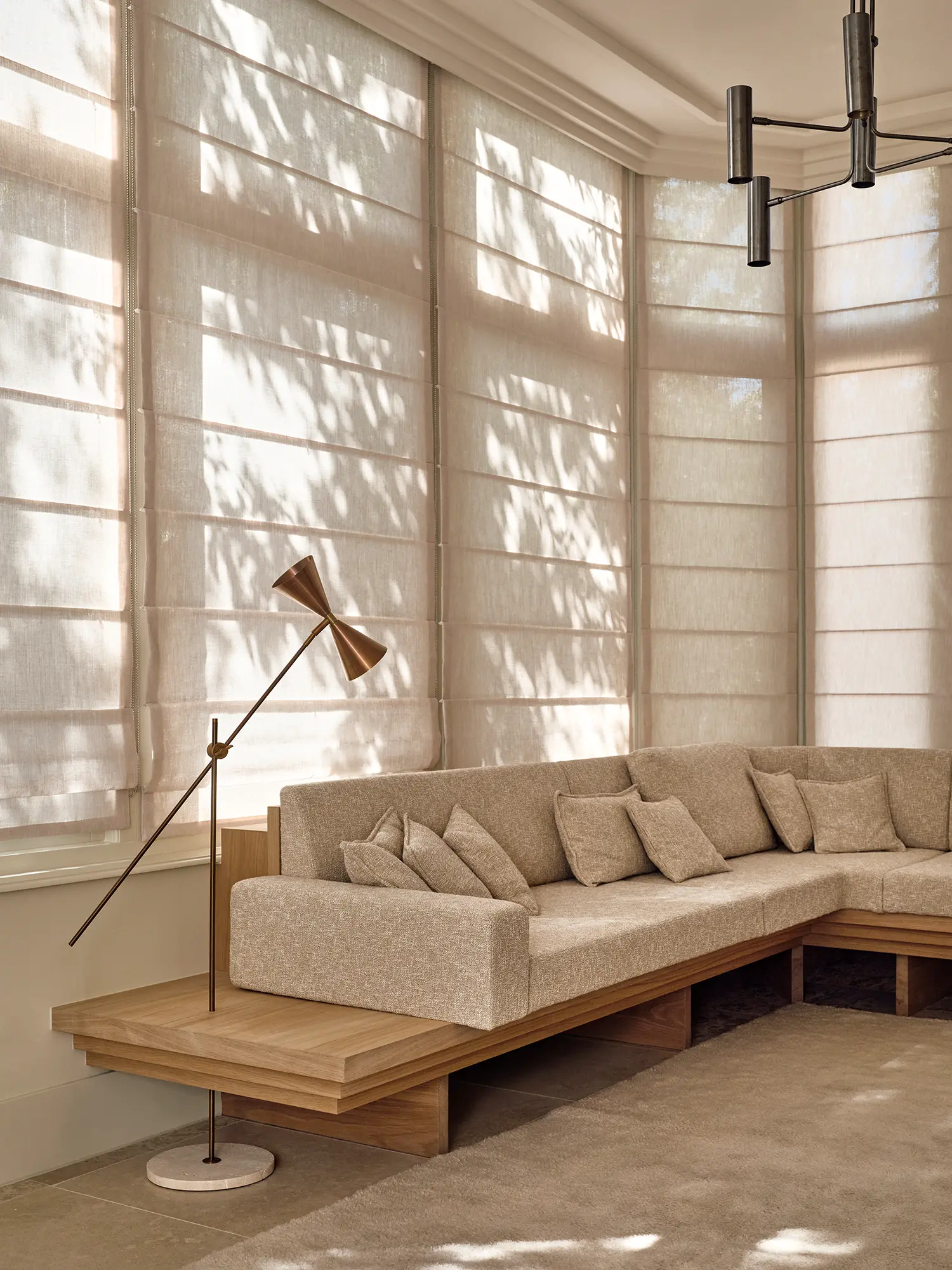
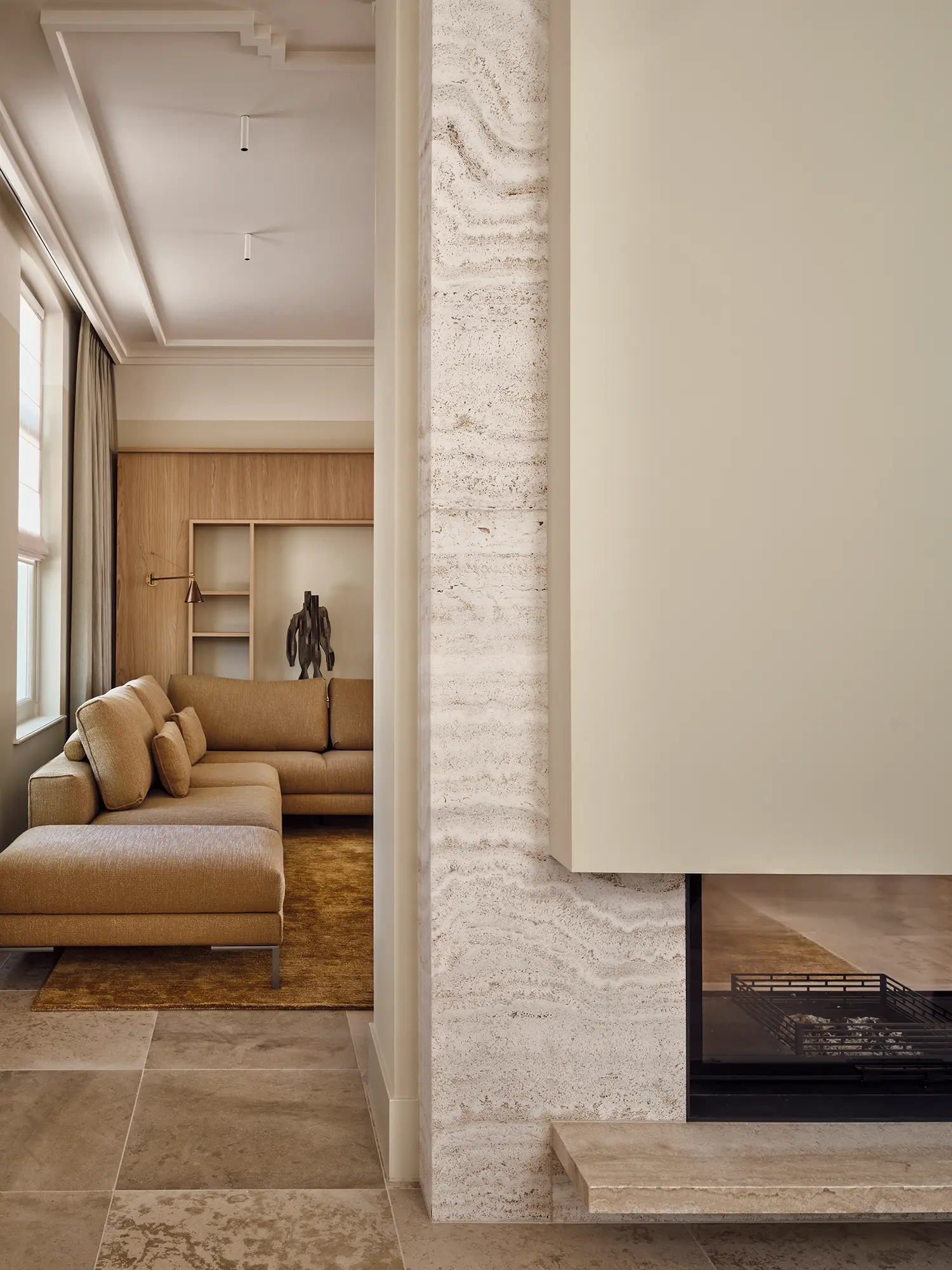
Warmth as a design decision. The material palette chosen for the living areas is not decorative — it is atmospheric. Walnut wood, natural stone flooring, wool upholstery, and copper accents build a tonal warmth that softens the weight of the historic walls without competing with them. Textured glass doors separate the living room from the entrance sequence, and through them the space reveals itself gradually rather than all at once. An open fireplace anchors the seating area; a see-through version of the same fireplace extends the warmth into the adjacent serre, where a custom sofa — proportioned precisely for the niche it occupies, with integrated LED detailing in the legs — creates the kind of corner that makes a large house feel inhabited rather than merely furnished. Orange-toned rugs punctuate the tiled floors like commas in a long sentence.
The kitchen as social infrastructure. The dining area and kitchen operate as a single connected field rather than adjacent rooms. A dark walnut table introduces the first strong chromatic contrast in the ground floor sequence — grounding the neutral palette and marking the transition from living to eating without erecting a spatial boundary. The kitchen itself is organized around a generous island that faces the garden, with a breakfast nook built into its mass. The back wall combines integrated storage, textured glass cabinet fronts, and warm-toned wood cabinetry; a stainless-steel countertop introduces an industrial register that keeps the composition from becoming too domestically soft. The kitchen smells of wood and morning coffee before you even reach it.
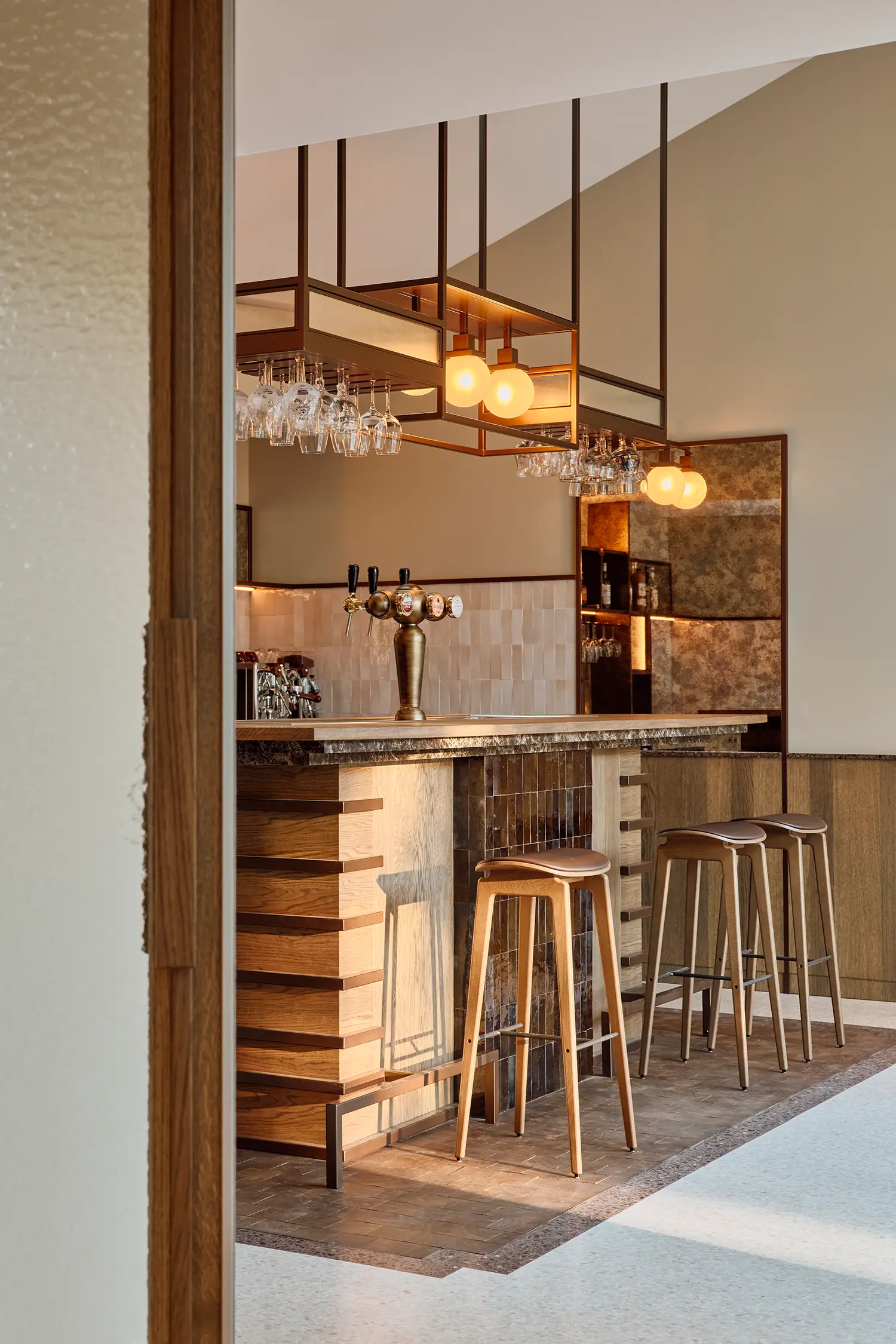
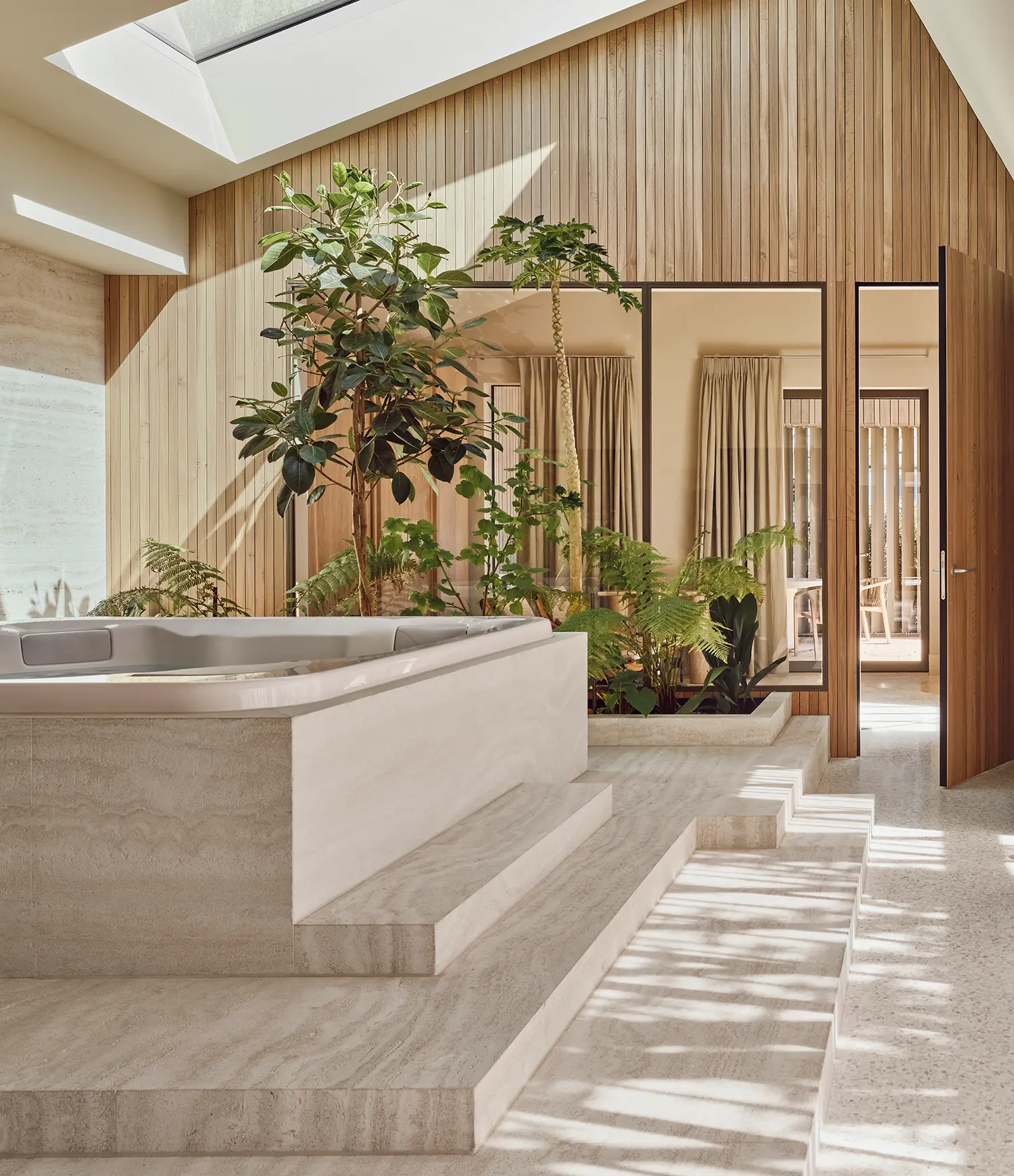
A new wing built in the language of the old. The most ambitious move in the project is the ground-floor extension — a sequence of spaces that unfolds from the main living area into bar, wellness, and multifunctional room, each one distinct in atmosphere but continuous in material logic. The bar draws directly from the architectural language of the historic house, adding brass geometric structures on the back wall for bottle and glassware storage, Zellige tiles in multiple colours, terrazzo, marble, and textured glass across a squared-pattern wood floor. It is the most visually dense space in the house — deliberately so. The wellness area immediately beyond it operates on an opposite register: engraved travertine walls, a travertine-clad jacuzzi facing the garden, large plants, and a glass wall that opens a controlled view into the multifunctional room beyond. The shift between the two is immediate and physical — from the warmth and chromatic richness of the bar to the cool, mineral stillness of the travertine. Between steam and brass, the body recalibrates.
Across the garden, a second satellite. Parallel to the bar and wellness wing, a separate structure houses the boathouse, wine room, and garage — a smaller volume that echoes the material palette of the main house and extensions to maintain formal coherence across the entire site. The wine room features custom cabinetry, a high table for seating, and a direct view toward the boat and the water beyond. Storing wine with a view of the Rijn is not a functional necessity — it is a statement about what this house considers worthy of attention.

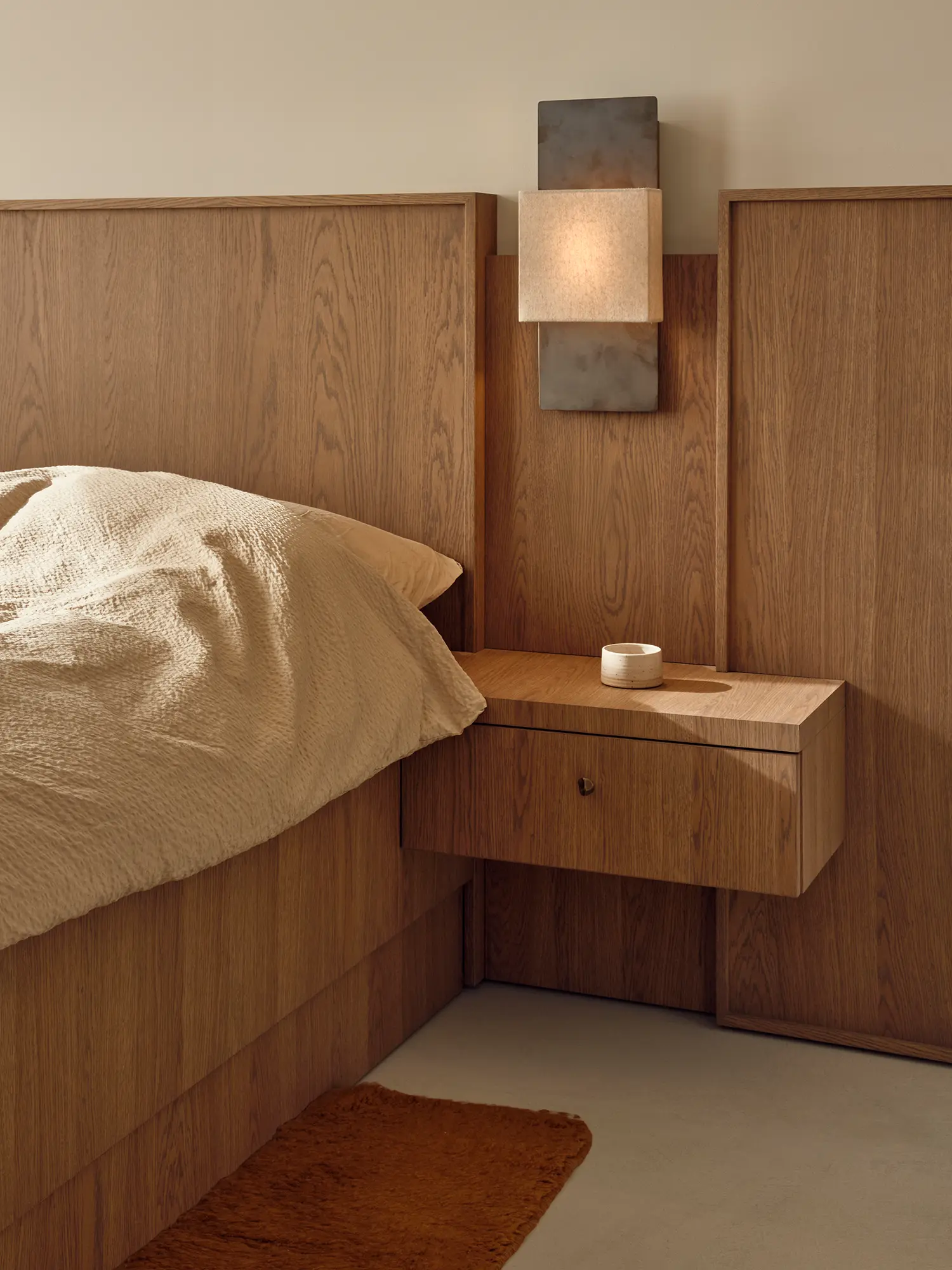
The upper floor as decompression. The second floor follows a quieter logic: each room derives its palette from the ground floor materials but reduces them to a cleaner, more restrained version. A seamless poured floor runs throughout the level. The master bedroom leads through sliding doors into a custom wardrobe, then into a bathroom that combines tiles, poured flooring, and travertine in a light cohesive palette — the same materials as downstairs, but lighter, more contemplative, oriented toward the garden and the river.
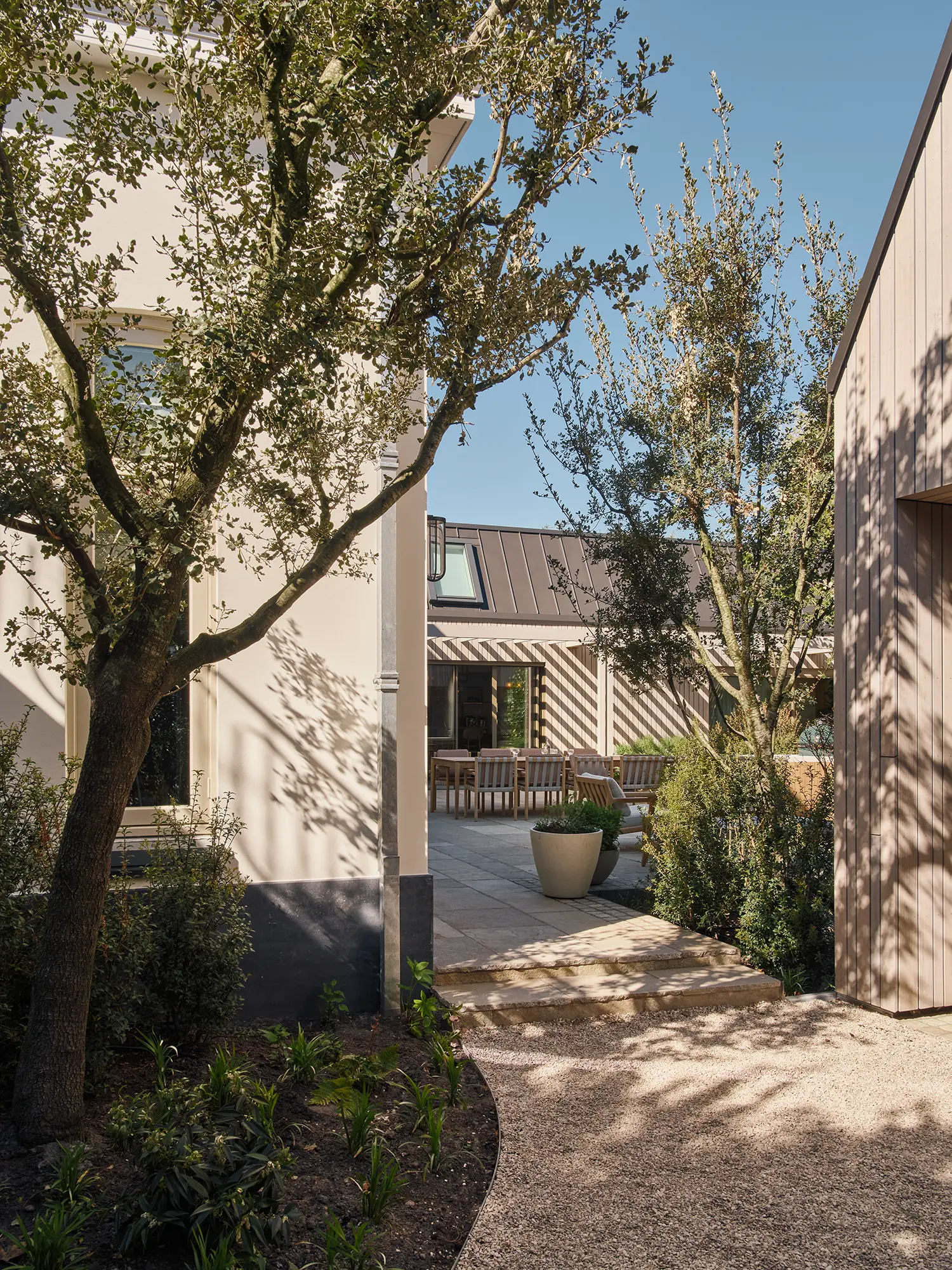
The garden as connective tissue. Designed by Arjan Boekel, the garden does not perform the role of outdoor room in the way most residential gardens do — it operates as the literal connective tissue between all the project’s volumes. Main house, bar wing, boathouse, waterfront: the garden holds them together without imposing a single dominant axis. Studio Modijefsky furnished it with light-material pieces that define different seating zones for different times of day and different social configurations. By the water’s edge in the evening, the house disappears behind you and only the river remains. This is where Home Wilhelminalaan makes its clearest argument: that the most sophisticated domestic spaces are not those that impress from the entrance, but those that keep revealing themselves the longer you stay.
Home Wilhelminalaan joins a body of work that positions Studio Modijefsky among the most considered residential practices currently operating in the Netherlands — a country that continues to produce some of Europe’s most intelligent approaches to Dutch residential interior design. For a broader view of residential work emerging from the Dutch context, the recently published Villa Voorwerf by Unknown Architects — a timber house in Zunderdorp that navigates landscape and enclosure with equal precision — offers a compelling point of comparison.