



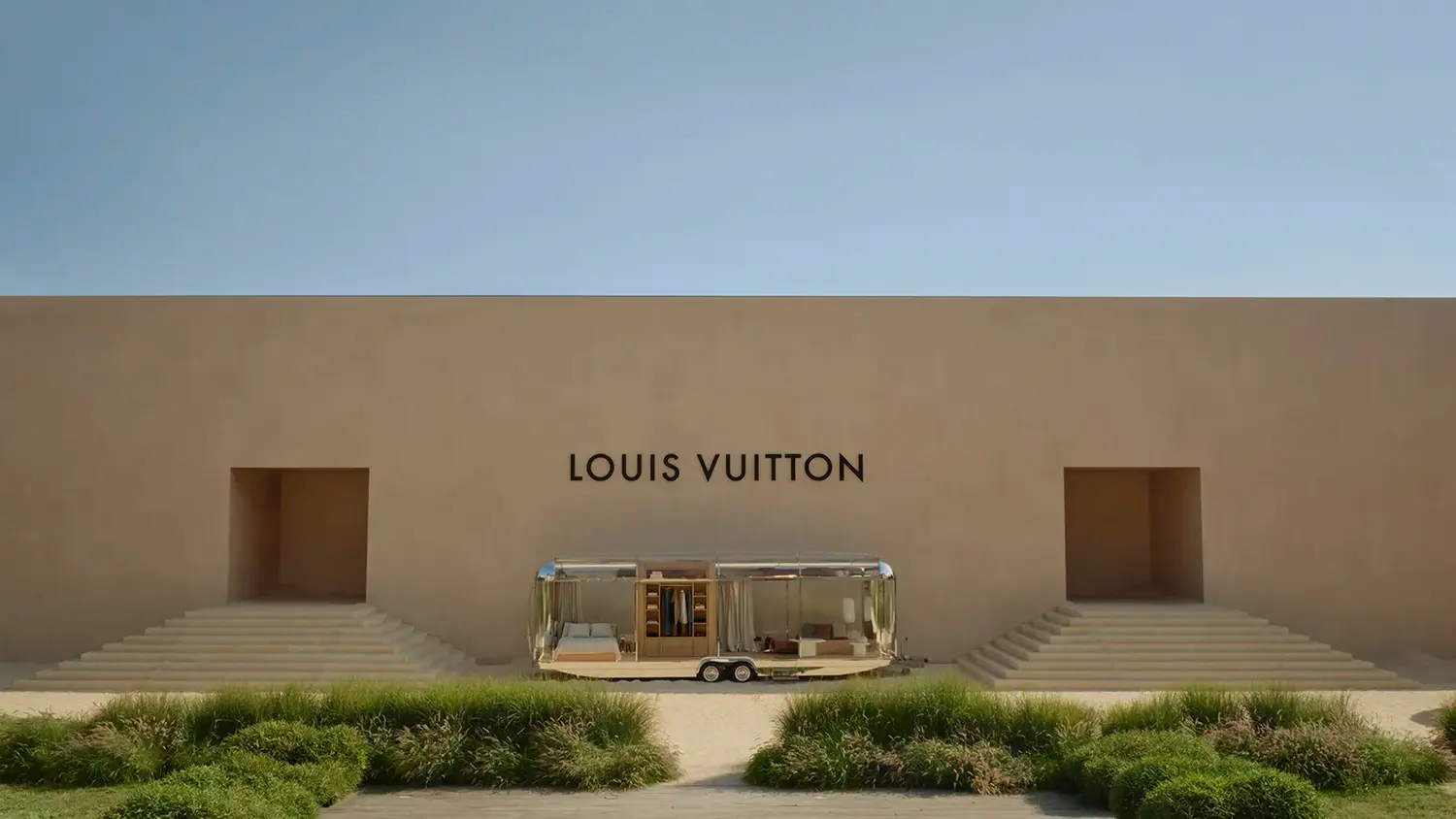
Louis Vuitton‘s Men’s Spring/Summer 2027 show, staged on 23 June 2026 at the Cité Internationale Universitaire de Paris, will be remembered less for what walked down the runway than for what the runway was built inside: an 8-metre-high, 37-metre-wide wave carrying real water from the Eau de Paris municipal network, cascading into pools of water at its base while models walked through mist on fine sand imported for the occasion. This is not a criticism of Pharrell Williams. It is a description of where fashion week — and the luxury sector that funds it — currently stands: in a moment where the set is the collection, the image is the product, and the show exists primarily to be experienced by people who were not there.
The luxury fashion crisis has been navigating a loss of relevance for several years. The post-pandemic appetite for conspicuous consumption has contracted; the generation that drove logo-driven growth has become more selective; and the traditional channels of aspiration — advertising, editorial, retail — have lost the authority they once carried. What has filled the gap is the spectacle economy: the idea that a brand’s most valuable product is not what it sells but what it makes people feel, briefly and intensely, through images that circulate faster than any campaign budget could previously reach. The Louis Vuitton show under Pharrell Williams has become the clearest expression of this logic in global fashion. Each season, the set grows larger, more materially ambitious, and more photographically irresistible. The SS27 wave is not the next step in that progression — it is its logical conclusion.
Pharrell Williams understands this better than almost anyone working in fashion set design today. His background is not in design but in music production — an industry that has been navigating the attention economy for longer than fashion, and that learned earlier that the most valuable currency is not the record but the cultural moment surrounding it. Since taking the creative directorship of Louis Vuitton’s menswear in 2023, Williams has treated each show as a produced event first and a collection second: the Snakes and Ladders board with Bijoy Jain at the Centre Pompidou, the prefabricated DROPHAUS residence with NOT A HOTEL at the Bois de Boulogne — covered in full in our DROPHAUS feature — and now a hydraulic wave on a university campus. The clothes change. The strategy is consistent.
The SS27 wave is, by any measure, the most discussed Paris Fashion Week set of the season. Real water that mists guests. A sand runway that gives every photograph a beach horizon. A barrel wave that frames models in a tubular void of cascading water — an image that reads identically whether you encounter it on a phone screen or from the front row. The front row itself — Victor Wembanyama, Léon Marchand, J-Hope, Jeremy Allen White, Bernard Arnault — was not assembled to evaluate the collection. It was assembled to generate content that the 650 million people who will never attend a Louis Vuitton show will consume in the following 48 hours. This is not cynicism about fashion. It is an accurate description of how the attention economy has restructured luxury, and Williams is its most fluent practitioner.
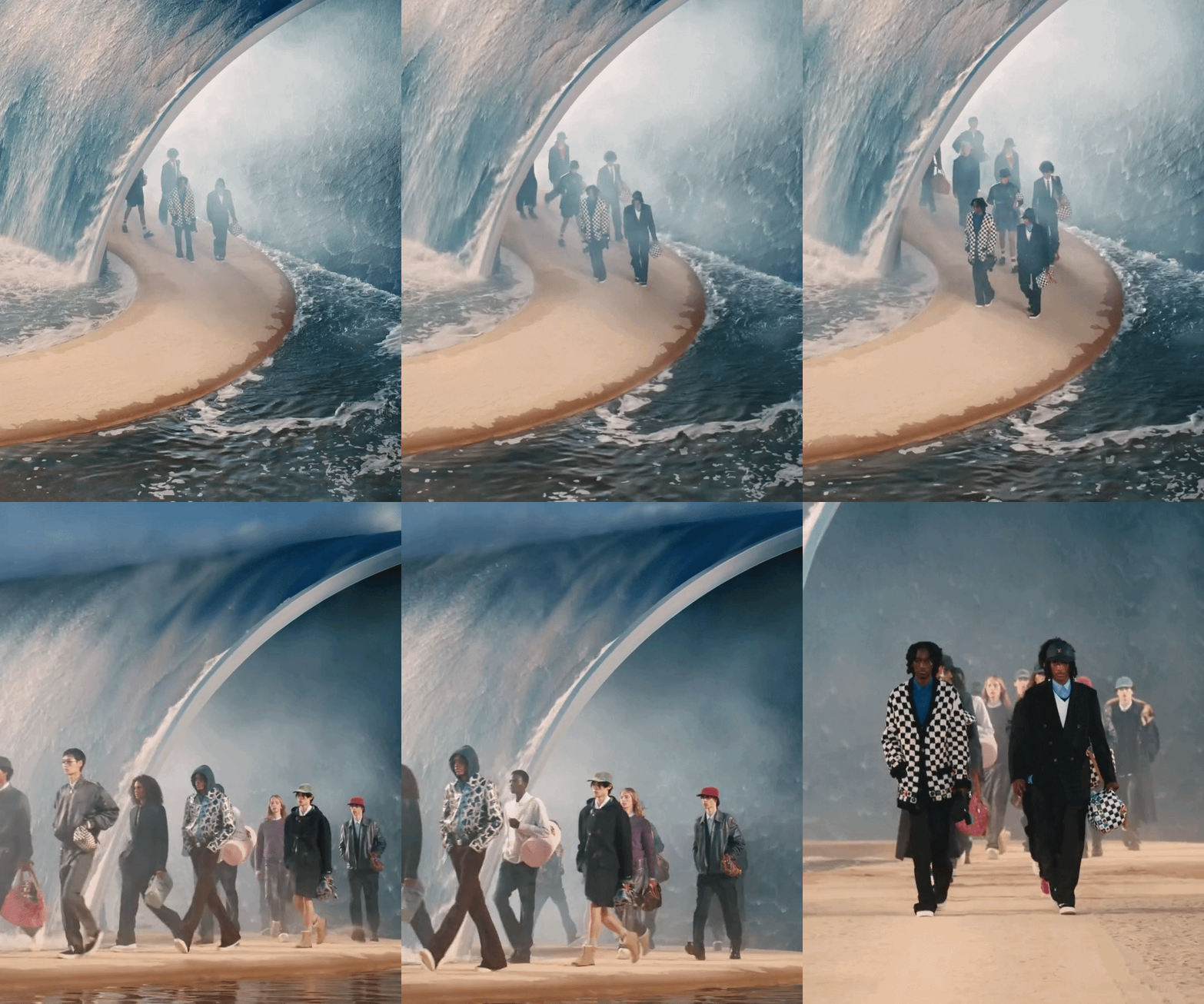
The clothes that walked through the wave were coherent with the set’s logic — relaxed tailoring, denim, skate-forward silhouettes, LV-monogrammed surfboards carried as props, a beach cart pushing an LV trunk down the sand. The collection extended Pharrell’s vision of the contemporary traveller moving between cultures, climates, and coastlines — wearable, confident, and entirely at home on a sand runway. In the economy Williams has built at Louis Vuitton, the set and the clothes operate as a single system: the scenography establishes the world, and the collection inhabits it. The wave works because the clothes belong inside it.
What the SS27 show ultimately describes is a new definition of fashion design itself. The most consequential creative decision Pharrell Williams made for this collection was not a cut, a fabric, or a silhouette — it was the decision to fill 37 metres of wave structure with real water from the Paris municipal network and let it run for the duration of a show. That decision generated more cultural reach, more brand equity, and more immediate global recognition than any garment on the runway. The logical endpoint of this trajectory is a Louis Vuitton show in which no clothes appear at all — and it will probably be the most successful one he ever stages.