



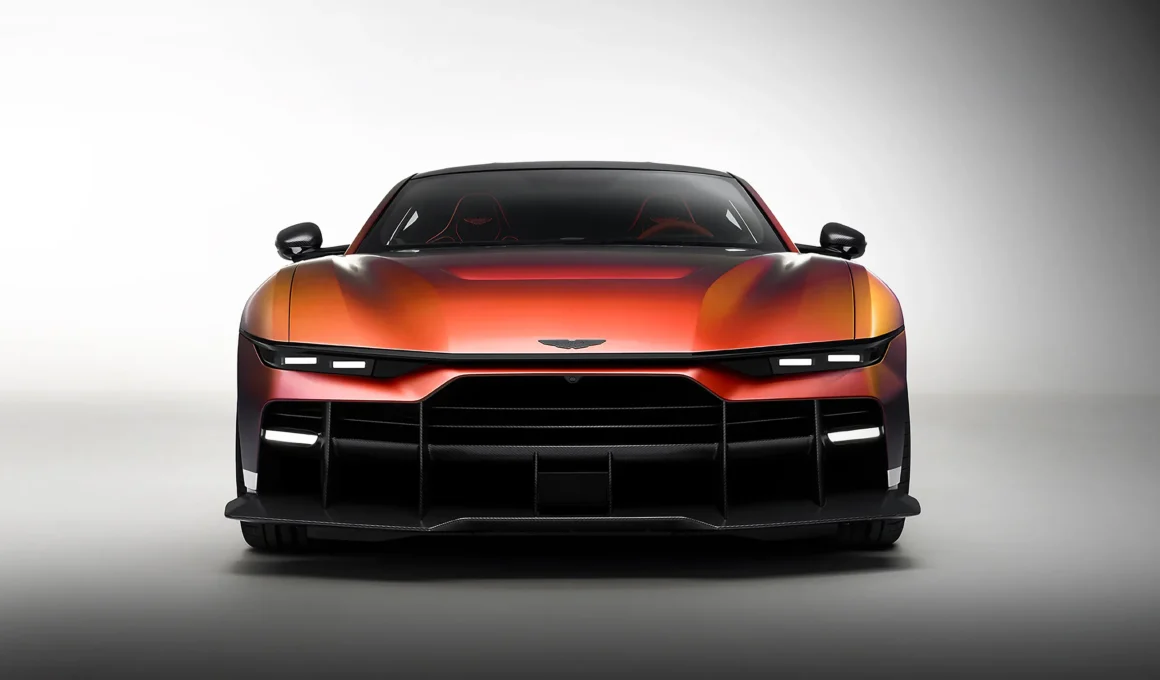
British automaker Aston Martin‘s Q division builds Valen by removing as much as it adds — 110kg (243lbs) of weight cut through material craft even as its most powerful front-engined V12 becomes the marque’s most powerful yet. The result is Aston Martin’s most powerful front-engined car in its 113-year history, built on a formula of subtraction as much as addition. It’s a distinction that separates Valen from a straightforward horsepower story.

Developed under Q by Aston Martin’s bespoke service, Valen follows Valour, Valiant and DBR22 as the latest in a lineage of limited-production twelve-cylinder specials, this time realized through the newly formed Special Vehicle Operations department. “Everything we’ve done to the powertrain and chassis has been driven by the same objective: to intensify the character and capability to deliver a truly thrilling experience that’s accessible to all skill levels, but keen drivers will absolutely relish,” said Aston Martin Director of Vehicle Performance, Simon Newton.

At the heart of the car sits a 5.2-litre twin-turbocharged V12 producing 850PS and 1000Nm of torque from just 2,500rpm, paired with a sharper-shifting 8-speed ZF transmission built on shift strategies developed for Aston Martin’s Vantage GT4 race programme. The result is a 0-60mph time of 3.0 seconds and a top speed electronically limited to 214mph.

Every drive mode reshapes how that power reaches the road, across Sport, Sport+ and Track modes. Sport and Sport+ use a shorter throttle map for quicker response on the road, while Track mode trades that immediacy for a longer, more progressive delivery when precision matters more than urgency.

Lightweight engineering runs through nearly every component on Valen, cutting 110kg (243lbs) from the core V12 platform through carbon fibre, aluminium, titanium and magnesium. An optional lightweight pack — machined-from-solid aluminium suspension arms, knuckles and titanium chassis bolts — accounts for a further 16.9kg (37lbs) on its own, while new magnesium wheels reduce unsprung mass to sharpen steering response.

The exterior announces that engineering logic visually, through deeply recessed headlamps beneath a plunging bonnet line, a bold geometric mesh grille and elongated side strakes that widen into the rear haunches. “Valen gave us the opportunity to explore and express more extreme emotions through a new form language and surface treatment,” said Aston Martin Chief Creative Officer Marek Reichman. A solid tailgate replaces the traditional rear window and trunk lid, opening onto a 170-litre trunk beneath an integrated aerodynamic wing.

Color plays its own role in that visual language: the show car wears a satin-finished Andromeda Red paint built with Chromaflair pigment technology, shifting between deep red, copper and blue undertones depending on the light. Customers can specify a fully exposed carbon-fibre body instead, tinted in custom colors — a material-driven approach to finish that echoes how Ferrari treats its own one-off commissions, where the CZ26’s Argento Veloce silver and Rosso Lampante accents were built around a single, deliberate material contrast rather than an applied graphic scheme.

Inside, the cabin was developed around visual lightness to match the car’s weight-saving brief: a slim, 3D-printed centre console angles toward the driver, while a new hierarchy of interior trim lets owners choose between Semi-Aniline Leather and Alcantara across five material splits, from Monotone through to a Driver Focused configuration.

Production closes at 150 examples, with first deliveries scheduled for Q2 2027. Even Valen’s titanium exhaust system — 3D-printed tailpipes and micro mufflers tuned to homologation limits — was built to save weight as much as to sound a particular way, the same instinct that shaped everything else on the car: performance measured as much in what was removed as in what was added.