



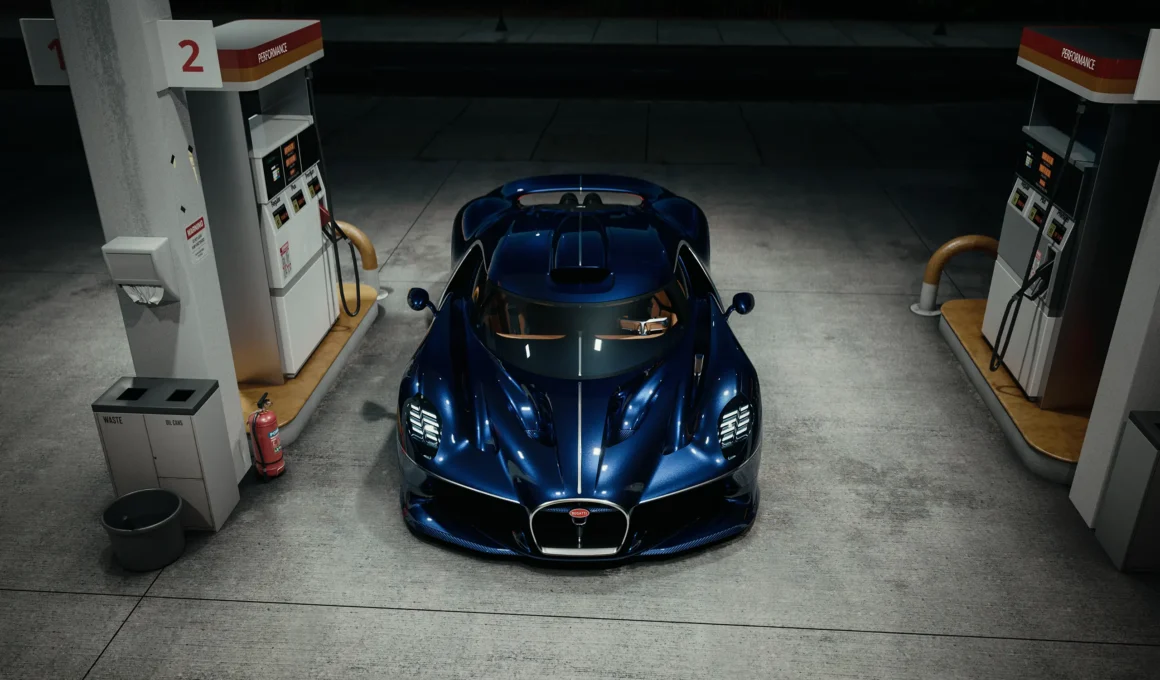
Bugatti‘s third Programme Solitaire commission strips away nearly everything that makes its donor car go fast, and calls the result the Destrier. The one-of-one made its physical debut at Monterey Car Week, shown first in a private unveiling at the Maison Bugatti in Pebble Beach before its public presentation on the Concept Lawn at The Quail, A Motorsports Gathering. Built on the chassis of the Bolide, Bugatti’s most extreme track machine, the car asks what that engineering package looks like once every wing, vent, and aerodynamic addenda has been removed and only proportion is left to do the talking.

The result of that removal is a car standing just one meter (3.3 feet) tall — dramatically lower than any other model in Bugatti’s current range — with a bare-volume body that leaves nothing to hide behind. This is the core premise behind Bugatti Destrier design: rather than layering on the visual vocabulary of downforce, as the Bolide does, the studio pared the surface back until proportion alone carried the visual case.

Wheel size does the rest of that visual work: twenty-inch units sit up front and 21-inch at the rear, a step up from the Bolide’s 18-inch items, and against the car’s compressed volumes they read as genuinely monumental — the kind of scale shift that makes a static car look like it’s already carrying speed.

A dedication plate marks the car’s connection to real coachbuilding history: hand-laser-engraved above the windscreen, it depicts both the Type 57G “Tank” and the Type 57SC Atlantic, tying the Destrier back to a chassis architecture that once underpinned both a Le Mans-winning racer and the car widely regarded as the most beautiful ever built — a race car and an objet d’art sharing one foundation. Destrier follows Brouillard, the inaugural Programme Solitaire hypercar named after Ettore Bugatti’s favorite horse, continuing that Bugatti Programme Solitaire naming logic while pushing the design language somewhere considerably more restrained.

The signature C-line pauses before the front wheel well instead of running as Bugatti’s usual unbroken curve of brightwork, letting bare bodywork show through before the line resumes its path toward a horseshoe grille wider than the one on the Bugatti Bolide-based hypercar it started from. Restraint governs the face here rather than aggression — a deliberate departure from the track car’s visual intensity.

Behind the doors, bodywork draws inward into a pronounced waist before swelling back out over the rear wheels into a powerful hip, an extreme body posture more commonly seen in early design sketches than in a fully realized production model. At the rear, a blended wing echoes the Chiron Profilée, closing the silhouette on the same quiet note it opened on.

A bespoke finish called Sapphire Celeste covers the exterior, multi-layered and created exclusively for this car and its owner, with a diamond-inspired sparkle built into the paint’s structure that lifts the sculptural surfaces against polished aluminum brightwork. Exposed carbon fiber, limited to the front splitter and rear diffuser, is tinted to match the Sapphire Celeste paint precisely, while brightwork inside the engine bay carries a hammered surface finish — a quiet nod to hand-beaten medieval armor that plays into the car’s equestrian name.

Inside, the cabin trades the Bolide’s stripped motorsport cockpit for the atmosphere of a tailor’s atelier, built around three materials: leather and nubuck in a warm brown called “Ambre Voyageur,” and an advanced 3D-knitted interior textile drawing on techniques from haute couture and performance sportswear. Copper yarns run through that knit as a circular “halo-line” pattern, with contrast stitching repeated in the headrest embroidery and the console’s flowing lines.

Underneath all of it sits the Bolide’s complete W16 powertrain, producing 1,600 PS (roughly 1,578 hp) at the peak of its development — mentioned here almost in passing, since the whole point of the Destrier’s design is that this figure isn’t the point. One meter off the ground and stripped of every aerodynamic device that usually signals a Bugatti’s intent, the Destrier makes its case for proportion carrying as much weight as horsepower always has.