



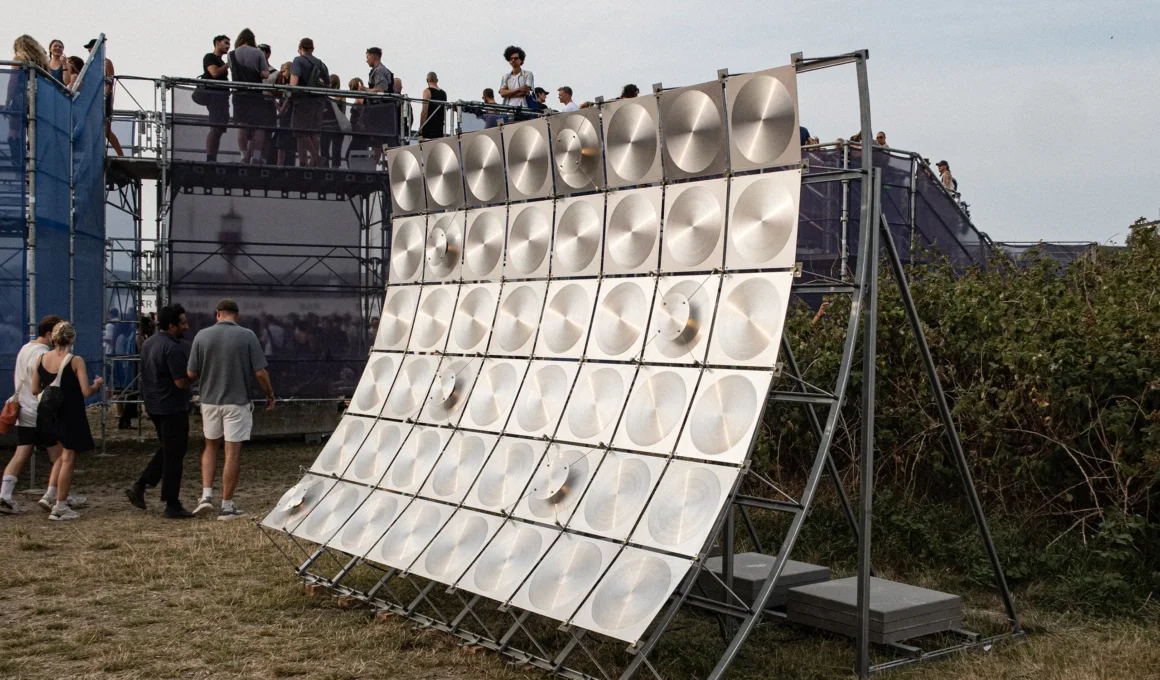
Speaker, the newest installation by Copenhagen-based studio Frederik Gustav, turns the anatomy of a loudspeaker into a wall of light that never makes a sound. Commissioned for O Days Festival 2026 on the Refshaleøen waterfront, the piece borrows a familiar shape from audio equipment and strips it of its function, leaving only geometry and reflection behind. What remains is an installation built to be read by the eye rather than heard by the ear — a curved mirror to the festival unfolding in front of it.

A grid built from speaker cones anchors the piece: dozens of circular-brushed aluminum panels, each pressed with the concentric rings of an audio cone, are bolted across a curved metal frame that tilts back like an amphitheater wall. The repetition is total — panel after panel, ring after ring — so that from a distance the surface reads less like individual objects and more like a single rippling skin stretched over the festival grounds.

Depending on where a visitor stands, that skin behaves differently. Some panels catch full daylight and flatten into bright, near-white discs; others sit in shadow and darken into soft gray hollows. The installation has no moving parts and no digital control system — the viewer’s own position does all the work, producing kinetic reflections that make the same wall of aluminum look solid from one angle and fragmented into dozens of separate lenses from another.

The reference to sound equipment is direct but never literal. Frederik Gustav takes the circular geometry of a speaker cone — a form built for acoustics — and repurposes it as a sound-inspired design object built for optics instead. It’s a swap that recalls other studios currently reworking the speaker as a design object rather than a black box, from Tylko’s sound HiFi speaker shelving to freestanding audio sculpture — though here the cone shape is emptied of its acoustic purpose entirely and pushed toward pure visual rhythm.

Nothing about the construction is hidden here: cables, turnbuckles, and bolts sit exposed at the intersection of every panel, forming small exposed construction details wherever two discs meet the frame. That legibility is consistent with the studio’s broader practice, which treats fabrication elements — fixings, joints, tension hardware — as part of the finished language of a piece rather than something concealed behind a clean facade.

After sunset, the piece changes register entirely: warm points of light appear behind a handful of discs, glowing through their centers like small eclipses scattered unevenly across the grid, while the surrounding aluminum dims to a cool, almost liquid gray. On the Refshaleøen, Copenhagen, Denmark waterfront, under festival lighting caught here in green and blue washes from a neighboring stage, the same static object reads as an entirely different piece from the one visitors saw in daylight.

The piece absorbs its crowd: positioned close to festival infrastructure and foot traffic at O Days Festival 2026, it pulls passing bodies briefly into its reflections before they dissolve out of frame again. That built-in instability places Speaker in company with other reflective installation work made for temporary, crowd-driven settings, in the same spirit as SPY’s Halos kinetic installation for Florence’s Bright Festival, where the audience becomes part of the composition rather than a passive viewer standing in front of it.

The studio behind the piece was founded by Frederik Weber and Gustav Dupont, who studied together at The Royal Danish Academy of Fine Arts in Copenhagen before setting up a workshop on the island of Amager. Its projects — objects, interiors, and large-scale installations alike — tend to build on one another, carrying forward the same interest in exposed structure and raw material logic from one commission to the next, with Speaker reading as the latest chapter in that continuing language rather than a standalone gesture.

By the time the crowd thins for the night, it’s the smallest details that stay with a visitor longest — a bead of condensation catching the glow of a single lit disc, or one panel angled just slightly off from its neighbors, refusing to sit perfectly flat within the grid.