



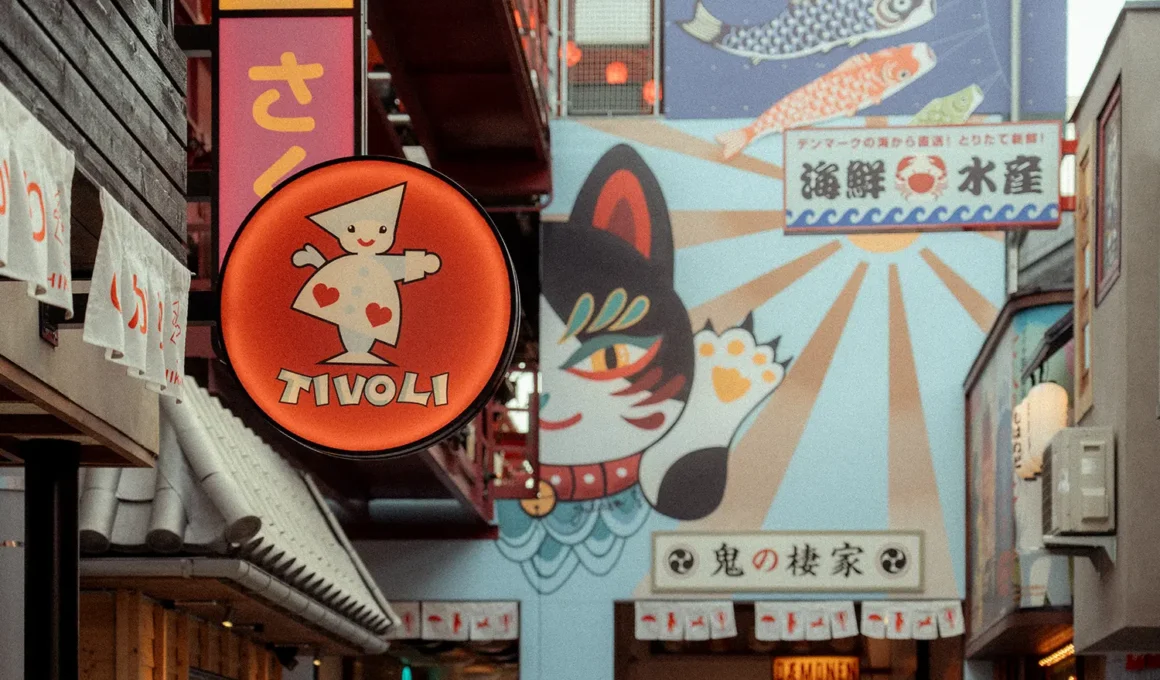
Hikari, the new Japanese-inspired district at Tivoli Gardens, imports sixty tonnes of Japanese brick and an original Takashi Murakami artwork into a 2,000-square-metre zone still built around a rollercoaster. The area replaces Tivoli’s former Asia-inspired district in Copenhagen, following two years of construction and the largest single thematic investment in the park’s nearly 200-year history. Rather than reconstructing Japan, Tivoli has folded genuinely imported material into its own theatrical logic, letting fairground and streetscape share the same footprint.

Bringing the world to Copenhagen is not new territory for Tivoli. Since opening in 1843, the gardens have drawn on cultures far beyond Denmark — the Chinese-inspired Pantomime Theatre, the Pagoda, and the original Asia area all trace back to founder Georg Carstensen’s instinct to bring distant places to a Danish audience long before international travel was widely accessible. Hikari continues that pattern as a Japanese-inspired district built for a contemporary audience; as Susanne Mørch Koch, CEO of Tivoli, says, the goal was for “Tivoli can continue to innovate, surprise and put new experiences on the world map.”

Space was the hardest constraint to solve. Tivoli sits on a fixed 80,000-square-metre (861,000 sq ft) footprint in the middle of Copenhagen, unable to expand outward on any side. Hikari’s 2,000 square metres (21,500 sq ft) had to be found within that boundary, which meant building across a multi-level amusement district rather than adding land — a masterplan condition that shaped nearly every other design decision in Hikari.

Authenticity arrived by the tonne. More than 60 tonnes (132,000 lbs) of imported Japanese brick were shipped to Copenhagen for the project, alongside reclaimed doors and windows and traditional roof tiles supplied by Japanese manufacturers Tsuruya and Eishirou Kawara. These aren’t props built to look old — they’re the same materials used in Japan, brought in at a scale unusual for a theme park renovation.

The street itself is the destination. Illuminated rice-paper walls, Japanese-inspired signage, and four sheltered gathering areas with a combined 180 covered seats line the immersive Japanese streetscape running through Hikari, designed for guests to pause and linger rather than pass straight through toward the next ride.

The Demon got a new mythology rather than a new track. Tivoli’s existing rollercoaster remains structurally the same but now winds through Hikari beneath the watch of a guardian figure inspired by the maneki-neko, Japan’s beckoning cat. Two new rides join it: Hotel Hikari, an immersive funhouse with tilted rooms and mirror mazes, and The Typhoon’s Eye, a zero-gravity rotating ride styled after Japanese storm systems.

Food carries its own narrative alongside the architecture. Five Japanese street food concepts — from onigiri and karaage at Comé Rice Kitchen to tableside grilling at Yaki-Tak! — line the alleyways close to the covered seating, while two shops, Sakura and Konbini by UME, extend the district’s story into ceramics, Japandi homeware, and convenience-store snacks sourced directly from Japan.

Art carries real weight inside the streetscape rather than sitting apart from it. An original Takashi Murakami artwork is worked into Hikari’s lighting and architecture directly, a treatment that runs on the same logic Louis Vuitton and Murakami used for their immersive Soho pop-up, where zoned, color-coded environments carried visitors through the work rather than around it. Sculpted pine, bamboo, Japanese azaleas, and a temple tree complete the planting, softening the district’s more theatrical edges.

Nothing was left to guesswork. Every material and detail was developed with a Danish and Japanese design collaboration specializing in architecture, culture, and aesthetics — a process Tivoli’s design and development director Rasmus Altenborg described simply: “we went to Japan to get inspiration,” as he told Blooloop ahead of the opening. That same instinct — building an entire environment around Japanese atmosphere down to its smallest threshold — shapes Jessica Mille’s Matsuri Marseille, where a single doorway shifts visitors from a French street into a fully constructed Japanese sensory world.
Sixty tonnes of imported brick and a rollercoaster still running through the middle of it all sit inside the same district for a reason: Hikari isn’t asking guests to believe they’ve left Copenhagen, only to notice how much of Japan actually made it there.
Hikari at Tivoli Gardens | Location: Vesterbrogade 3, 1630 Copenhagen V, Denmark