



Leandro Erlich has spent three decades constructing replicas of the most trusted objects in architecture — elevators, staircases, facades, swimming pools — and his first major retrospective in France, now open at the Grand Palais in Paris through 6 September 2026, is built entirely from what happens when those objects refuse to function. Fourteen monumental installations fill Galleries 9.2, 10.1, and 10.2 of the recently renovated Beaux-Arts monument, organized by GrandPalaisRmn and Arthemisia and curated by Fabrice Bousteau: a survey of thirty years of a practice that uses the mute furniture of urban life as an instrument for a specific kind of epistemological failure. It is the largest retrospective dedicated to the Argentine artist in Europe, and among the most formally ambitious exhibitions the revitalized building has yet mounted.
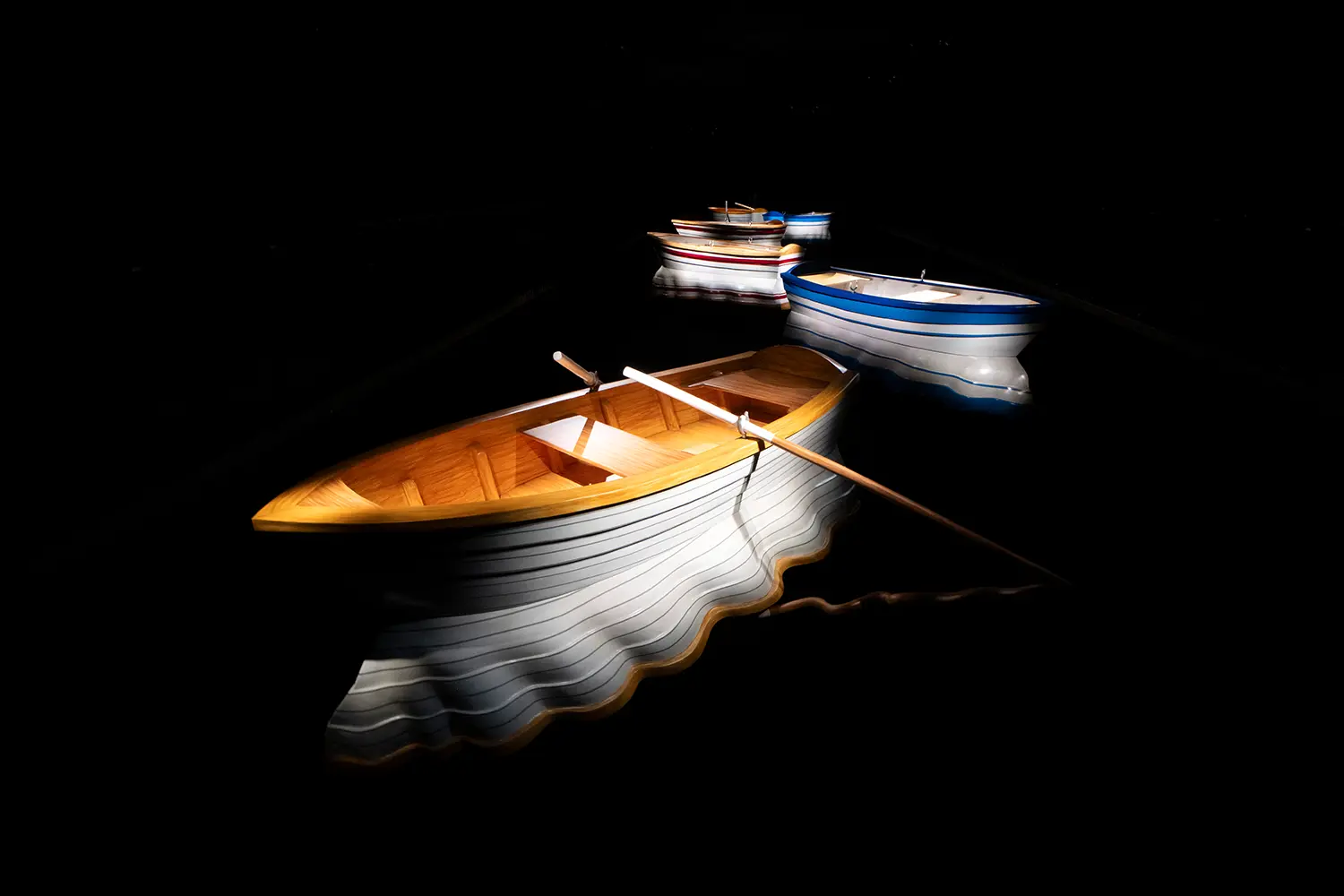
The exhibition opens in darkness. Port of Reflections (2014) draws visitors down a dim embarcadero toward what reads, immediately and convincingly, as a harbor at night: small fiberglass rowboats rocking gently on black, motionless water, their hulls apparently doubled in reflection below the surface. There is no water. A concealed mechanism animates the boats; what appears to be their reflection is part of the sculpture’s own construction — an optical agreement engineered to hold at a distance and dissolve up close. The work places Leandro Erlich‘s entire practice in a single room: not a trick to be solved but a condition to be inhabited.
Born in Buenos Aires in 1973, Erlich began his professional career at eighteen with a solo exhibition at the Centro Cultural Recoleta. After residencies in Houston and early exposure to the New York art world of the late 1990s, he represented Argentina at the 2001 Venice Biennial and was included in the 2000 Whitney Biennial — institutional recognition that came early for a practice already structurally unlike anything being produced around it. His subject was never sculpture or architecture as form; it was architecture as cognitive infrastructure, the mute compact between a building and the people who have stopped noticing it.
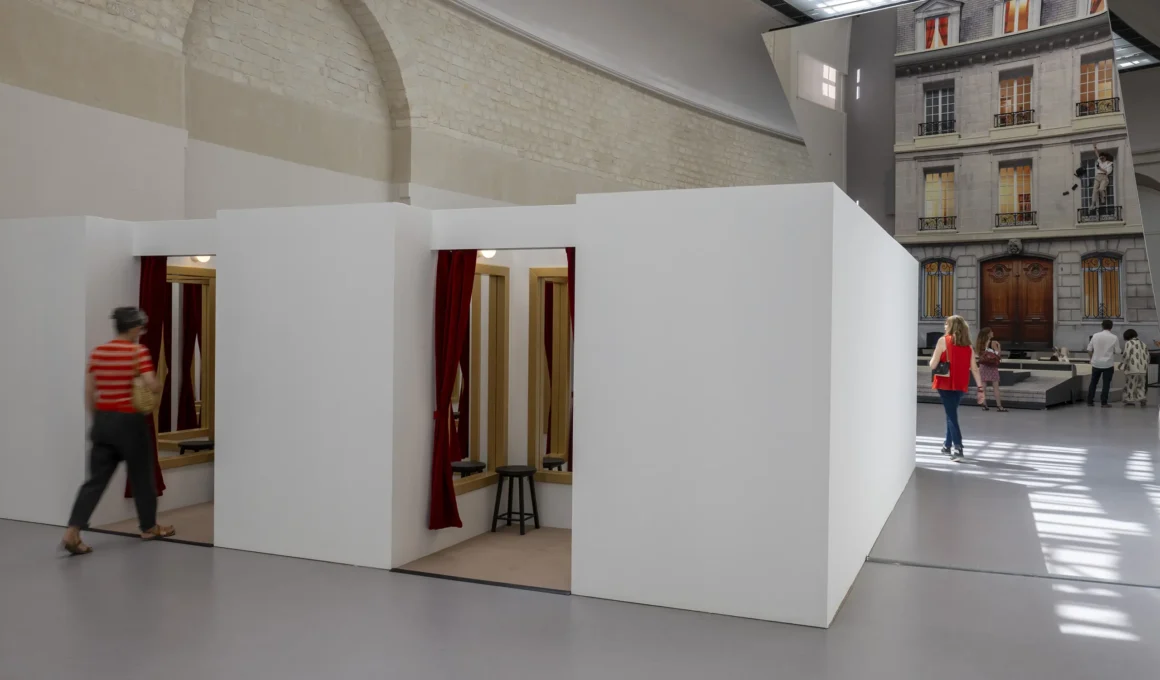
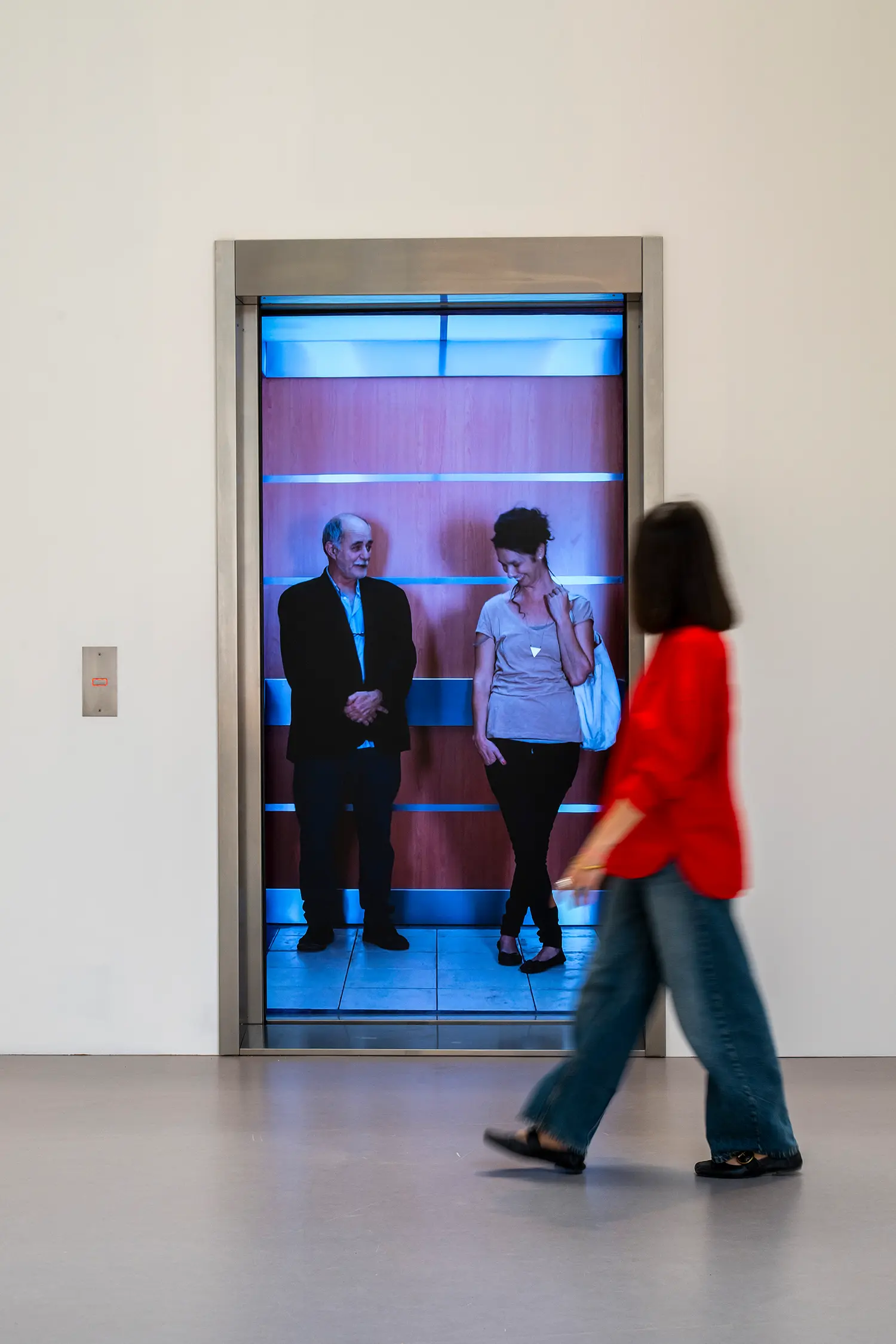
The works never choose spectacular subjects. Elevators, staircases, apartment windows, building facades — the functional furniture of daily urban life, selected specifically because repeated exposure has rendered them invisible. In Elevator Maze, visitors approach a row of open elevator doors and step inside, only to find that the mirrors lining some cabins are not mirrors at all but empty frames, voiding the spatial logic that makes an elevator legible. The confusion registers in the body before the mind names it: a half-second of wrongness before the analysis catches up, by which point the work has already done what it came to do.
The most historically weighted piece in the retrospective is Bâtiment, first created in 2004 for Paris’s Nuit Blanche. A full-scale Haussmann-style facade — the defining residential unit of the city, imprinted on the eye of every resident and visitor — is laid horizontally on the gallery floor and reflected by an enormous overhead mirror, so that visitors who lie down on its surface appear, from the mirror’s angle, to be scaling or falling from the building’s exterior wall. The gesture is formally precise: Erlich does not alter the facade, only the gravity that gives it meaning. Twenty-two years after its Parisian debut, the work has come home.
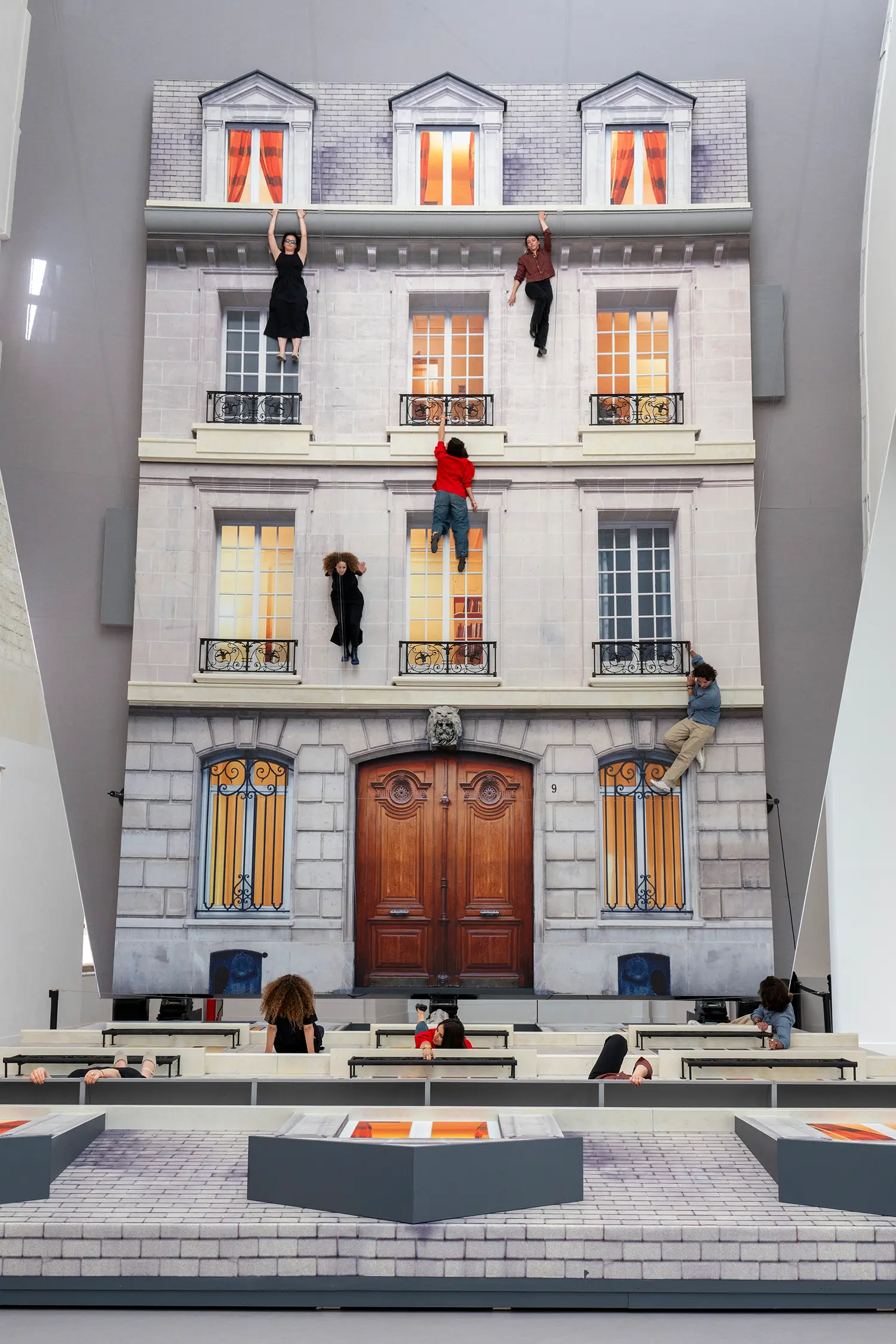
Its return coincides with a building rebuilt from the inside out. The Grand Palais renovation led by fr-ch architectesrestored both the structure’s infrastructure and its ambition as a venue for large-scale contemporary culture — a project about reinstating confidence in a landmark. That Bâtiment, a work about the failure of architectural trust, has returned to the city of its birth and found a home inside that landmark is not a coincidence the curators make explicit, but it is difficult to ignore.
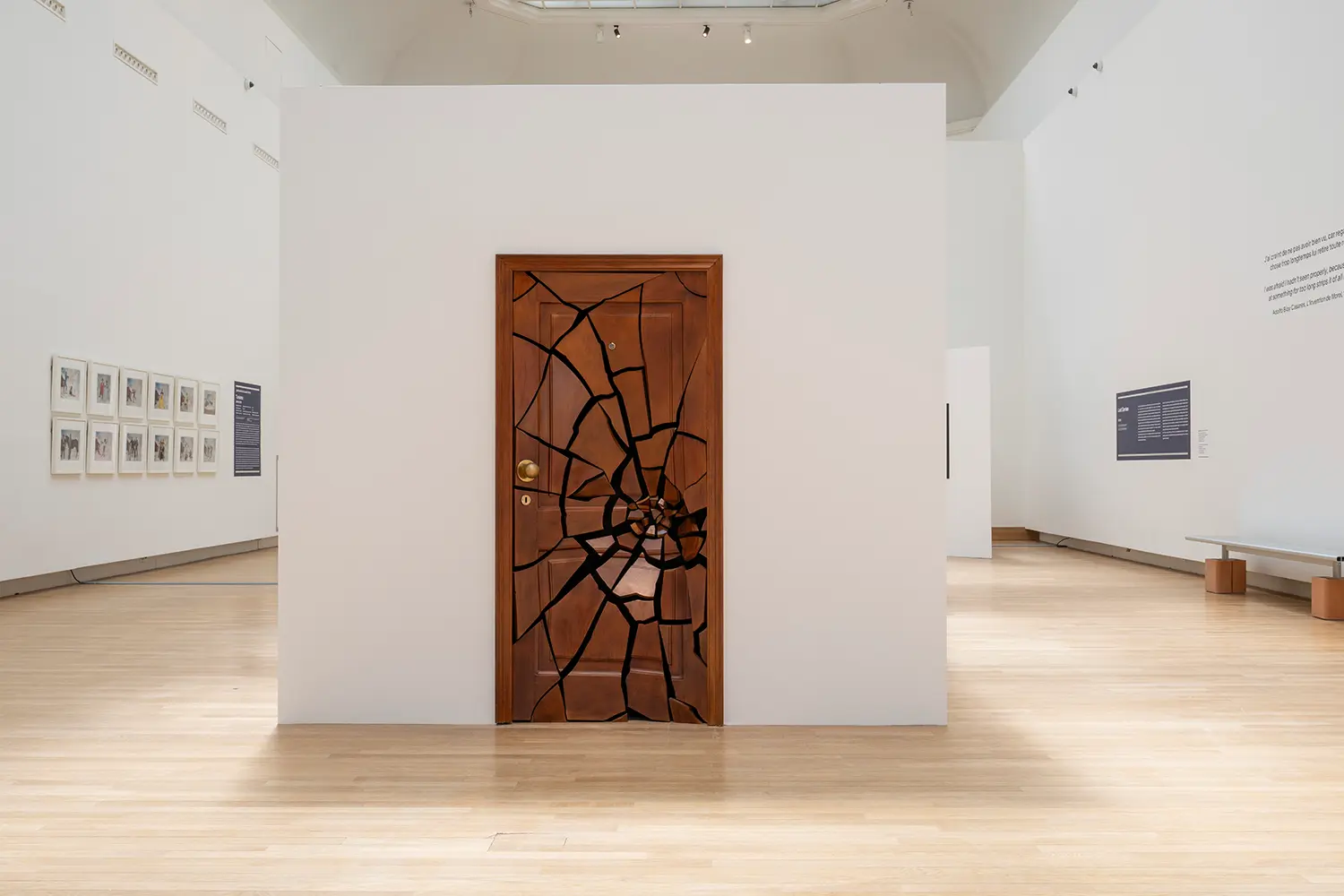
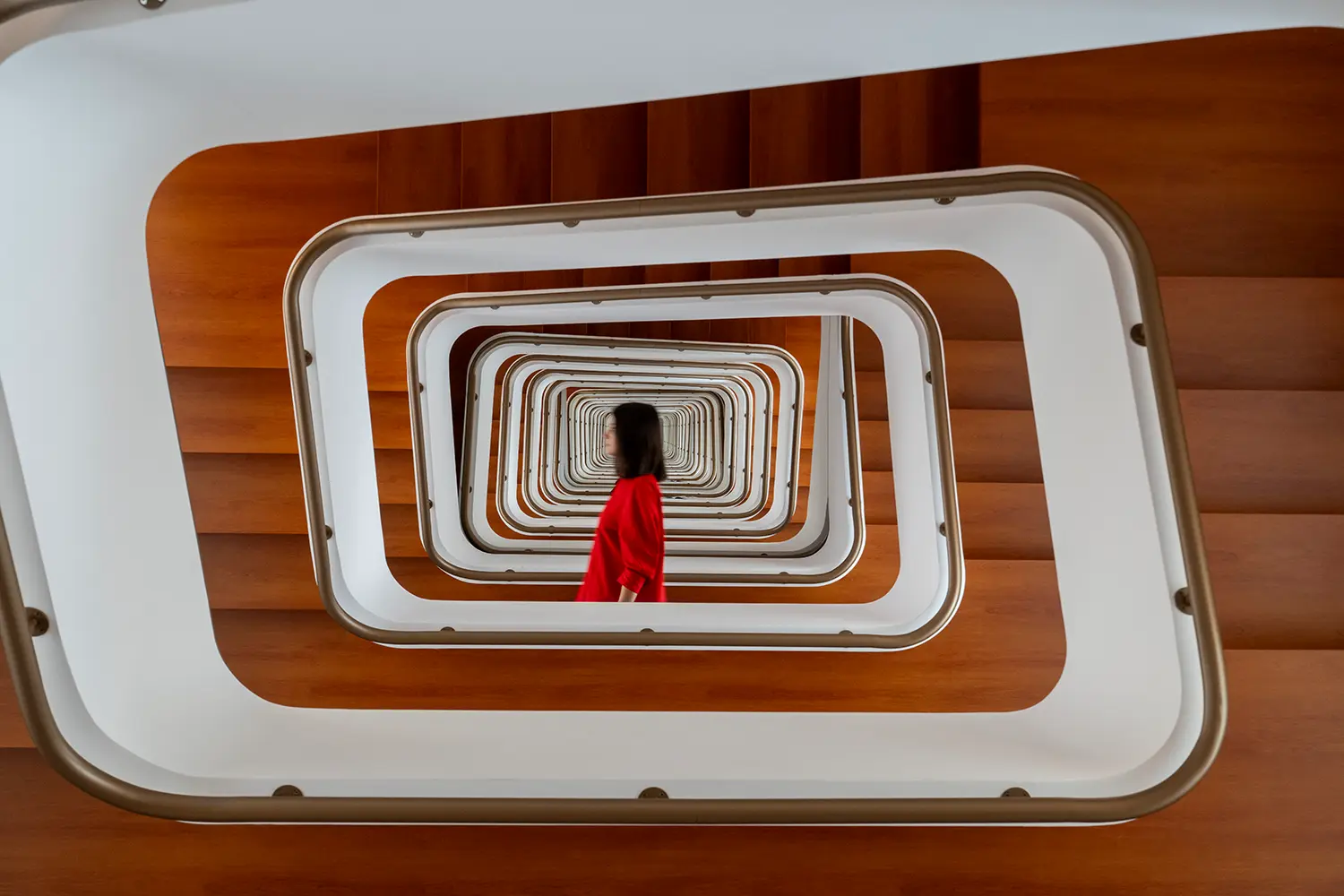
Curator Fabrice Bousteau, director of Beaux Arts Magazine, has structured the retrospective as a progressive erosion of spatial confidence rather than a chronological survey. The sequence moves from darkness and still water to mirrors and empty frames, from horizontal facades to infinite shafts, each room dismantling another assumption about how built space behaves. By the time visitors reach Infinite Staircase — which delivers the precise optical sensation of peering into a bottomless shaft — the body has been conditioned to distrust its surroundings long before the mind finishes processing any individual work.

The participatory logic of Erlich’s practice is what separates him from artists who deploy similar optical mechanisms. His immersive installations are not objects to be photographed from outside — they require physical entry, bodily orientation, and the specific discomfort of standing inside something that is misbehaving. Swimming Pool (1999), documented in the exhibition’s Documentation Room though not installed in the galleries, places a thin layer of actual water over a glass sheet: visitors above see people apparently submerged below; those below look up through rippling water at figures on dry ground. No image captures it. The work exists only in the body’s encounter with it.
Erlich has described his method in terms that bypass aesthetics entirely. “I like to describe myself as a conceptual artist working in the realm of reality and perception,” he said in a statement accompanying the exhibition. “My focus is on reality, symbols, and the potential of meaning. I seek to create a body of work — especially in public spaces — that unlocks the imagination, disrupts normality, challenges representation, and suggests actions that construct and deconstruct situations in order to disrupt reality.” The candor is striking: few artists operating at this institutional scale describe their mechanism this plainly, without mystification.
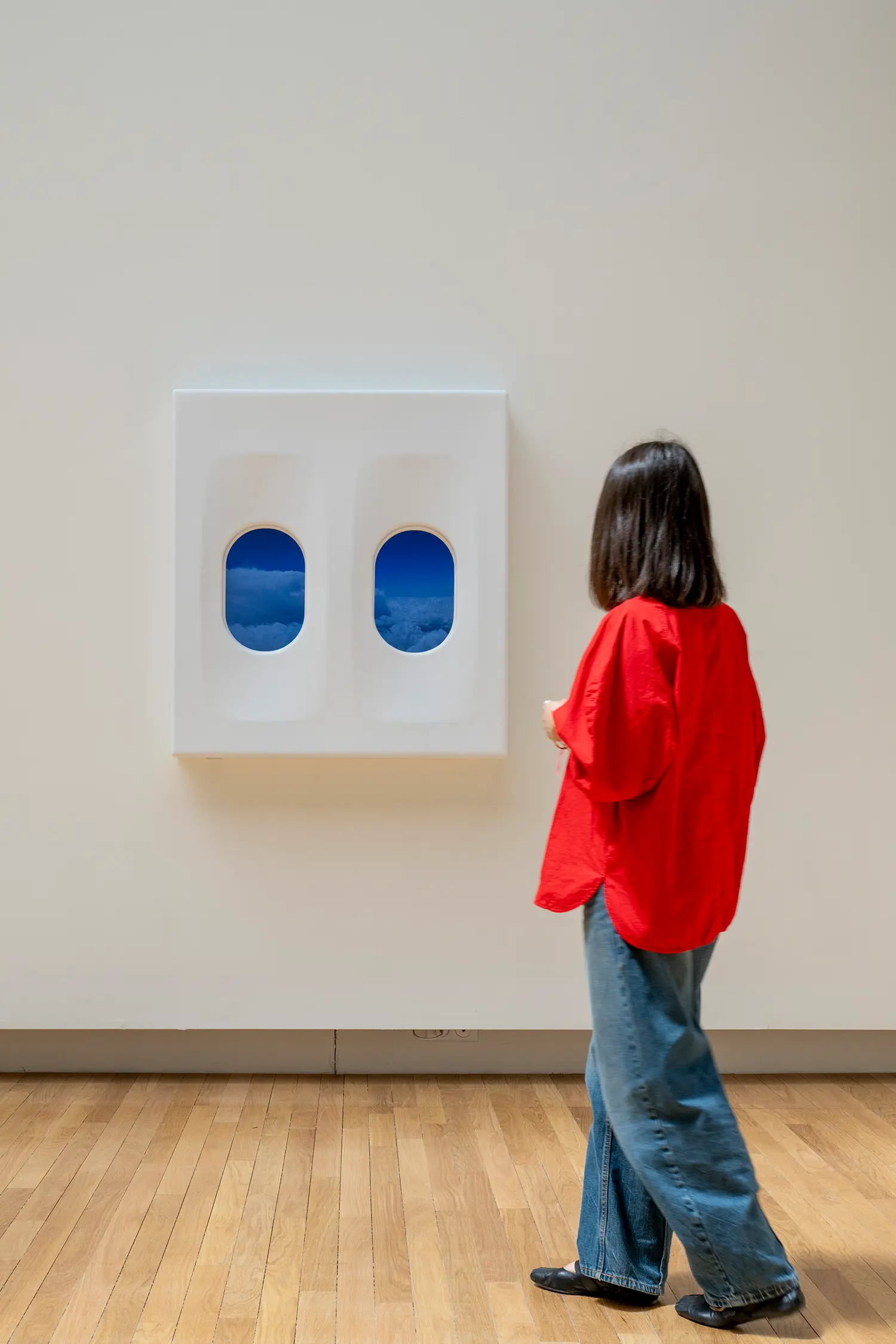
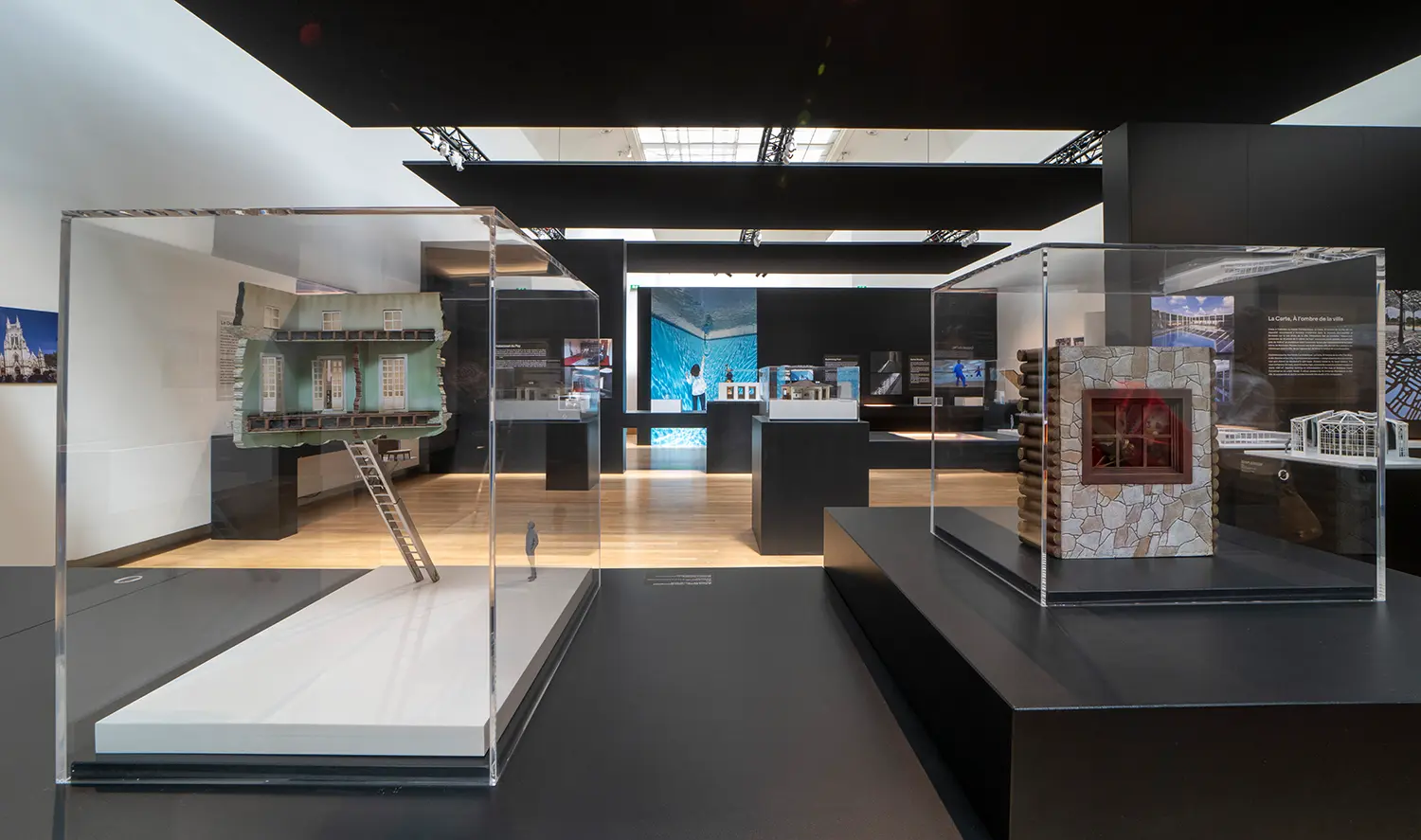
The Documentation Room on the upper level shifts register entirely. Forty-one works spanning 1994 to 2026 are presented as models, photographs, and archival material — including unrealized proposals such as Sablier and Lunas, projects that existed only as intent, never as built experience. The room functions as a critical counterweight to the immersive galleries below, making visible the conceptual architecture behind the physical ones. For visitors who arrived primarily for the spectacle, it is the most demanding section of the show: Erlich without the vertigo, which turns out to be Erlich at his most precise.
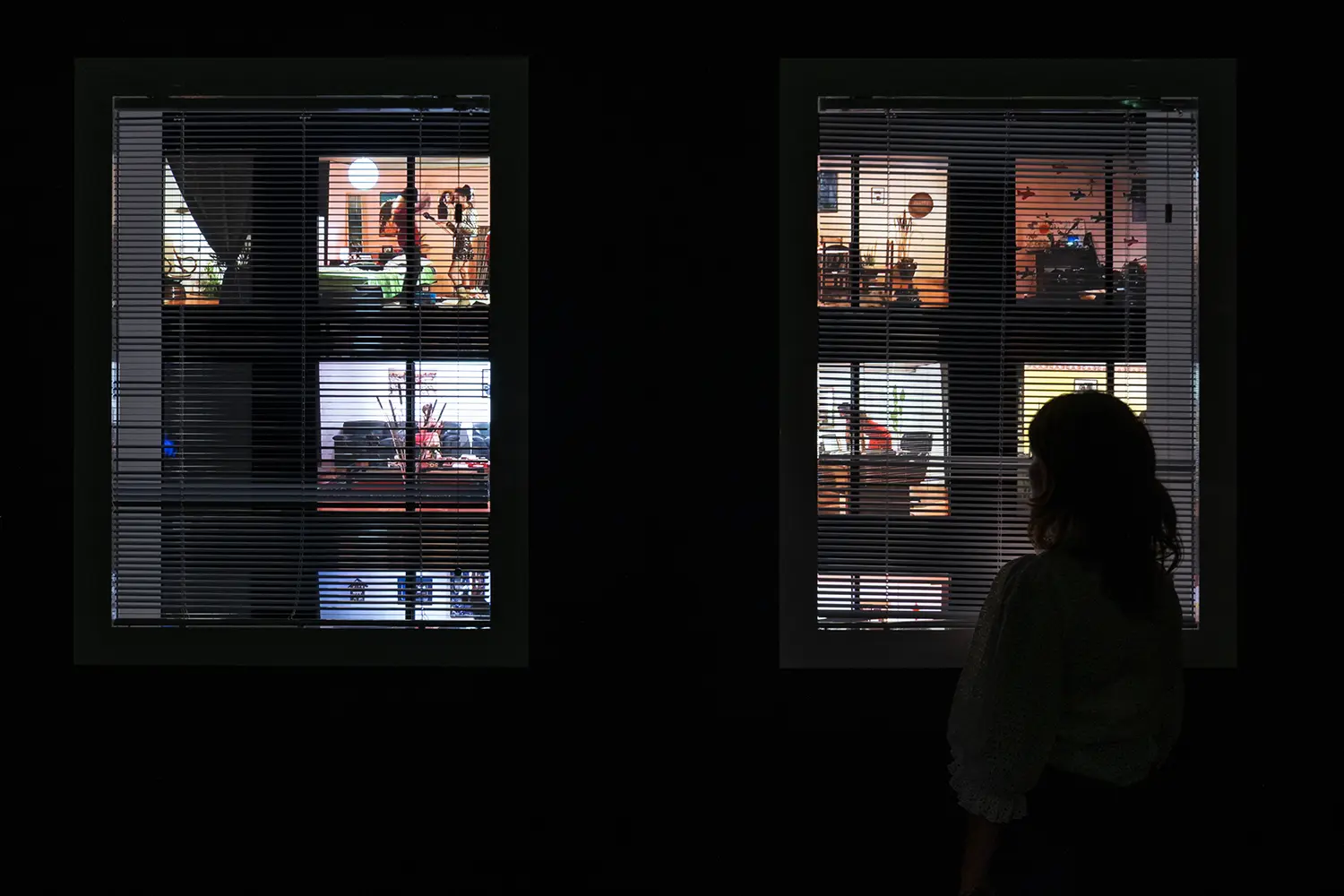
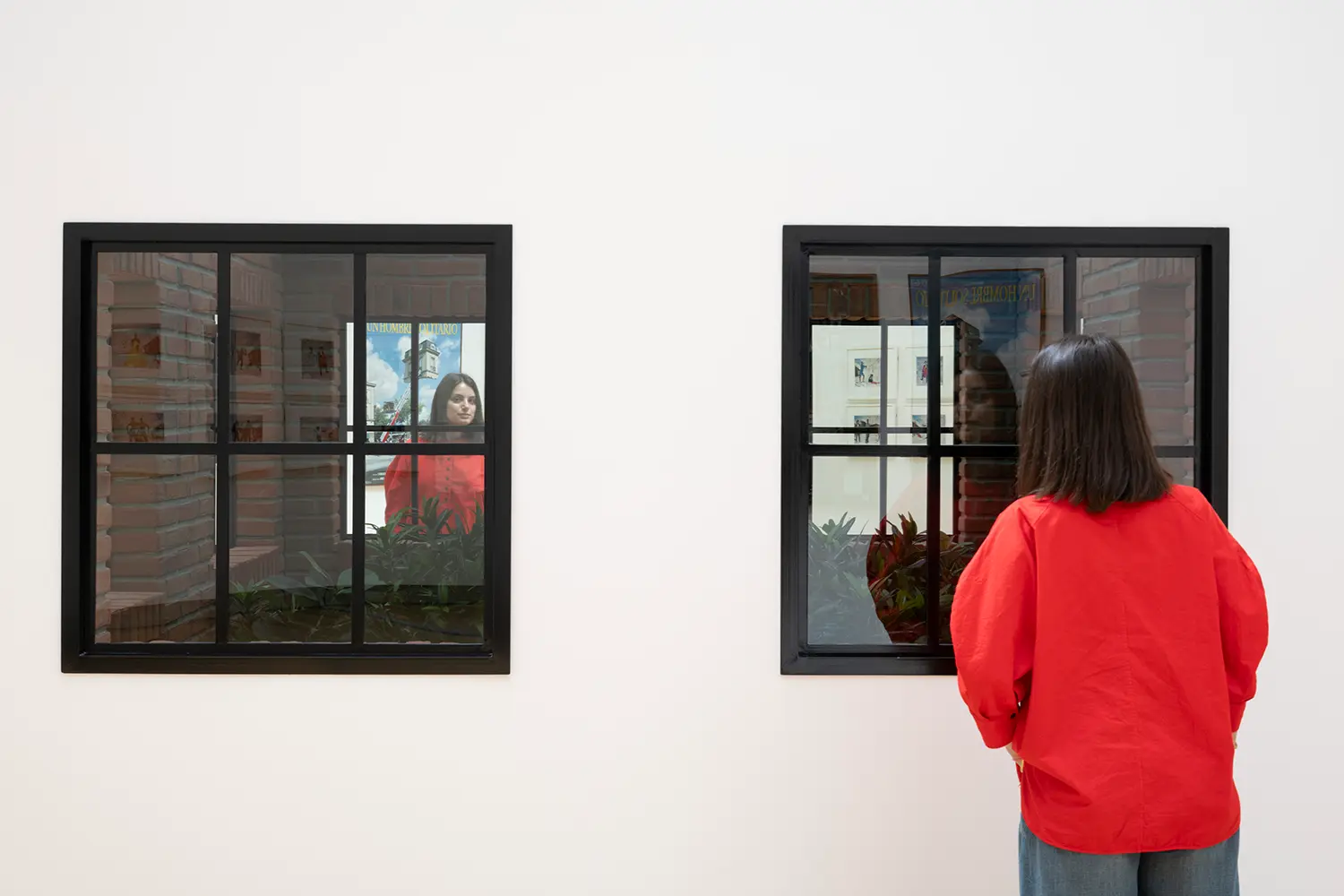
The video sculpture The View presents two apartment windows through which a dozen characters move through the routines of private life — cooking, arguing, watching television — visible through half-closed blinds in the manner of any Paris street after dark. The work occupies the register between urban intimacy and surveillance, using the grammar of the Haussmann block as a compositional device. What Erlich adds is the knowledge that no such neighbors exist: the figures are performers, the windows are constructed, and the voyeuristic impulse the piece triggers is both invited and implicated in the same gesture.
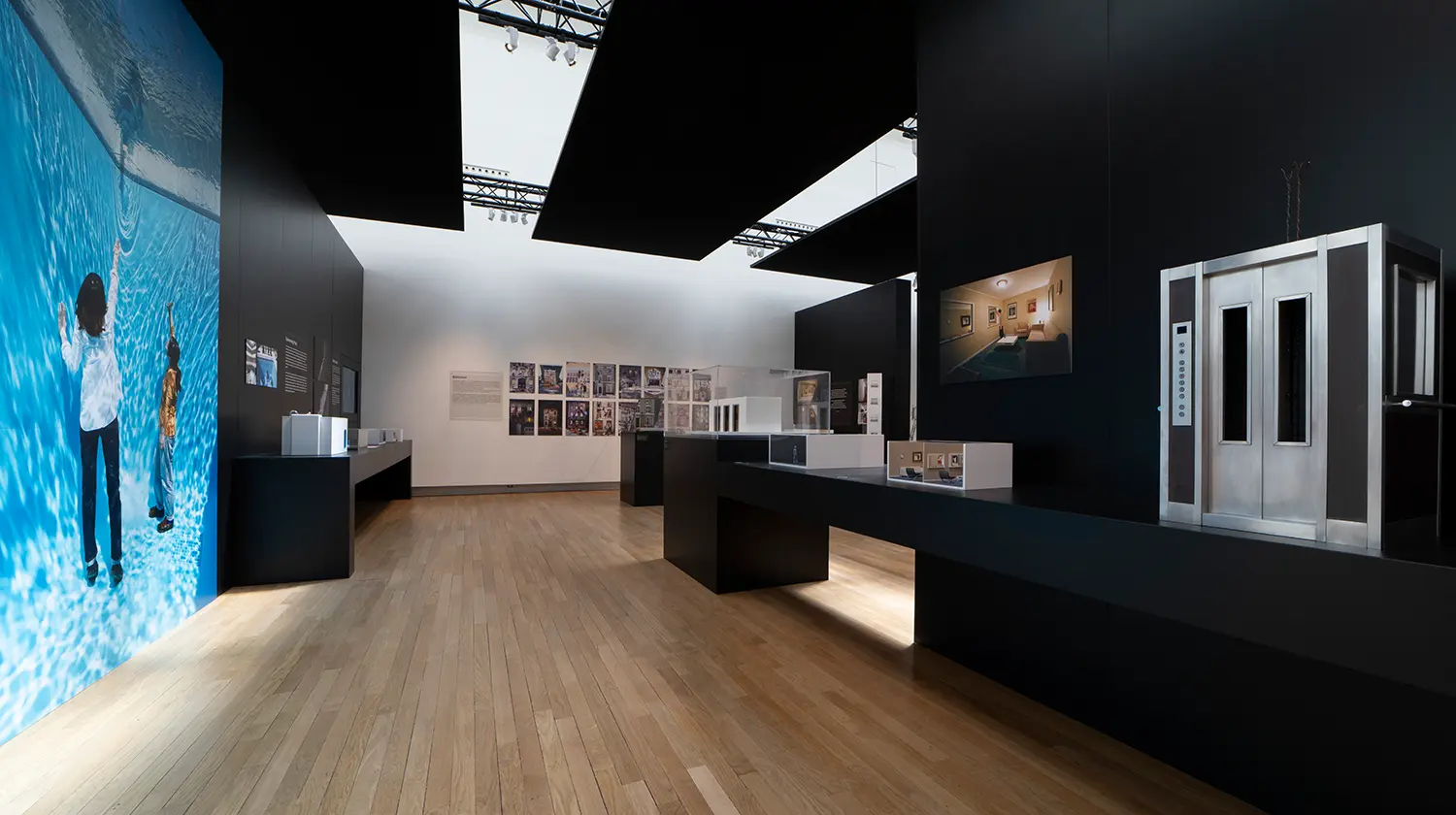
A sound installation threaded through the Grand Palais’s own staircase turns the building’s circulation infrastructure into a medium. Voices and ambient fragments of communal life are layered into the architecture so that the act of moving through the building — the most unremarked thing a visitor does — becomes charged with narrative and spatial uncertainty. It is among the most understated works in the retrospective and one of the most effective: it extends the exhibition beyond its gallery walls into the host structure itself, making the Grand Palais momentarily complicit in its own destabilization.
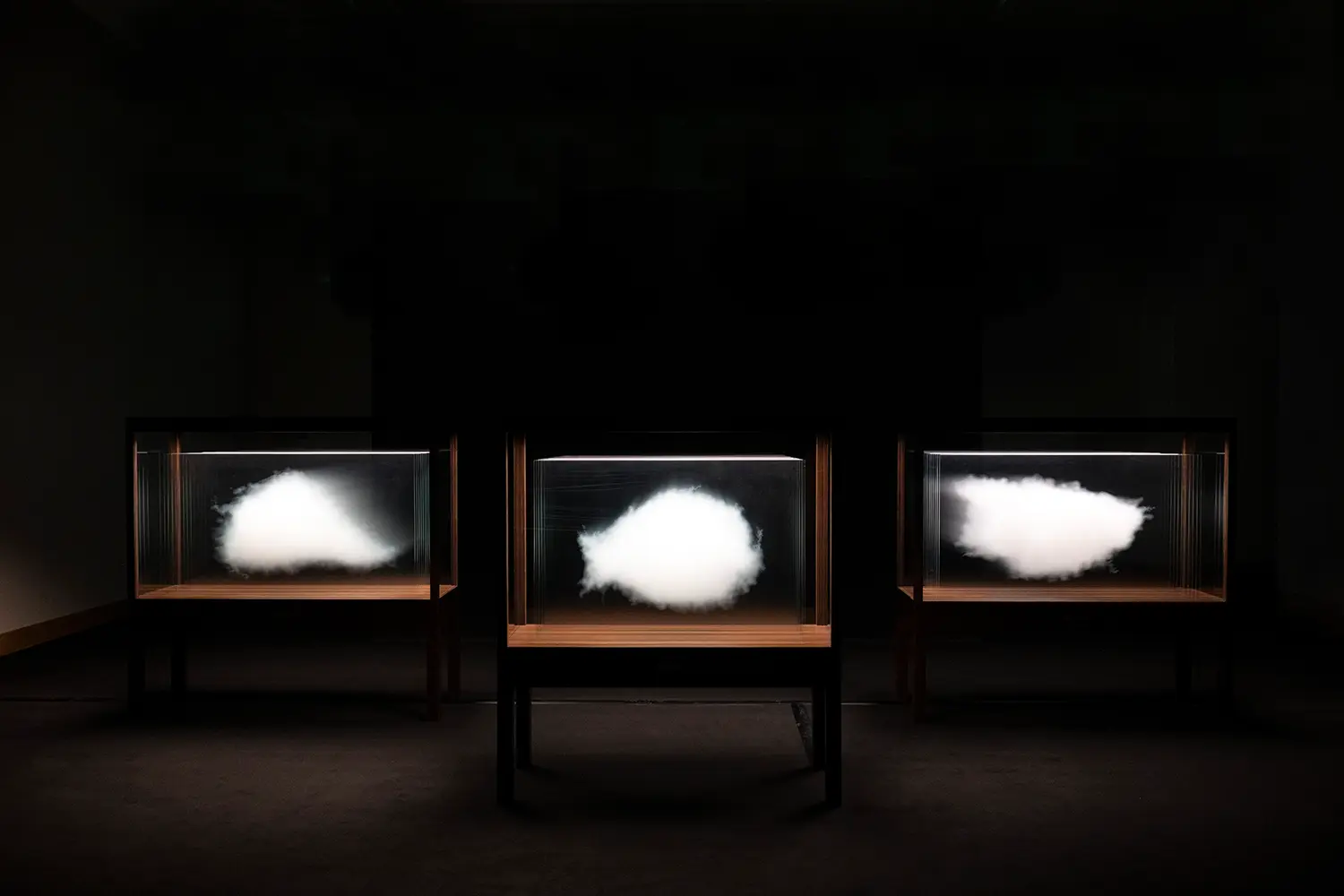
The Cloud, suspended from the ceiling in a state of absolute stillness, extracts a weather phenomenon from its natural context and deposits it inside an institutional volume, made strange not by transformation but by category error. Erlich has placed versions of it in permanent collections — notably at the Voorlinden Museum in the Netherlands — where outdoor adjacency softens the dissonance. Here, enclosed within the neoclassical height of the Grand Palais, the work is both more visible and more confined: a cloud with nowhere to go, which is, depending on how you read it, either the premise of an installation art piece or the description of Paris at the height of summer.
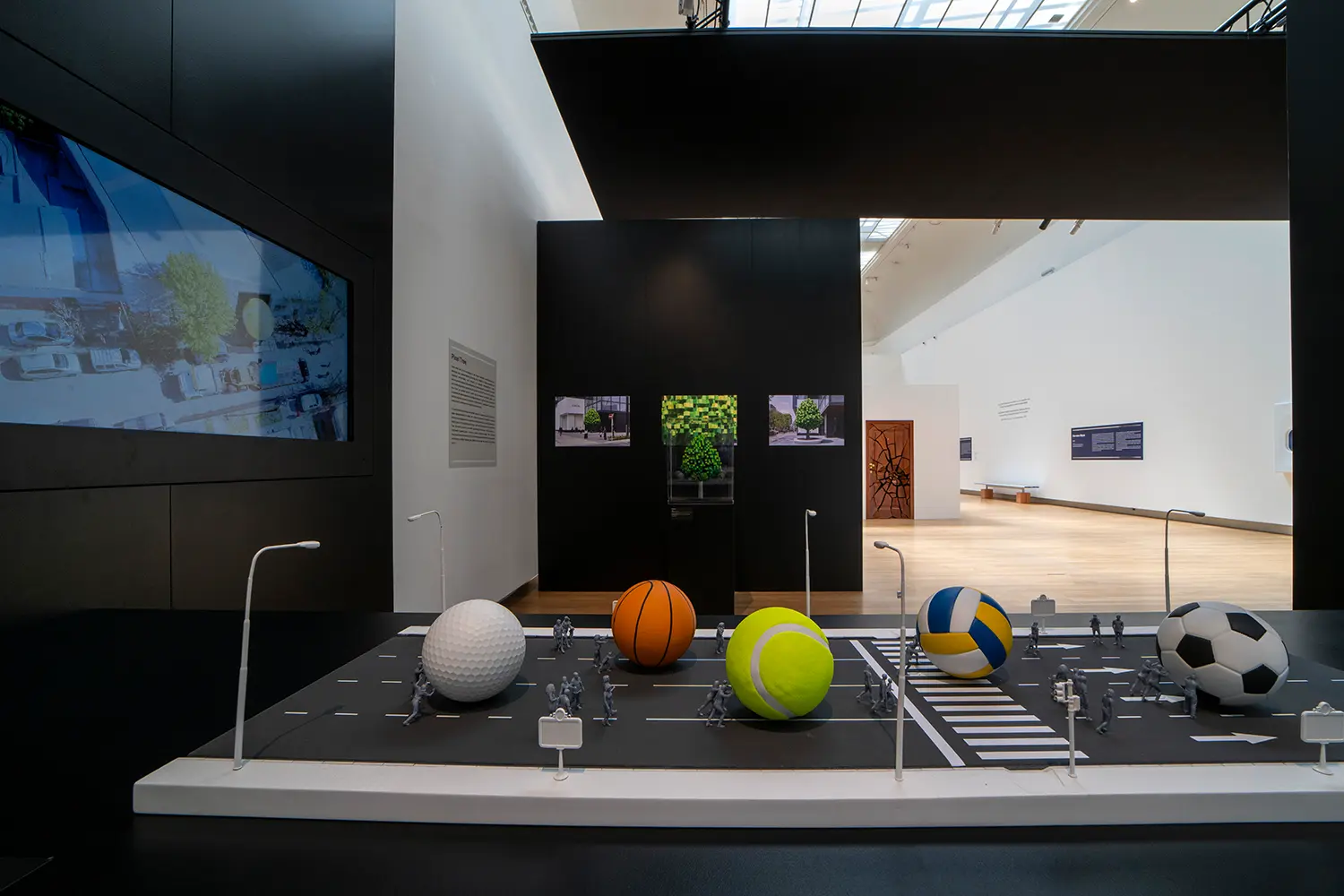
The retrospective’s accumulated institutional weight gives the fourteen works a density that a first encounter would not provide. Presentations across Buenos Aires, Tokyo, Miami, Milan, and Helsinki preceded the Paris show, the largest European retrospective dedicated to Erlich to date; this is not an introduction but a settlement, a confirmation that the practice holds at scale and across cultural contexts — from Japanese museum pavilions to Latin American public squares to the vaulted galleries of one of Paris’s most consequential exhibition spaces. The show opened on 2 June and runs through 6 September 2026.
Erlich is represented by Galleria Continua and Xippas Galleries, both of which have sustained his European practice for over two decades. The institutional lineage matters: his career has been built by organizations that understood early that accessibility and conceptual rigor were not mutually exclusive — a claim that remains contested in parts of the contemporary art world, where the popularity of his most widely photographed works is occasionally cited as evidence of their limits. The perceptual installation as a genre is not widely defended in criticism; this retrospective is, among other things, a challenge to that skepticism.
What the installations share — across subject, scale, and medium — is the choice of architecture as an instrument of doubt rather than its object. Erlich does not depict buildings; he deploys them. The Haussmann facade, the elevator shaft, the harbor embarcadero are not representations of familiar space but functioning physical environments engineered to fail at a calculated moment, producing the specific sensation of a system that was trusted and then wasn’t. That experience has no equivalents in painting or film, which is why the photographs that have made Erlich’s reputation communicate so little of what the practice actually does — and why those photographs, paradoxically, continue to fill the internet.
The summer timing positions the retrospective at the center of a deliberate repositioning: the Grand Palais, having invested a decade in becoming a monument again, is now making the case that large-scale immersive contemporary art belongs in its program as a primary offering rather than a complement to historical blockbusters. The exhibition is open daily from 10am, with late-night opening on Fridays until 10pm; tickets are priced from €19, with concessions available for younger visitors. The circuit of fourteen installations runs to roughly ninety minutes — efficiently calibrated for a summer audience that may or may not have arrived prepared for what is, structurally, a sustained attack on their spatial confidence.
The sharpest question the retrospective leaves open is not about Erlich’s work but about the frame around it: whether the Grand Palais — having invested heavily in its own reinstatement as a monument — is the right container for an artist whose entire practice is devoted to making people stop trusting monuments. The friction is genuine. The fact that both parties appear untroubled by it may be the most interesting thing about the exhibition.
Leandro Erlich | Where: Grand Palais, Galleries 9.2, 10.1 and 10.2 — Avenue Winston Churchill, 75008 Paris | When: 2 June – 6 September 2026