



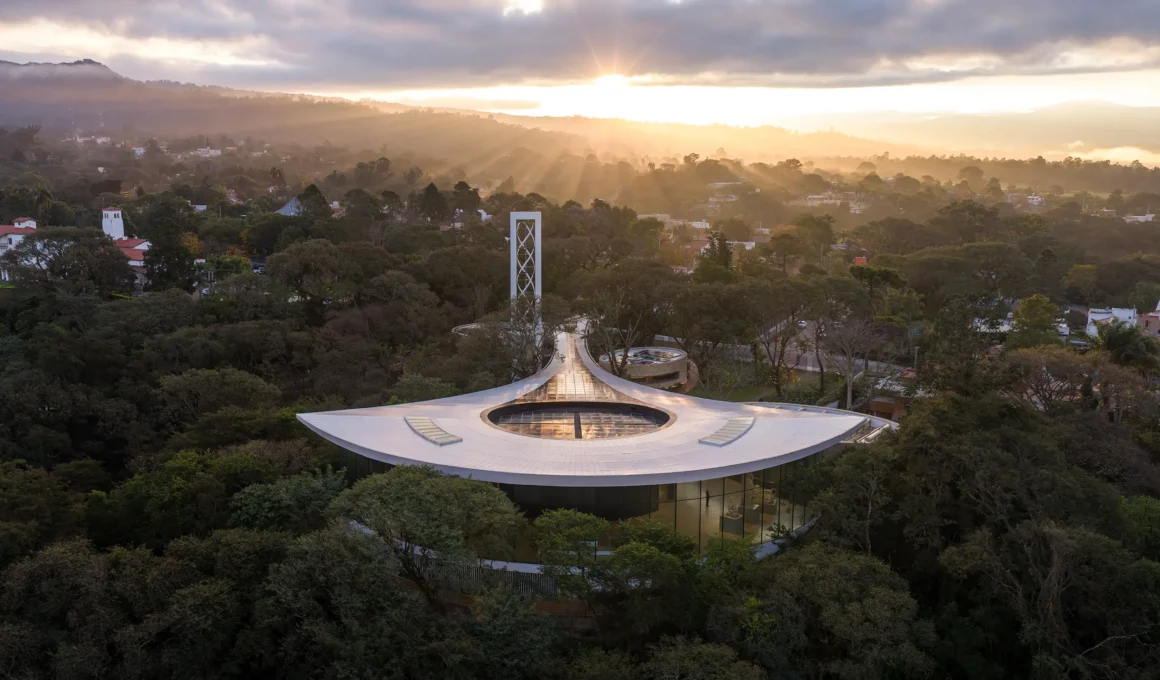
Six marble sculptures stood outdoors in northwest Argentina for more than a hundred years, and the building Pelli Clarke & Partners has finally raised to shelter them is made largely of glass. The Lola Mora Cultural Center in San Salvador de Jujuy is the New Haven and New York practice’s first cultural building in South America, and the last project led by its Argentine-born founder, César Pelli, who died in 2019. Completed seven years after his death, the center was carried to completion by his son, Rafael Pelli, now Partner at the firm — a detail confirmed directly to urdesign by the practice. Enclosing the works meant keeping the forest and the mountains they weathered under in full view.

A narrow entrance opens onto a bridge that spans a natural ravine, engineered to minimize disruption to the land beneath it. From there the section widens gradually until it reaches the main lobby, so the approach to the cultural center in Jujuy is a compression followed by a release rather than a threshold crossed in one step. The building is entered across a gap in the terrain before it is entered at all.

The curving form follows the topography of the site, at the foot of the Andes and surrounded by dense subtropical Yunga forest, overlooking the city from a slope it does not flatten. The plan bends to embrace an existing grove of native trees, which is to say that the trees were there first and the geometry gave way. The architecture is woven among them rather than laid across them.

Floor-to-ceiling windows clad the main exhibition hall, allowing the sculptures to be seen from multiple angles and distances against a backdrop of forest and mountains. “The building’s internal layout was designed so that Lola Mora’s works are gradually revealed, alternating between distance and proximity, between viewing them in groups and encountering each sculpture individually,” said Axel Zemborain, the project’s Design Team Leader. The same withdrawal governs a Chinese art center dispersed as pavilions through a forest, where the glass-walled exhibition hall stops competing and lets the work and the landscape be read together.

What the hall holds explains the rest of the building. The Lions, Liberty, Progress, Work, Peace and Justice, monumental neoclassical figures carved in Carrara marble by the Tucumán-born Argentine sculptor Lola Mora, were commissioned in 1906 for the inauguration of the Palace of the Argentine National Congress in Buenos Aires, removed fifteen years later, and donated to the province of Jujuy, where they have stood exposed to the elements ever since. They are together for the first time in over a century.

Buildings raised around a single body of work carry a particular burden, one shared by museums such as a clay museum built for a Chinese pottery city, where the architecture answers to what it holds rather than the reverse. Here the collection arrived first by more than a hundred years, and the program around it runs to an interpretation center, a restaurant, a library, a gift shop and an atelier for visiting artists. Museography was handled by MUDE and lighting by Cappiello + Partners, with Arturo Beccar Varela & Asociados as architect of record for the Government of the Province of Jujuy.

A vertical tower answers the horizontal mass, signals the center from a distance, and houses five wind turbines. With photovoltaic panels and solar thermal collectors for hot water, the net-zero cultural building generates one hundred percent of its energy needs, while a high-performance envelope and mechanical systems cut consumption by twenty-three percent. A rainwater-harvesting system feeds irrigation, small dams across the ravine slow runoff and hold back erosion, and the project is pursuing LEED Gold.

The gardens on the 1.3-hectare site (3.2 acres) were designed by Balmori Associates, the landscape practice founded by César Pelli’s late wife, Diana Balmori, and a significant portion of the materials, including the stone cladding, was sourced locally. “We approached the project as a process of discovery and, above all, as the art of knowing how to listen: to the site; to the client; to the engineers, builders, and craftspeople, whose knowledge shapes what can be built,” said Susana La Porta Drago, partner in charge of the project at Pelli Clarke & Partners. The founder was a native of the Argentine Northwest and knew Lola Mora’s work from childhood, which for the family made the commission something other than a job. “To create a space that celebrates and carries forward her legacy, in a community so close to my heart, is a true privilege,” said Rafael Pelli, Partner at the firm.

Marble records what happens to it. A hundred years of sun, rain and mountain air have left their evidence on six figures carved for an interior in Buenos Aires and never installed there, now standing indoors above San Salvador de Jujuy. The weather they came through is on the other side of the glass.
Lola Mora Cultural Center by Pelli Clarke & Partners | Location: San Salvador de Jujuy, Jujuy Province, Argentina — Year: 2026 — Key materials: locally sourced stone cladding, glass