



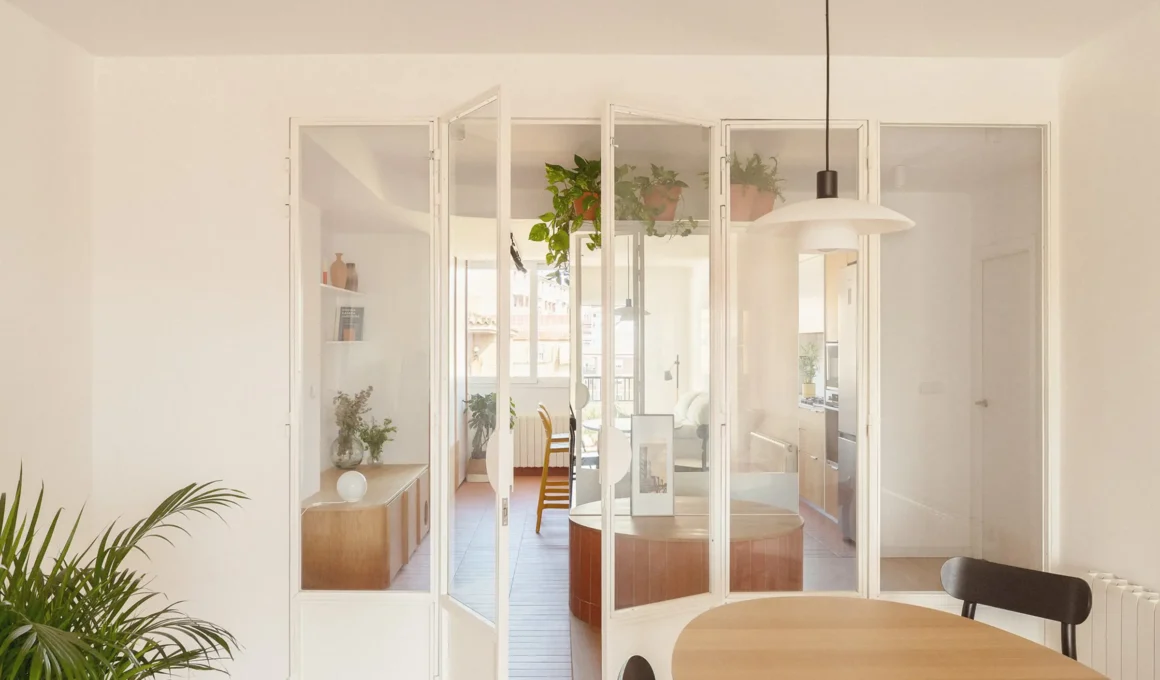
The challenge of transforming an outdated 1980s apartment, plagued by excessive doors and a dark, compartmentalized layout, fell to La Cooperativeta Arquitectura in the heart of Valencia, Spain. The new occupants, Vane and Dídac, along with their two feline companions, sought more than just a fresh coat of paint; they needed an emotional shift. Their brief demanded an apartment that would break its inherent rigidity, become a genuinely comfy spot for hosting friends, and, crucially, provide elevated viewpoints for the cats—all while preserving the integrity of the existing private rooms. The result is the Pinazo 19 apartment, a masterclass in reconfiguring space through strategic, minimal additions.

The genesis of the entire interior renovation hinges on a single, unconventional demand: storage for bicycles. Its eventual dimension and location became the central axis structuring the entire project, allowing the owners to organize their lives and activities without interruption. By adding simple elements like shelves and a seat, this structural challenge evolved into a key piece of multifunctional furniture. It defines the entrance hall, serves as a trunk, a place to take off shoes, and supplements kitchen storage, subtly providing privacy while neatly hiding the bikes. This custom-made storage device shapes the space, proving that utility can be the ultimate driver of poetic contemporary design.

A critical move was ensuring this new device, which anchors the communal area, does not reach the full ceiling height (except where it integrates an existing downspout). This deliberate void emphasizes the visual and spatial connection between formerly isolated rooms, allowing the daylight zone to feel like one continuous, end-to-end space. This optimized volume drastically improves natural light penetration and facilitates necessary cross-ventilation across the facade, achieving a feeling of open-plan living without major architectural intervention in the private quarters.

The firm further refined the spatial geometry using two distinct horizontal planes. A beautiful, gentle curved ceiling defines different heights, subtly guiding the flow and use-space relationships. Below, the material distinction of the floor engages in a dialogue with the base of the furniture, emphasizing the continuous connection between the kitchen, entrance hall, and living room. Floor and ceiling collaborate to form a precise geometrical design that contracts or expands the perceived area. This spatial configuration is unified by a consistent 48 cm high baseboard—an unassuming but powerful unifying element whose material cleverly shifts with its location.

The redesigned kitchen is now the undisputed center for social gathering and daily operations. It features a central island for work and leisure, placed adjacent to the custom-made piece that artfully splits the space. On one side, the fully equipped cooking area boasts warm oak finishes tailored to Vane’s culinary passions. The opposite side, more open and connected to the dining area, features a longitudinal storage strip with a unique handle solution that emphasizes rhythm and seamlessly extends the aesthetic into the entrance. The lower part of this element cleverly doubles as somewhere to sit and, charmingly, a perfectly camouflaged hideaway for the household’s other protagonists: the cats.

This unifying material language extends to the dining room’s steel doors. They feature opaque elements, contributing to a continuous enclosure, while their central structure uses the same rhythm and meeting of materials seen elsewhere. A mirror placed above the sitting area creates a visual full circle—a formal tribute to the project’s leitmotifs, completed by the circular design of the door handles when closed. When fully retracted, these doors transform the area into a single, dominant space flooded with light and reflections. In stark contrast to the main living area, the bathroom boldly detaches itself, utilizing smaller white tiles up to the mirror and glass screen, transitioning above that line to larger, soothing green pieces—a deliberate material and color shift creating a relaxed and highly contrasted interior in this innovative Spanish design by La Cooperativeta Arquitectura.