

Plywood spent decades as the material building sites hide behind drywall — five recent kitchens across Europe now put it directly on display, unfinished edges and all. From a 1936 modernist flat in Switzerland to a hempcrete-insulated refuge in Brussels, architects are choosing plywood not as a budget compromise but as the primary finish a kitchen is built from, layered edges and grain fully exposed rather than concealed behind lacquer or veneer. The pattern says something about where kitchen design is heading: honesty about construction is becoming more desirable than the illusion of a seamless surface. Our earlier look at bespoke kitchen cabinetry as a spatial argument covers the broader shift away from treating the kitchen as a neutral, disappearing surface — plywood is one of the clearest material expressions of that same instinct.
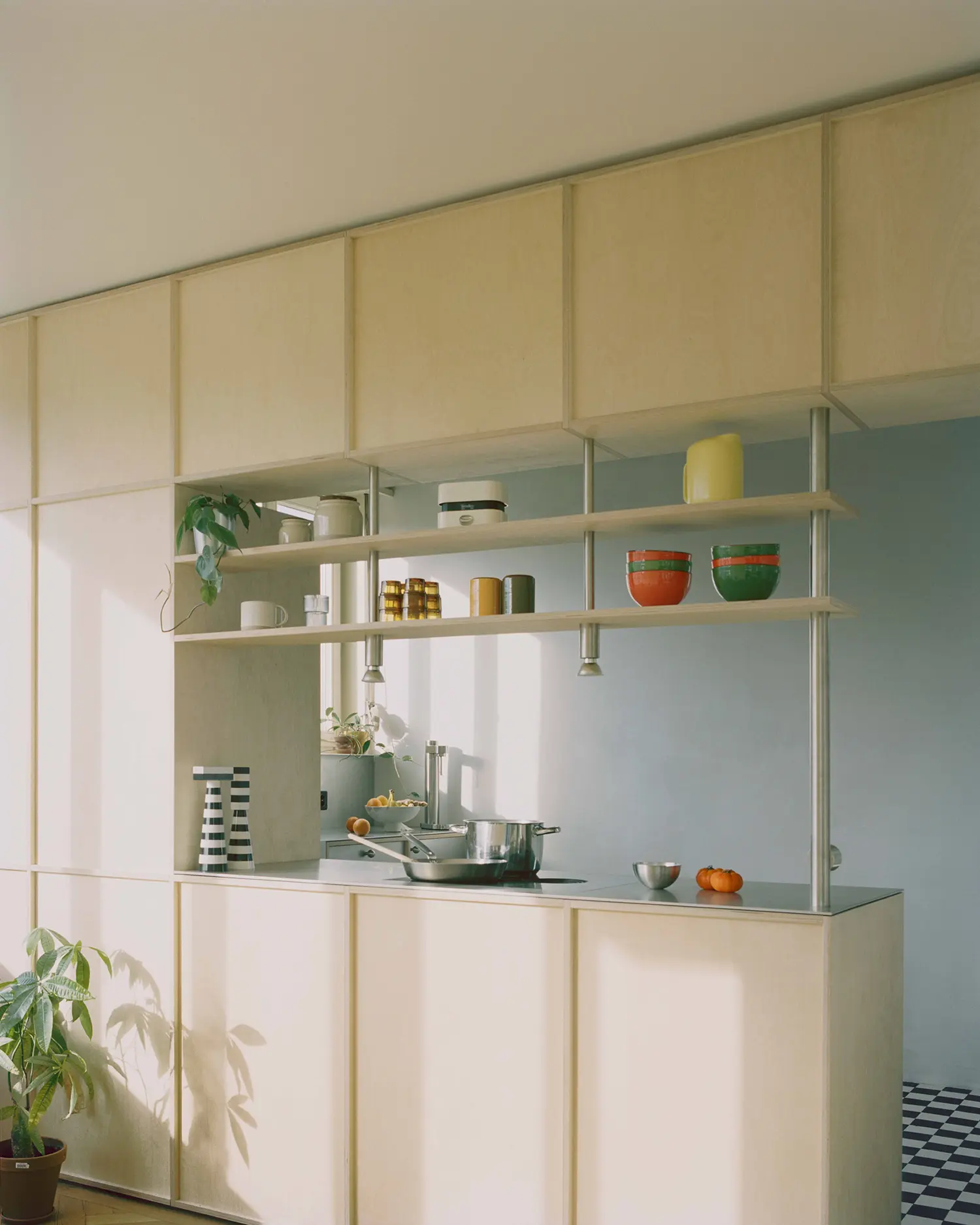
Noue Studio treats plywood as a structural instrument rather than a cabinet finish inside a 1936 modernist apartment in Fribourg, Switzerland — the first modern building constructed in the city, now protected as a heritage asset. A wall-height joinery system in birch plywood kitchen cabinetry runs floor to ceiling, replacing a sealed partition that had accumulated over decades of renovations, with closed panels above and below and open shelving at cook’s eye-level. The kitchen doesn’t sit behind a wall here — the plywood system is the wall, connecting the cooking zone to the dining area through material continuity rather than an opening cut into solid drywall.
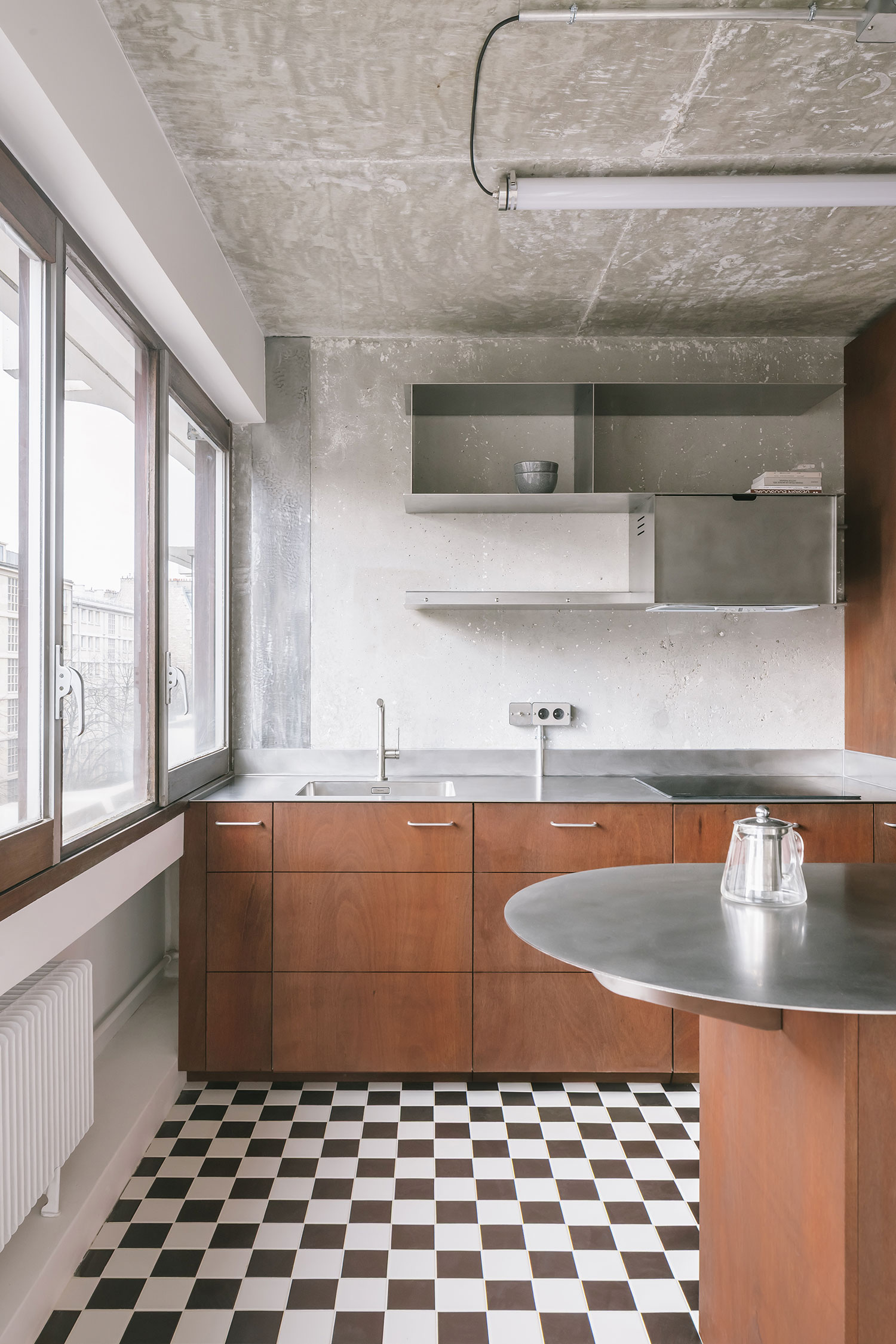
Atelier Apara went further into industrial territory for a 1969 apartment renovation in Paris’s 15th arrondissement, choosing okoumé plywood — a material more commonly associated with boatbuilding than kitchen cabinetry — for the full run of kitchen units. The rich, reddish-brown grain sits against stainless steel counters and a black-and-white checkerboard tile floor, deliberately avoiding the softer, paler birch tone that dominates most plywood interiors. The choice signals plywood’s range: the same base material can read as warm and Scandinavian in one kitchen and as raw, workshop-grade in another.
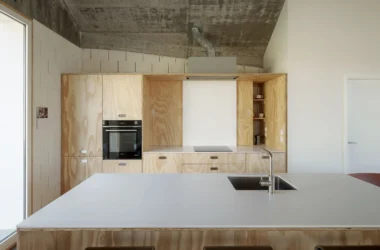
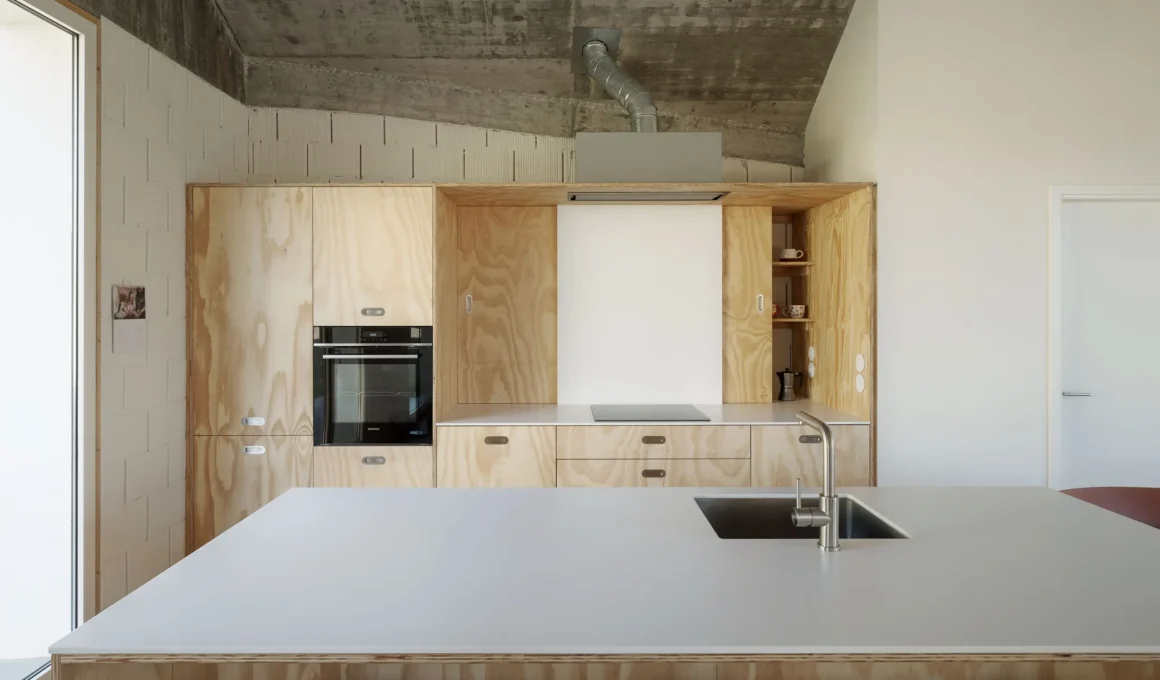
Sinaldaba covered an entire kitchen wall in pale plywood carpentry for Cecebre House, a rural home built into a sloping site in Cambre, Galicia. Cabinets, integrated ovens, and open display niches all share the same material, softening what the studio describes as an otherwise industrial palette of concrete ceilings and exposed blockwork. Working with a limited construction budget, Sinaldaba used the plywood’s warmth to counterbalance the raw structural surfaces surrounding it — proof that the material’s practicality and its aesthetic appeal aren’t separate arguments but the same one.
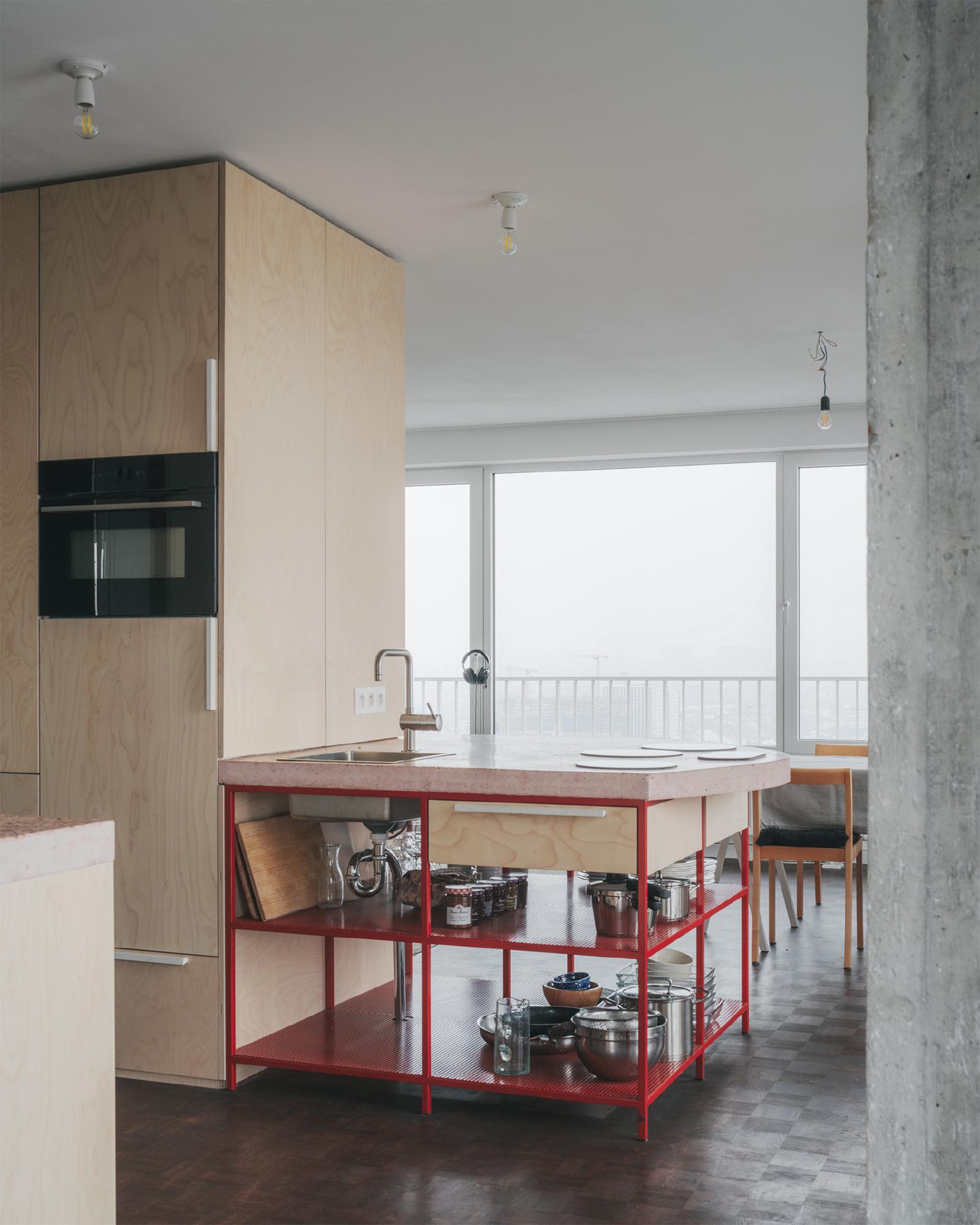
Altstadt built the kitchen as a freestanding sculptural volume rather than a wall of cabinetry inside a hempcrete-insulated apartment in Brussels. A block of plywood joinery in kitchen design, framed in red steel with a concrete countertop, anchors one corner of an otherwise fully open plan, concealing the building’s technical shafts inside its mass. The apartment’s insulation — hempcrete and cork — reflects a broader commitment to bio-sourced construction that extends naturally to plywood as a finish: both materials trade synthetic uniformity for visible, honest texture.
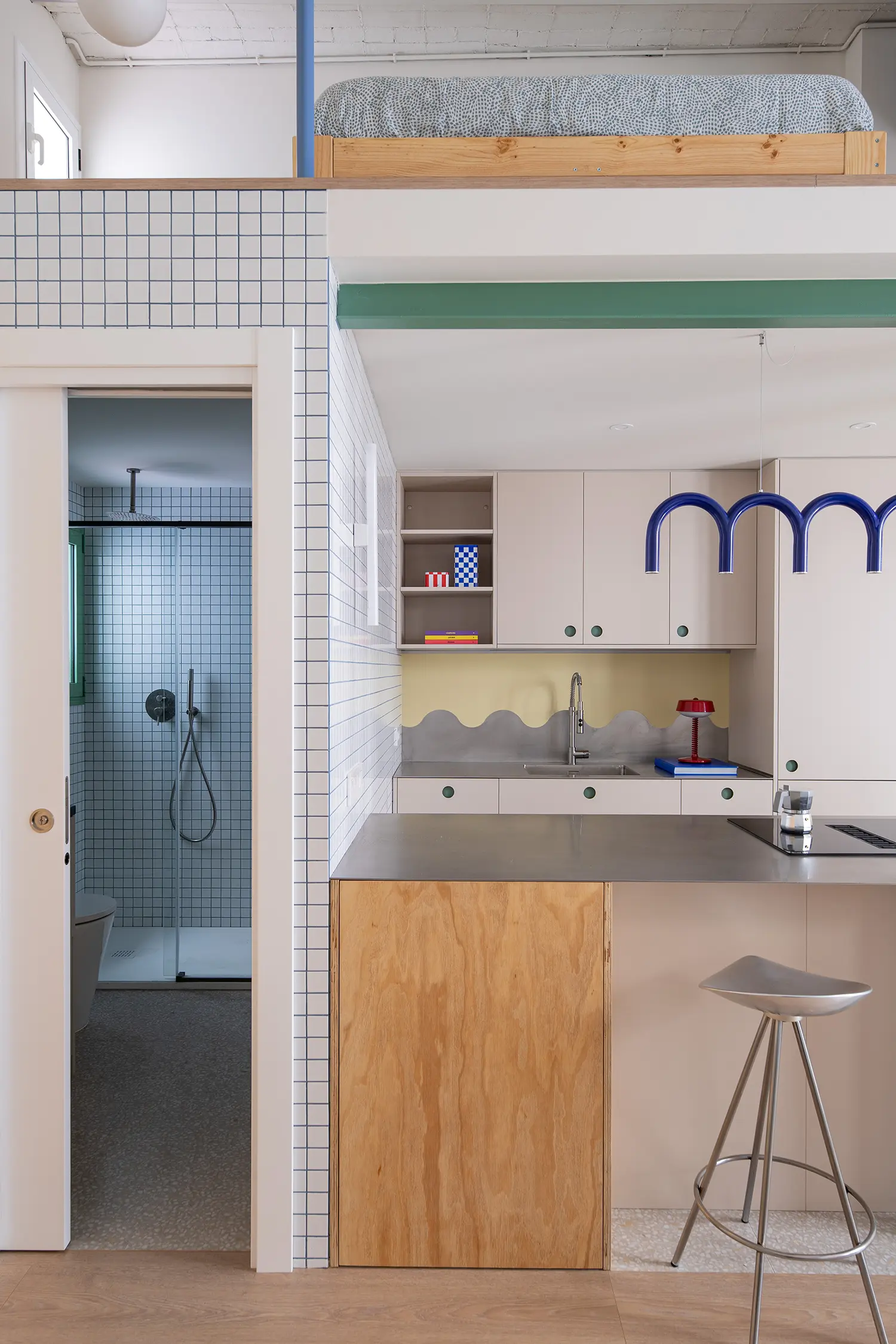
Not A Studio used plywood more sparingly inside a 36-square-meter (388-square-foot) flat in Barcelona’s Sarrià neighborhood, applying it as a grounding panel at the kitchen’s base rather than across the full cabinetry run — the same material reappears in a custom staircase elsewhere in the apartment, tying the compact plan together through a single recurring surface. Paired with a METOD kitchen framework and a custom steel countertop, the plywood panel functions as one note in a broader material palette rather than the kitchen’s defining surface, showing that plywood doesn’t need to dominate a room to register as a deliberate choice.
What unites all five kitchens is a refusal to sand plywood’s construction logic away. None of these projects paint over the layered edge, route a decorative profile into the panel face, or hide the material behind a veneer that pretends to be something else. The exposed edge — visible cross-section, alternating grain — has become the detail architects choose to leave in, not the flaw they engineer out.
The range across these five projects also argues against treating plywood as a single, interchangeable material. Birch reads pale and Scandinavian at Noue Studio; okoumé reads dark and nautical at Apara Convention; the same base construction produces entirely different atmospheres depending on species, finish, and how much of the kitchen it’s asked to cover. A material once reserved for subfloors and shuttering now carries enough range to define five kitchens that look nothing alike.
Plywood’s appeal in 2026 isn’t really about cost, even where budget constraints genuinely shaped the decision, as at Cecebre House. It’s about a growing preference for materials that admit how they were made — a preference that runs directly counter to the seamless, gapless kitchen surfaces the industry spent the last two decades perfecting. Five kitchens built the same year suggest that preference isn’t a coincidence.