



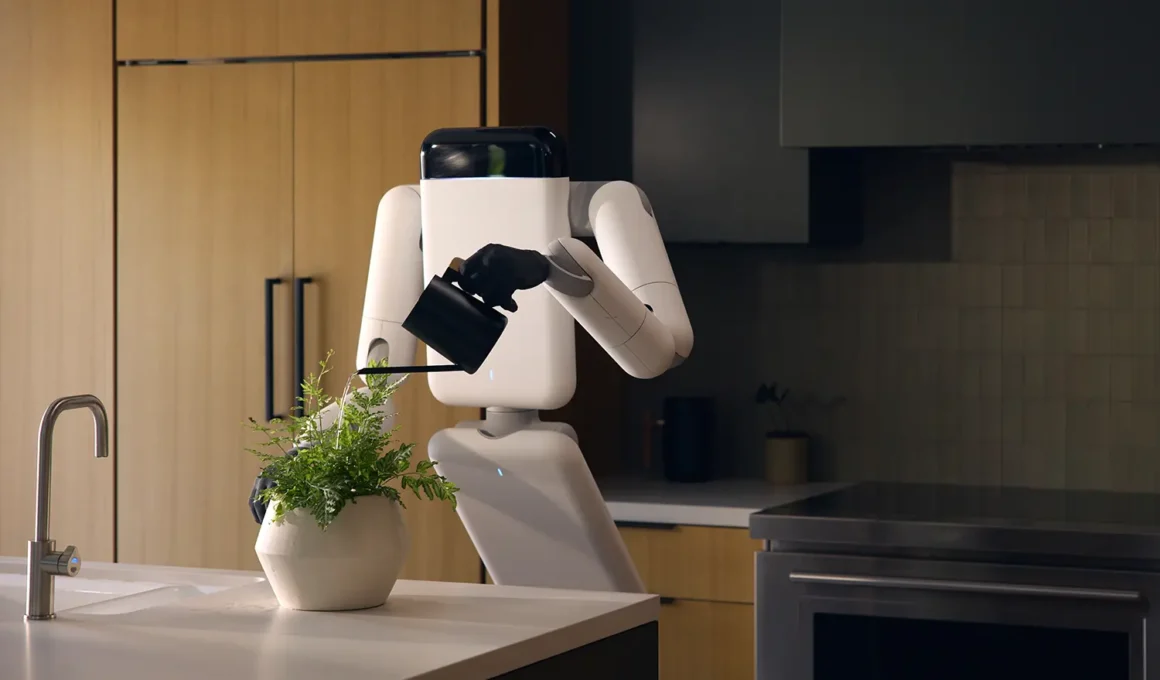
Genesis AI has unveiled Eno, its first general-purpose robot, and its most deliberate decision was refusing to give it a human shape. Instead of legs, a head, or a face, Eno moves on a wheeled base topped by a tower of articulated panels that rises to working height and folds down when the robot is idle — a form built specifically to sidestep the exposed-joint, human-mimicking aesthetic that dominates the current wave of humanoid robotics.
Founded in December 2024 by CEO Zhou Xian, a robotics PhD from Carnegie Mellon, and Théophile Gervet, a former research scientist at Mistral AI, Genesis AI emerged from stealth in July 2025 as a physical AI company with a $105 million seed round co-led by Eclipse Ventures and Khosla Ventures. Bpifrance, HSG, Eric Schmidt, Xavier Niel, MIT roboticist Daniela Rus, and computer vision researcher Vladlen Koltun also backed the round — an unusually research-heavy investor list for a robotics startup barely a year and a half old.

Rather than mimicking a person, Eno was designed around human capability — prioritizing mobility, dexterity, and real-world function over anthropomorphic detail. There is no face, no eyes, no synthetic expression built to read as friendly, a sharp departure from robots like Fauna Robotics’ Sprout, which leans into expressive, almost cartoonish features to seem approachable. That choice sidesteps the uncanny valley problem altogether rather than trying to design around it: the mechanical components that most humanoid robots leave exposed are instead hidden inside a minimal shell, giving Eno a restrained, tool-like presence closer to industrial design than to science fiction.

Daniel Hundt led that restraint. Genesis AI’s Head of Design, previously at autonomous vehicle company Nuro, explains the thinking behind Eno’s pared-back form: “When designing Eno, we started with the question of what it needed to be,” said Hundt. “We reduced the form to its essential elements so that every detail serves a purpose, from the way it moves between environments, to the precision, range and sensitivity required to operate alongside people in the real world.”

At the center of the system are Genesis AI’s proprietary dexterous robotic hands, built to match the size, shape, and range of motion of a human hand rather than the two-finger grippers common across the robotics industry. Each hand carries 20 active, back-drivable degrees of freedom, allowing Eno to grip, rotate, and manipulate the same tools, door handles, and containers already designed for people — without requiring any environment to be re-engineered around the robot.

The tower above the base adjusts height and reach in real time, extending to working height for tasks and folding down to roughly the size of a checked bag for storage or transport. That folding mechanism is as much a logistical decision as a design one: Genesis AI has said industrial customers explicitly asked for a general-purpose robot that could move through standard warehouse aisles and be parked out of the way between shifts, rather than one built primarily to demonstrate bipedal walking.

Eno’s body was engineered alongside GENE, Genesis AI’s robotics-native foundation model, now in its GENE-26.5 iteration — a pairing of hardware and AI designed as a single system rather than the AI treated as an add-on. Given a single high-level goal, GENE allows Eno to retain memory, reason through changing conditions, and plan multi-step tasks over extended periods — moving the robot beyond pre-programmed motions and toward managing entire workflows, such as keeping a production line stocked or resetting a facility between shifts.

That integration was the point, according to Zhou Xian, Genesis AI’s co-founder and CEO. “The only path to creating a robot that can truly deliver value to society and excel in the real world is through intentional design and a single, comprehensive system,” said Xian. “From day one we’ve approached our design and engineering through a production mindset built around bringing our hardware, software and intelligence together as a whole. Eno is an important step forward for what general-purpose robots can help society achieve, and Eno is just the beginning.”

Genesis AI offset that absence with an optional chest-mounted screen carrying a cognitive interface that displays Eno’s reasoning and intended next actions in real time. The screen is not designed to simulate an expression — it functions closer to a diagnostic window than a face, letting the people working alongside Eno see what the robot is about to do before it does it, building trust through visibility rather than personality.

Genesis AI plans to begin targeted customer deployments by the end of 2026, starting with manufacturing, logistics, and laboratory settings, where floors are flat and routes are predictable, before expanding into hospitality and healthcare and eventually into consumer homes. LG CNS has already signed on as a deployment partner — the same conglomerate already testing the consumer end of that roadmap through LG’s Cloid home robot. Early prototype specifications reviewed by Forbes put Eno’s payload at roughly 3 to 5 kilograms (6.6–11 lbs) per arm with four to six hours of working battery life, though the company has said these figures are still being optimized ahead of production.

Genesis AI is betting on legibility. The premise is that a robot people can predict will earn more trust in a factory or a hospital than one built to resemble them. Most of the well-funded humanoid field, including Figure, Boston Dynamics’ Atlas, and Tesla’s Optimus, is still working from the opposite premise — that a human shape is the fastest route into spaces built for humans. Eno is the clearest case yet that most of the industry has settled that shape question the wrong way: the wheeled base and hidden mechanics are not a compromise on the way to a future humanoid, they are the point.