



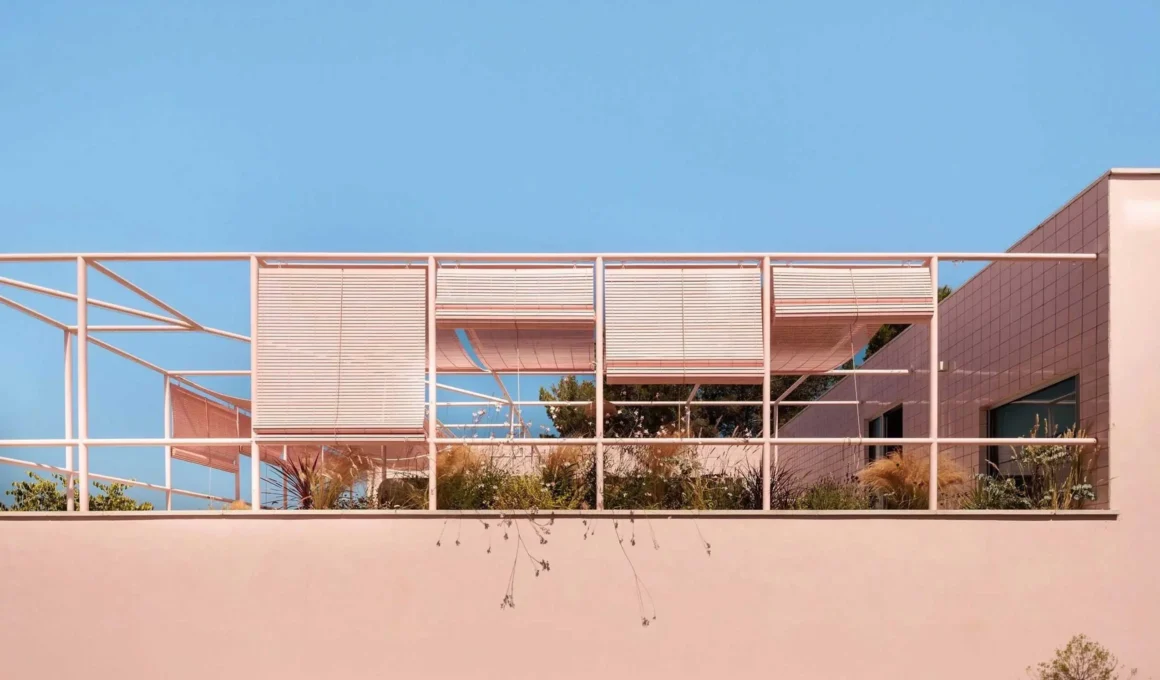
When summer heat peaks become a structural condition of the calendar rather than an anomaly, the collective response defaults to a technology — the air conditioning unit — that consumes energy to fight a problem that energy consumption helped create. The irony is architectural as much as it is environmental. The tools to manage extreme solar gain without mechanical intervention have been present in the Mediterranean construction tradition for centuries: courtyards that regulate airflow, thick masonry that buffers diurnal temperature swings, pergolas that filter rather than block the sun. What changed is not the climate alone, but the profession’s relationship to these devices. For decades, they were treated as vernacular — useful in villages, irrelevant in contemporary architecture. Casa Galamares by atelier RUA in Sintra, Portugal, makes the opposite case: that the architectural shading system, handled with design intelligence, is the most contemporary move a house can make.
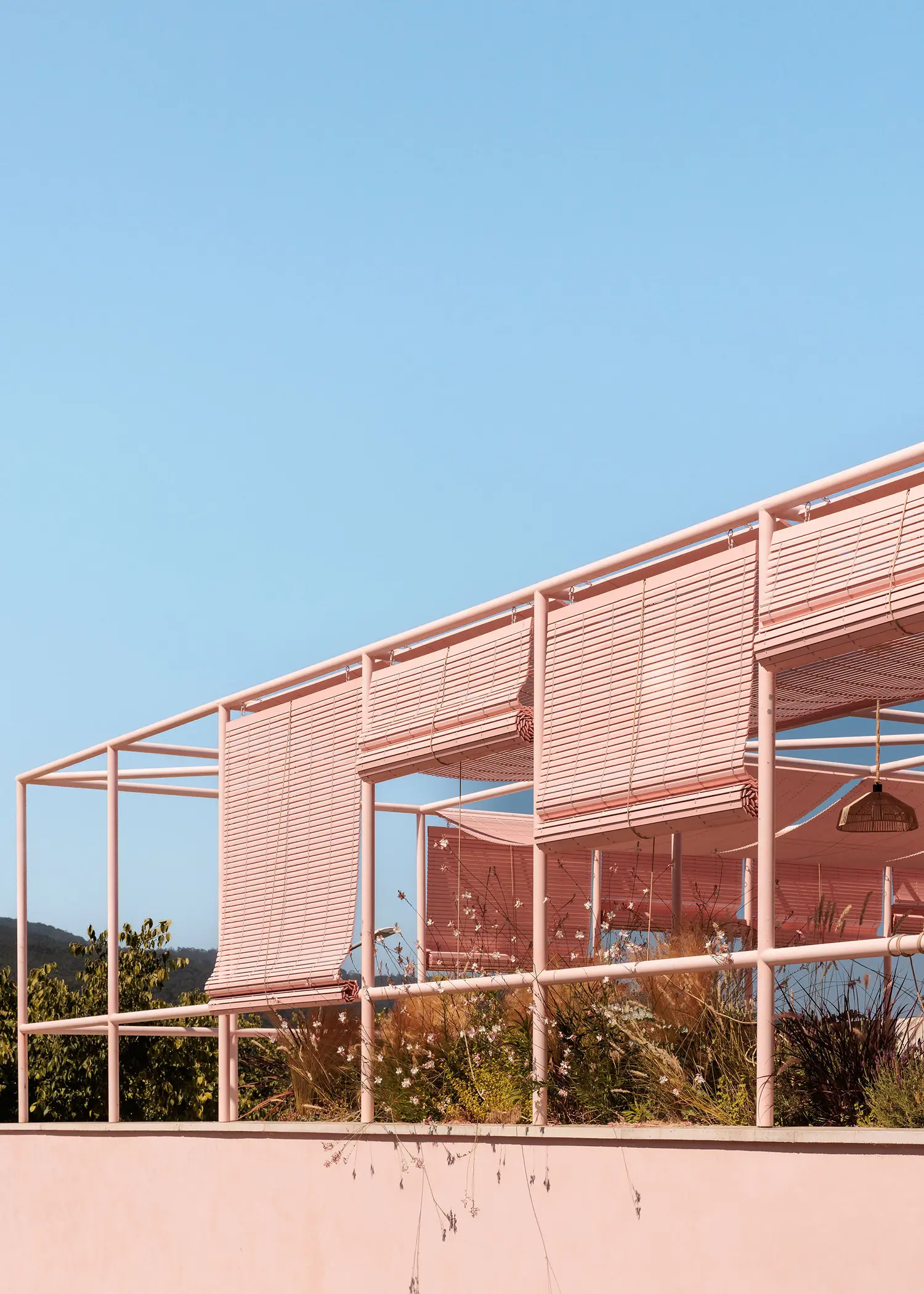
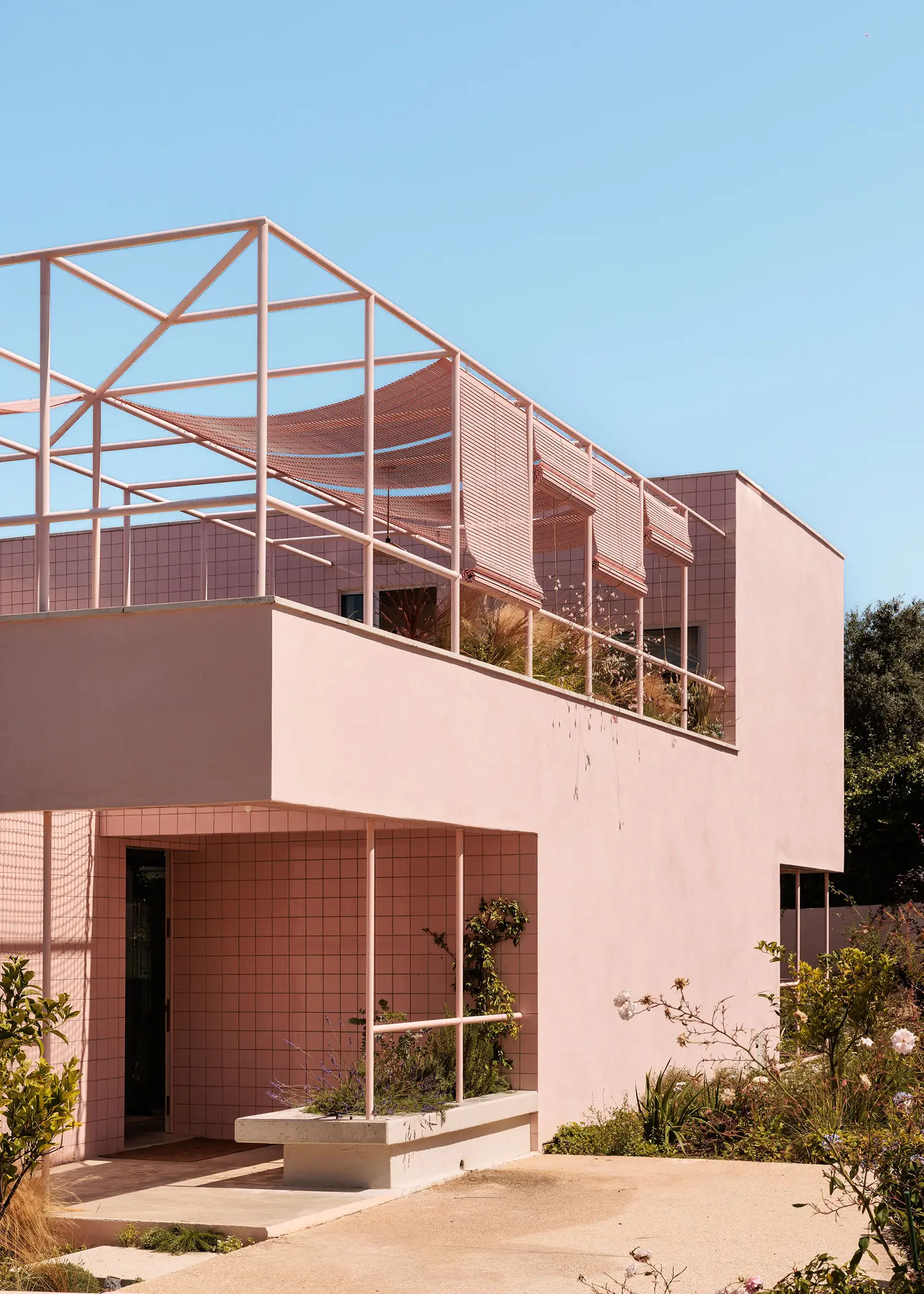
The point is worth stating precisely because the photographs do not shout it. Casa Galamares is immediately, unmistakably a pink house. The blush ceramic tile cladding wraps the entire exterior in a single chromatic register, softening the building’s mass against the dense Atlantic vegetation of the Serra de Sintra and keeping it visually coherent from every angle. The color performs, but it does not dominate. What dominates — once you look long enough — is the tubular steel pergola that crowns the first-floor terrace, a lightweight orthogonal framework from which roll-up reed screens and stretched textile shade sails are suspended. The structure is monochromatic with the building below it. It is also a fully resolved solar management strategy for residential architecture.
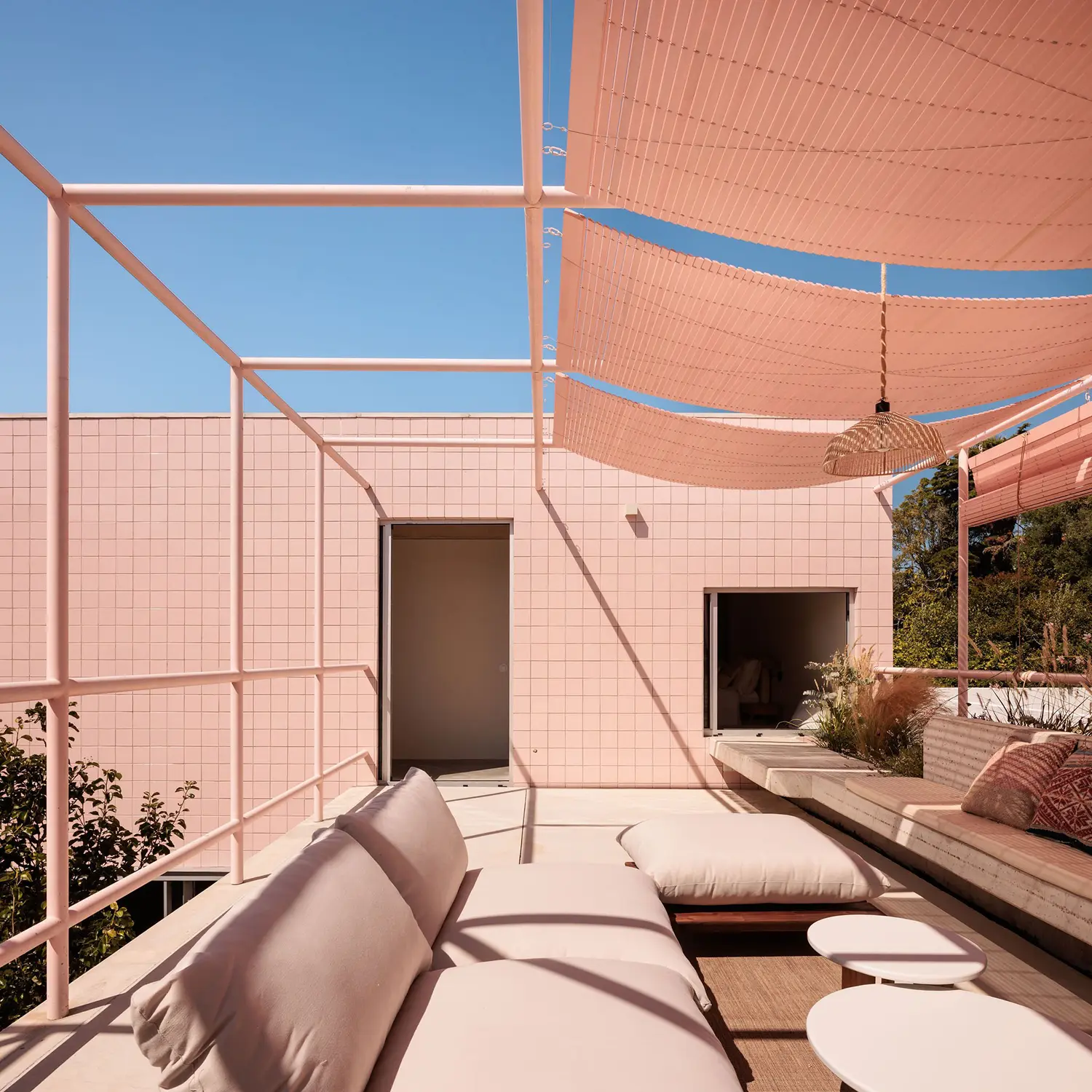
The distinction between a pergola that controls the sun and one that merely gestures at it comes down to calibration. At Casa Galamares, the passive solar shading system was not added after the spatial program was resolved. It was integrated into the architectural logic from the outset, with the terrace conceived as a sun-facing room — oriented east, south, and west, therefore maximally exposed — that is made habitable precisely through the layering of its overhead filter. The reed blinds cut direct solar radiation during peak afternoon hours; the textile sails are tensioned between the steel frame members to deflect lateral glare while preserving the view across to the Pena and Monserrate Palaces. The assembly is adjustable, seasonal, and entirely non-mechanical solar control. It does not cool anything. It prevents heat gain from occurring in the first place.
This logic — reduce the load before deploying the system — has deeper roots than the current climate emergency. Passive heating and cooling strategies in low-tech architecture have been part of the architectural conversation for decades, even if marginalized by the cheapness of energy and the perceived modernity of mechanical systems. The Mediterranean patio tradition is one expression of this knowledge; the brise-soleil is another. What atelier RUA has produced at Galamares is neither a quotation of these precedents nor an abstraction of them — it is a rigorous contemporary synthesis in which architectural solar control is treated as a design material with the same status as tile, steel, and concrete.
The rooftop lounge makes the position explicit. Upholstered outdoor furniture in pale linen sits under the pergola on a concrete terrace; climbing vegetation is anticipated along the steel members; the shadow cast by the shade sails shifts across the pink tile floor through the course of the day. The space works as outdoor living because the thermal comfort design is precise enough to make sitting outside at peak afternoon hours a possibility rather than an endurance test. This is not a secondary achievement. Climate data over the past decade shows that the viability of outdoor domestic space is contracting across warm-climate regions — heat peaks arrive earlier in the season and stay longer. An uncovered terrace is already, for meaningful portions of the day and year, unusable without intervention. Galamares keeps it in play.
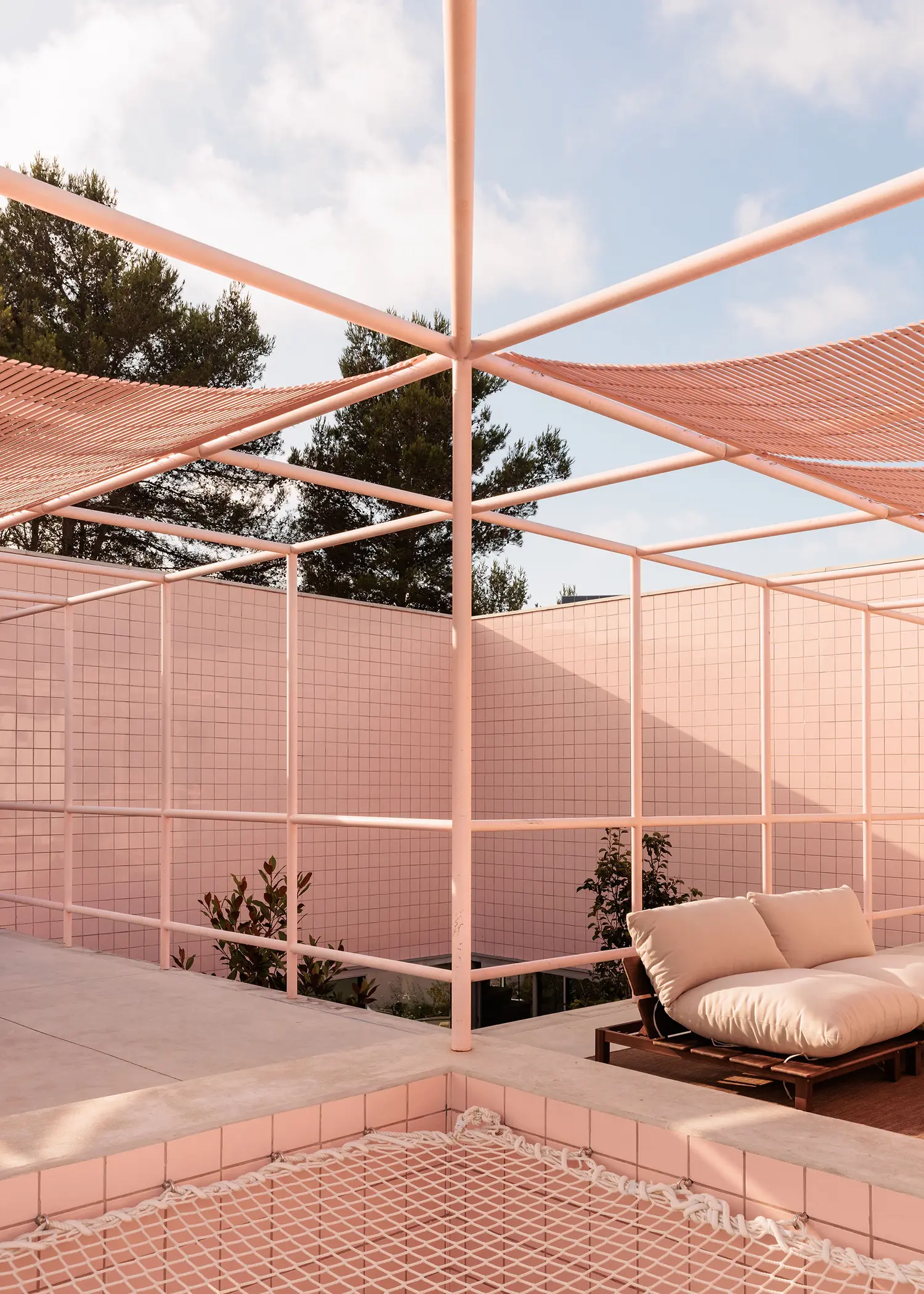
The structural logic of outdoor shading is worth examining at close range. The tubular steel frame is painted to match the ceramic cladding precisely — same pink, same value — which means the pergola reads not as an addition to the building but as an extension of its skin. There is no tonal break between wall and overhead structure; the integrated shading system continues upward into an open-lattice field. This chromatic continuity is not decorative. It enforces the reading that the shading element is part of the design proposition, not an afterthought applied to a finished volume. It also distinguishes the project clearly from the consumer-grade pergola kit market — the category that dominates the residential response to extreme heat globally. What Galamares argues, quietly but clearly, is that residential shade architecture operates in architectural territory. It belongs in the architectural brief.
There is a broader pattern here worth tracing. As courtyard typologies have returned to contemporary residential designand as climatic adaptation has been reframed as a spatial problem rather than a mechanical one, the shading element has migrated from the periphery of the architectural composition to its center. In Galamares, the courtyard below and the pergola above form a vertical system: the central void draws air upward while the overhead sun filter prevents the terrace from overheating. Neither component is sufficient alone. Together, they replace an air conditioning unit with a passive cooling strategy — one that consumes no energy, requires minimal maintenance, and becomes more effective as the climbing vegetation matures and contributes its own latent cooling effect through transpiration.
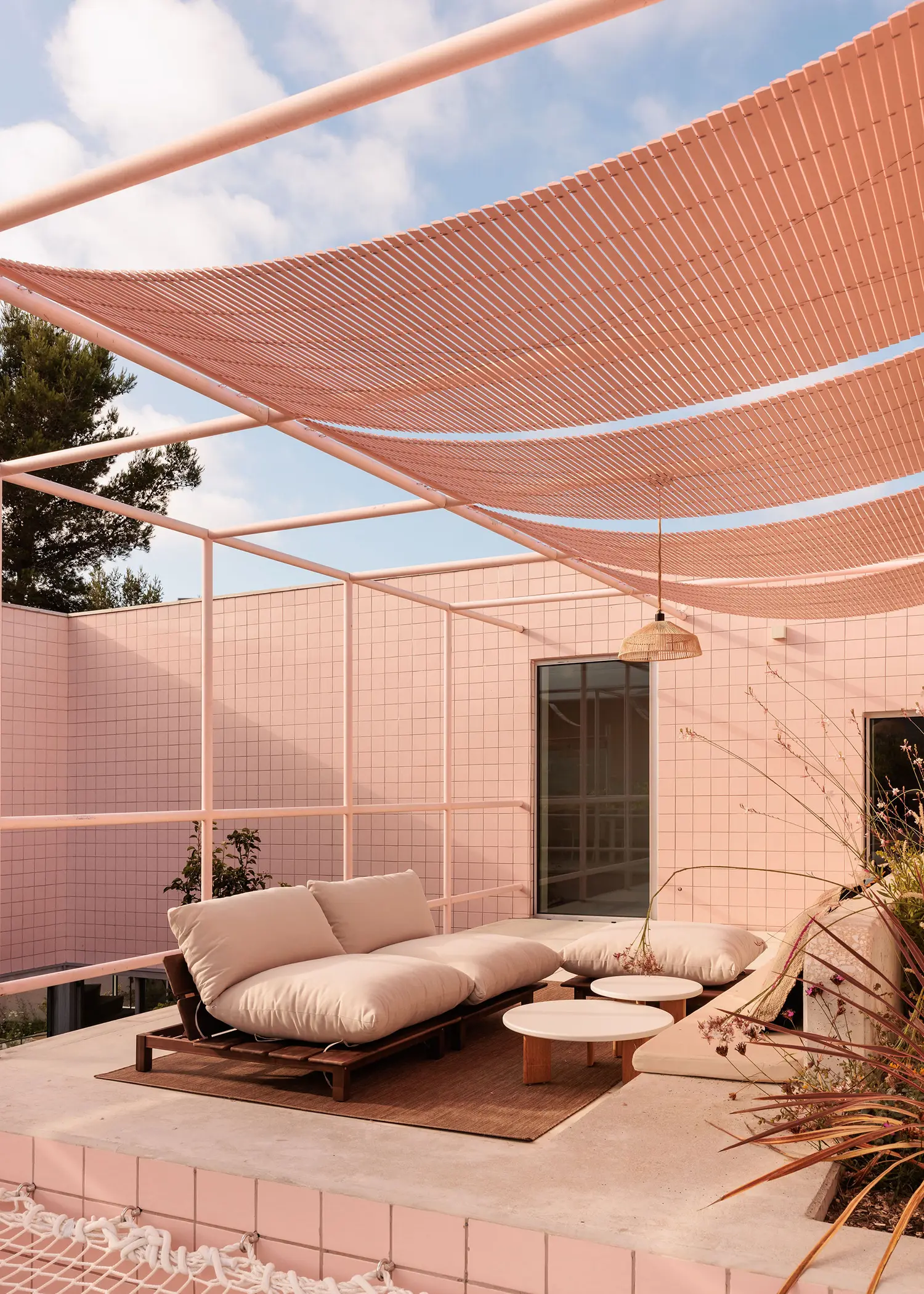
The high thermal mass materials that perform best in this context are the same ones a builder on the Iberian Peninsula would have recognized generations ago. Ceramic tile absorbs heat slowly and releases it slowly, damping the amplitude of surface temperature fluctuation. The concrete terrace floor behaves similarly. The steel pergola, though conductive, carries minimal thermal mass and contributes minimally to radiant heat load. The textile sails and reed screens carry almost none. A house built from these materials, in this configuration, does not require the same mechanical cooling loadas one with large-format glazing and a flat concrete roof exposed to direct summer radiation. This is the fundamental proposition that bio-based and low-carbon material strategies are now encoding at the level of specification — that material choice and climate management are not separate conversations.
What makes Galamares relevant as a reference rather than merely as an object of admiration is its transferability. The solar shading strategy atelier RUA has deployed is not site-specific in the sense that it requires this landscape, this tile industry, or this particular topography. The logic — orient outdoor spaces to capture light, provide an adjustable overhead shading system that modulates rather than eliminates solar gain, and maintain chromatic and tectonic continuity between the shading element and the building itself — applies at any scale, in any sufficiently warm climate. It is the same logic being worked through in the design of outdoor kitchens and durable exterior spaces that must function through a full warm-season calendar.
The question of thermal sustainability in residential outdoor design connects to a parallel shift in how domestic pools are being specified. As dark-finish pools have been reconsidered as thermal systems rather than purely recreational ones, the broader category of exterior domestic space has begun to be evaluated against climate criteria that barely figured in the residential brief ten years ago. How hot will this surface get at 3pm in August? How much will this material retain that heat into the evening? How does the shading sequence affect the usability window of the terrace? These are engineering questions dressed in architectural clothing — and they are now arriving in design conversations where they were previously absent. The Passivhaus standard, long positioned as a cold-climate efficiency tool, is increasingly relevant in hot climates because its logic of envelope-first, mechanical-second applies equally to cooling loads.
Casa Galamares does not claim to be a Passivhaus. It does not need to. What it demonstrates is that solar shading architecture can be produced without sacrificing the visual and spatial quality that makes a house worth looking at — and worth living in. The pink pergola is not a concession to comfort. It is the design. That, more than any specific technical specification, is the position this house takes: that the tools for inhabiting a hotter world are not foreign to good architecture. They have always been part of it.