



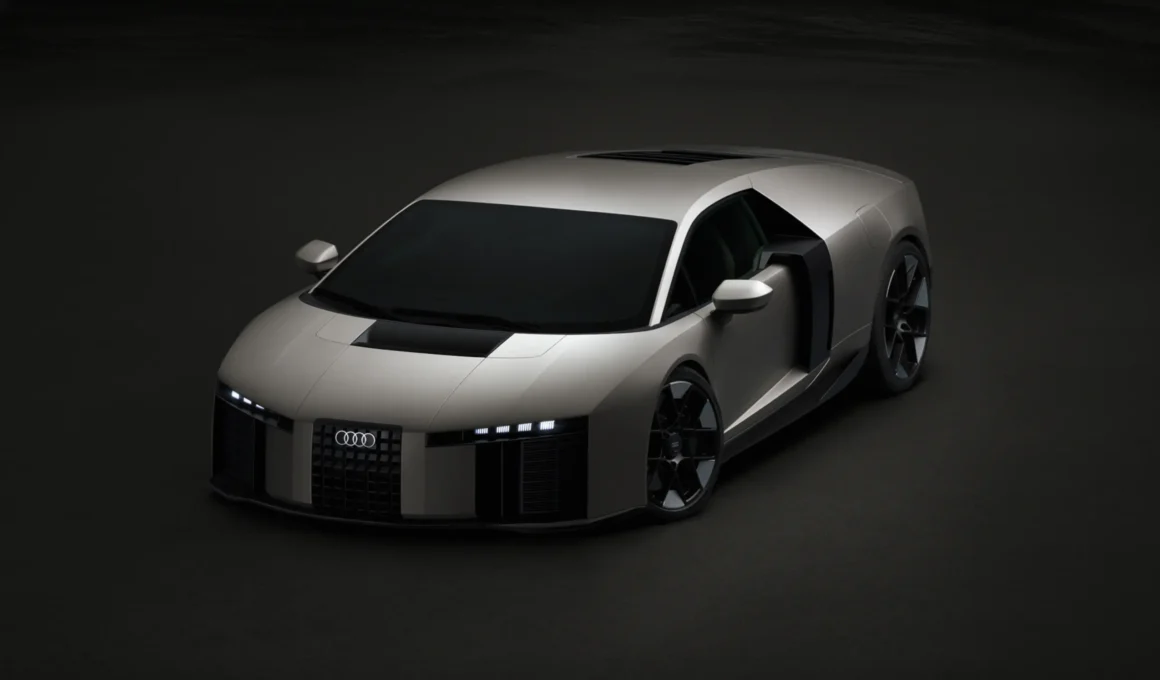
The Audi Nuvolari takes its name from Tazio Nuvolari — the Italian racing driver famous for winning races his machinery had no right to win — and in a car that makes 1,001 PS (987 hp), that choice reads less as tribute and more as a declaration of intent. Unveiled on 4 June in Antibes on the eve of the Monaco Grand Prix, the near-production prototype is the most powerful production vehicle in Audi’s history: a high-performance hybrid supercar limited to 499 units, with a top speed exceeding 350 km/h (217 mph) and deliveries beginning in the first half of 2027. It is also the first production vehicle to carry Audi’s new design language from concept to the road — and the clearest statement yet of what that language is actually arguing.

Massimo Frascella has been Audi’s Chief Creative Officer since June 2024, arriving from Jaguar Land Rover by way of Stile Bertone, Ford, Lincoln/Mercury, and Kia. His design philosophy for the brand, which he calls “The Radical Next,” rests on four principles — clear, technical, intelligent, emotional — and a conviction that is less corporate language than personal history. In 1998, he took a day off work in Turin to stand in a dealership and examine the first Audi TT for hours. “For me, the TT was more than just a car,” he said in an interview with Audi Communications. “It was a message: you don’t need to shout to be heard. You don’t need excess to make a statement. You just need clarity. And, more importantly, the courage to follow it.” The Audi Nuvolari is what that conviction looks like when it has access to 1,001 PS (987 hp).

The design language was first established in the Audi Concept C — the study that introduced the Vertical Frame as the new organizing identity element, replacing the traditional singleframe grille. The Nuvolari applies it to production for the first time, in the most demanding context: a supercar, where every decision is measured against a century of genre convention. The signature color Titanium, shared with the Concept C and the brand’s Formula 1 race car, threads a deliberate visual continuity across the three objects that now define Audi’s new identity.

Form follows the mid-engine layout with the discipline Frascella describes as non-negotiable. Almost all exterior panels are carbon fiber reinforced polymer, produced using prepreg autoclave technology — a method transferred directly from Formula 1. Forged center-lock wheels make their production debut. The deployable adaptive rear wing integrates flush into the body; in the retracted position, the solid-metal Audi rings sit within its surface. The interior is divided into two zones: a deep, dark front section designed for concentration, a lighter Shadow Dune rear. Color accents in the human-machine interface reference the Auto Union Type C race car of the 1930s. “Every design decision has a clear purpose,” Frascella said in a statement. “Nothing is decorative.”

The decision to build a hybrid rather than a pure electric supercar is the most deliberately counterintuitive aspect of the Nuvolari, and the most significant. The 4.0-liter V8 biturbo at the system’s core delivers 800 hp (588 kW) and reaches 10,000 rpm — a rev range previously reserved for motorsport. Three axial flux electric motors, each producing 110 kW (148 hp), complete the drivetrain: two oil-cooled units at the front axle enabling variable torque distribution, a third positioned between the V8 and the transmission, for a combined system output of 1,001 PS (987 hp). The 7.3 kWh battery capacity makes the architecture explicit — this is not an electric car with a combustion engine for range. It is a combustion car using electric motors to reach performance parameters the V8 alone cannot access.

The most consequential technical innovation is the least visible. The quattro predictive ride is Audi’s first fully predictive all-wheel drive system: rather than reacting to traction loss, it reads steering angle, acceleration, yaw rate, and grip level simultaneously, anticipates instability before it develops, and pre-coordinates the powertrain, brakes, torque distribution, and active aerodynamics as a single integrated response. Gabriel Bortoleto, one of the two Audi Revolut F1 Team drivers who tested the prototype at Nardò, described the result with the precision of someone who has driven it: “What stands out immediately is how clean and predictable the car feels on turn-in. There’s basically no understeer, which is impressive given the level of performance. The balance stays very neutral and precise.”

Active aerodynamics operate across three configurations — Closed, Low Downforce, and High Downforce — governed by driving mode with manual DRS override on the steering wheel. In high-downforce configuration the system delivers over 400 kg (882 lbs) of downforce; an S-duct at the front axle channels airflow through the Vertical Frame elements to manage both downforce and powertrain cooling without external ducting. The Audi Ceramic Pro braking system, with 420 × 40mm (16.5 × 1.6 in) front discs and 10-piston calipers, has an energy absorption capacity of 2.8 megawatts — on par with a current Formula 1 car.

The Nuvolari arrives at a moment when the luxury performance segment is being contested on terms that have less to do with power figures than with identity. Ferrari’s first electric car, developed with Jony Ive’s LoveFrom studio, approaches the same question from precisely the opposite direction: where Ive’s method is to ensure the object announces its own extraordinary nature at every surface, Frascella’s is to make Audi feel inevitable — unarguably itself without declaring the effort. Both are coherent positions. They represent genuinely different beliefs about what the most expensive cars in the world should be asked to say.

The harder question the Nuvolari poses is not technical but philosophical: whether a car designed around the conviction that restraint is the highest form of ambition can survive the social dynamics of 499-unit limited production and the visibility that inevitably follows. Frascella’s argument is that clarity holds under pressure because it has nothing to prove. Tazio Nuvolari made the same argument at 200 km/h (124 mph) on tracks that were not designed for it. Whether Audi can hold the same line at dealership pace is the most interesting design problem the car leaves open.