



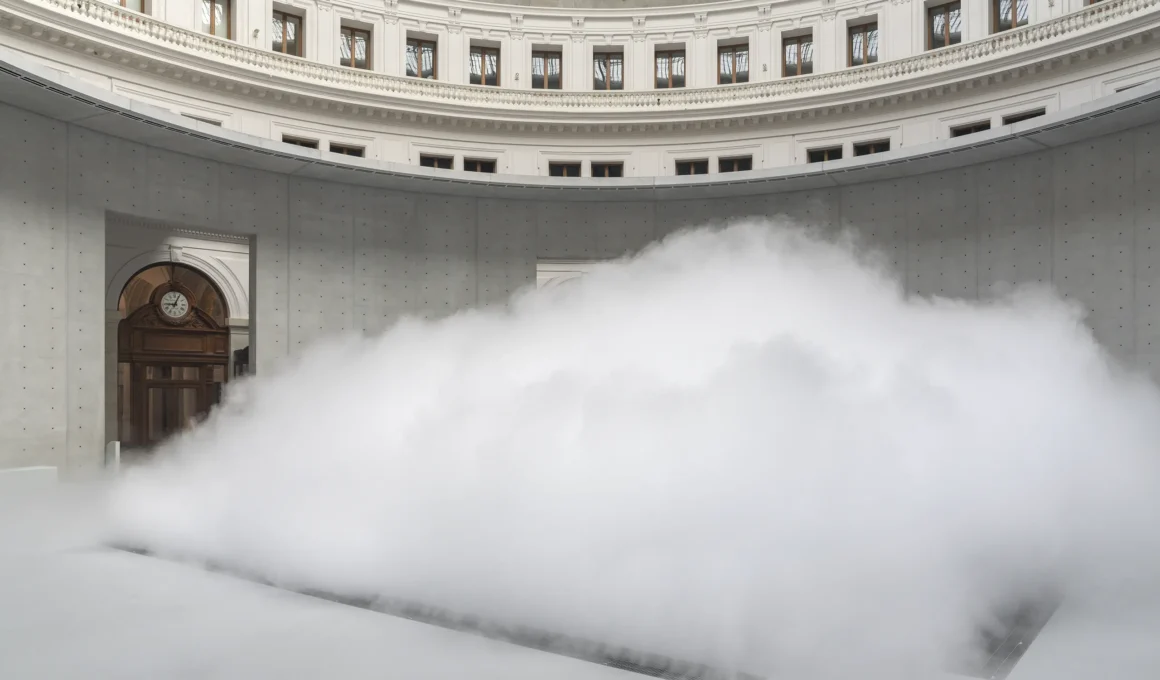
The only object in the Rotonde de la Bourse de Commerce capable of making Tadao Ando‘s concrete cylinder disappear is a cloud made of water — and Fujiko Nakaya has been building those clouds since 1970. Cloud #07156, on view from 4 June to 14 September 2026 as part of the Pinault Collection‘s “Clair-obscur” exhibition curated by Emma Lavigne, takes the form of a thick mass of water vapor released within the Rotonde’s skylit dome, shaped by air currents and the movement of visitors rather than by any fixed compositional intention. It is the most engineered and the most natural object in the room — and the most ephemeral response possible to one of the most permanent architectural insertions in contemporary Paris.

The Rotonde itself is already a doubled space. The circular 18th-century commodity exchange — its upper levels lined with a panoramic marouflage canvas, its dome flooding the floor with shifting light — was reopened in 2021 by François Pinault as a major contemporary art venue, its interior transformed by Tadao Ando’s insertion of a smooth concrete cylinder that rises from the floor to near the roofline, doubling the building’s circularity without explaining itself. That cylinder is the defining spatial feature of the room: authoritative, permanent, non-negotiable. It is also exactly what the fog is designed to address. Celeste Boursier-Mougenot’s clinamen previously occupied the same Rotonde with floating porcelain bowls set in motion by water currents — a different proposition but the same understanding of the space as a site where natural processes, given room, become sculptural.

The mechanism is precise to a molecular scale. Fujiko Nakaya artificially recreates the physical composition of natural fog using high-pressure pumps and nozzle systems that break pressurized water into droplets of “twenty or thirty microns in diameter,” she explained — the same particle size as those that constitute natural atmospheric fog. The system is made up of rows of pipes, pumps, and diffusers calibrated to the specific conditions of the site: humidity, temperature, air currents, and the density of human presence all influence the behavior of the released particles. The fog is natural in composition; it is artificial only in its origin. What arrives in the Rotonde is not a representation of weather. It is weather.

The number in the title is not decorative. 07156 is the code of one of the weather stations closest to the Bourse de Commerce Paris, making the artificial cloud inside the building a strange counterpart to the real clouds drifting above the dome. Each Fog Sculpture in Nakaya’s practice is titled with the code of the nearest weather station — a naming system that anchors the work to a specific meteorological location while emphasizing its dependency on conditions the artist cannot control. Nakaya has called these works “atmospheric sculptures” and compared them to “conversations with the wind”: the art is not the fog itself but the dialogue between the manufactured mist and the air that shapes it.

For Nakaya, fog is primarily an epistemological instrument. It renders invisible what is ordinarily visible — in this case, the Rotonde’s architecture itself — while revealing what normally escapes perception: the movement of air, the paths of circulation, the behavior of light when it has no surface to land on. The work draws explicitly on the Japanese concept of ma — architecture understood not as object but as interval, a space of relationship between beings and things where connection, not emptiness, is the organizing principle. From the first-floor balcony, visitors can look down onto a dense sea of vapor through which the Ando cylinder is only intermittently legible. The question is no longer one of viewpoint, as curator Anne-Marie Duguet observed in the exhibition catalogue, but of visibility itself — the fog functioning as an anti-panopticon, defying observation through permanent, partial, and unpredictable transparency.

Born in Sapporo in 1933, Nakaya grew up as the daughter of Ukichiro Nakaya, the physicist who developed the first method for producing artificial snowflakes in laboratory conditions. The inheritance is structural: where her father learned to manufacture one natural atmospheric phenomenon for scientific purposes, Fujiko Nakaya has spent fifty years manufacturing another — fog — for artistic ones. Trained initially in oil painting in Japan and the United States, she joined the collective Experiments in Arts and Technology (E.A.T.) in 1967, which brought artists and engineers into direct collaboration. Her first fog sculpture appeared in 1970 around the Pepsi Pavilion at the Osaka World Expo, built with engineer Thomas Mee; subsequent decades brought collaborations with composer David Tudor, choreographer Trisha Brown, and artist Bill Viola.

The dialogue with Ando is the most formally specific relationship in Cloud #07156. Ando has described his own practice as “the search for a state in which architecture and nature coexist, whilst clashing violently” — his concrete wall inside the Bourse de Commerce functioning as a stage for the sun’s passage through the Rotonde, its geometry an oculus that conceals as much as it reveals the architecture around it. Tadao Ando uses permanent material to register the transience of natural light; Nakaya uses transient material to register the permanence of built space. The fog makes the cylinder visible precisely by obscuring everything else — the two practices meeting at the point where each makes the other more legible.

Cloud #07156 arrives in Paris at a moment when the city is hosting an unusually concentrated encounter with large-scale immersive art. At the Grand Palais, Leandro Erlich’s retrospective deploys fourteen installations designed to destabilize spatial certainty through architectural illusion — a practice that shares Nakaya’s interest in the body’s encounter with compromised perception, though through entirely different means: where Erlich uses mirrors and false surfaces, Nakaya uses meteorology. The proximity of both shows this summer invites a comparison that neither exhibition proposes but that the city, inadvertently, provides.

The sharpest question Cloud #07156 poses has followed Nakaya’s practice since its beginning: whether a work that cannot be fixed, reproduced, or photographed with any reliability belongs inside an institution whose function is precisely to fix, reproduce, and make visible. The fog in the Rotonde will never look the same twice, cannot be owned, and will leave no material trace when the installation closes in September. That may be the most rigorous artistic position on display anywhere in Paris this summer — and the most difficult to defend to a collector.
Cloud #07156 by Fujiko Nakaya | Where: Bourse de Commerce — Pinault Collection, 2 rue de Viarmes, 75001 Paris | When: 4 June – 14 September 2026