



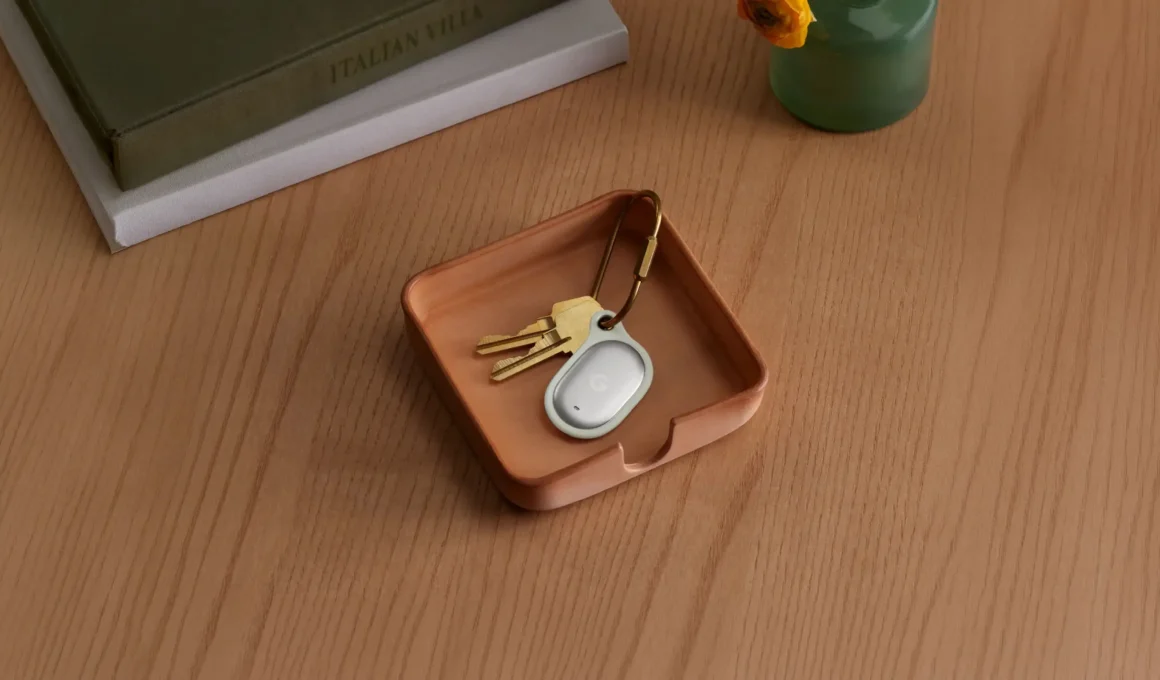
Google’s first-ever finder tag skips the one fix five years of AirTag accessories have been built around — the Pixel Tag still has no way to attach itself to anything, out of the box. Announced August 12, 2026 alongside the Pixel 11 series and Pixel Watch 5 at Made by Google, the small stainless steel tracker runs on Google’s Find Hub network and won’t reach buyers until November 11. Any Pixel Tag vs AirTag comparison starts here: it’s a deliberate object, priced and positioned to match Apple’s tracker point for point — right down to repeating its most-criticized design gap.

A capsule, not a disc is the shape Google settled on for its first tracker, breaking from the round-coin silhouette AirTag and most competitors share. The stainless steel tracker weighs about 12 grams (0.4 ounces), comes in a single matte finish called Fog, and is rated IP67 for dust and water resistance. The instinct to choose a quiet, unbranded-feeling object over a flashier one echoes Microsoft’s Project Solara, where the same logic applied to a work badge instead of a keychain fob.

No built-in loop or hole comes with the tag itself — Google sells its own keychain loop accessory separately, the same fix an entire third-party market has been selling for AirTag since 2021. The battery, at least, is meant to be opened rather than sealed in: a user-replaceable CR2032 coin cell rated for about a year, paired through Fast Pair by pulling a battery tab and holding the tag near an Android 9 or newer phone, then named by category or custom label inside the Find Hub app. A single tag can be shared with up to 10 people. Finding works in both directions, too — a built-in speaker plays a sound to locate a misplaced tag, and a physical button on the tag rings the paired phone in reverse.

Precision finding needs specific hardware to reach its sharpest form. Pixel Tag combines Ultra-Wideband with Bluetooth Channel Sounding for visual distance and directional cues up close, but that particular accuracy requires a phone running Android 16 with Bluetooth 6.0 — hardware most current Android devices don’t yet have, meaning basic Bluetooth-range finding will be the default for most buyers at launch. Left Behind alerts and unknown-tracker detection add a safety layer once out of range, falling back on a crowdsourced network of more than a billion Android devices with end-to-end encrypted location data. That reach extends to a Pixel Watch through the Find Hub app, and — for Pixel Buds owners — to a spoken request asking Gemini to ring it, folding the tracker into hardware people already have on their body, the same instinct Connor Grady tested with IRIS.
Visualizza questo post su Instagram
Whatever accessory eventually clips a Pixel Tag to a set of keys will be sold separately, ordered on top of the tag itself — the same as it’s been for every AirTag sold since 2021.
Pixel Tag | What: Google’s first Bluetooth and Ultra-Wideband item tracker — Where: store.google.com — When: available November 11, 2026, priced at $29 (single) / $99 (4-pack)