



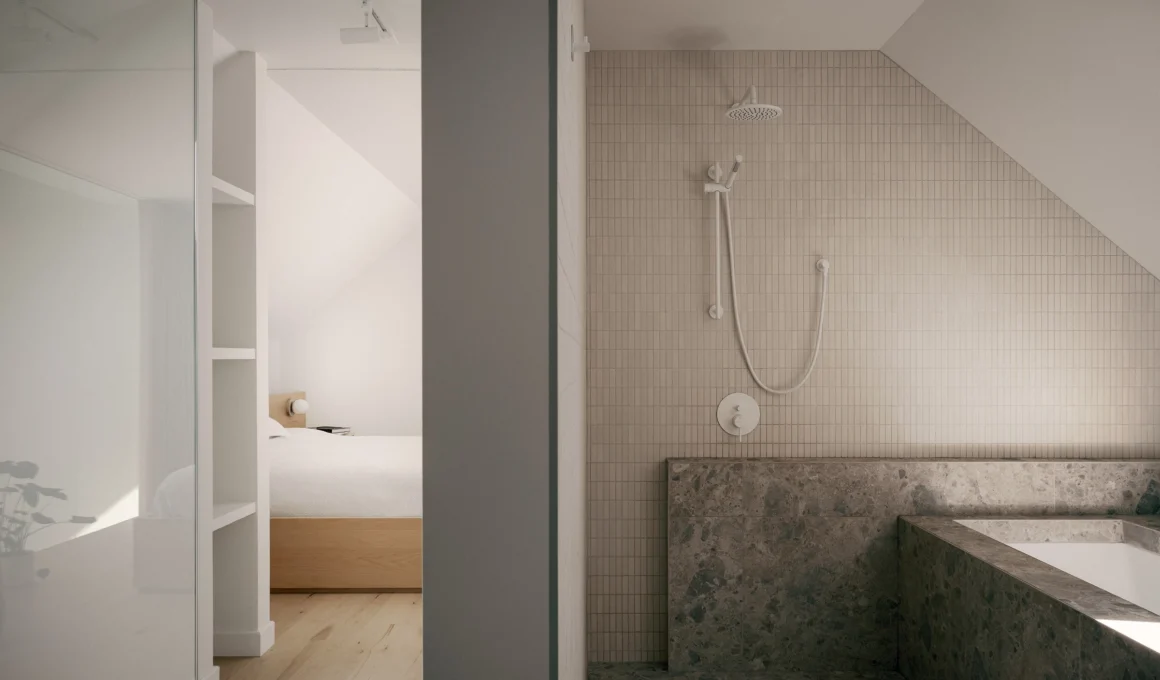
The modern master ensuite is no longer a mere functional amenity; it is an extension of the primary living space—a private sanctuary designed for ritual and recovery. Architectural publications often celebrate the stunning visual appeal of open-plan ensuites—the monolithic stone, the oversized freestanding tubs , and the sweeping views. However, true luxury design must now transcend surface aesthetics to address the complex functional and psychological performance of this highly integrated space.
or the forward-thinking architect and homeowner, the challenge lies in creating a harmonious transition between the rest area and the wet room—a critical shift toward Wellness Architecture. This piece explores the cutting-edge strategies and smart technology that ensure an integrated ensuite actively supports, rather than sabotages, occupants’ sleep quality and mental well-being.
Beyond Aesthetics: The Mandate of Performance Ensuites
Integrating the bathroom and bedroom, while visually appealing, introduces major design challenges: noise transmission, temperature fluctuation, moisture control, and loss of privacy. A truly successful ensuite renovation or new build must be engineered to mitigate these issues, making the space work holistically to support the daily routine, from morning energization to evening relaxation.
The Psychological Imperative
The bathroom is the beginning and end point of the day’s rituals. Its design profoundly impacts mindset and energy levels. By utilizing principles of holistic design, such as Biophilic Design—incorporating natural light, organic materials (like stone or wood), and textural elements—the ensuite transforms into a restorative, nature-connected retreat. This connection to nature is scientifically proven to reduce stress and improve sleep quality.
Mastering the Invisible: Acoustic and Thermal Control
The integration of sleeping and bathing areas demands that noise and thermal performance be treated as primary luxury features, often achieved through invisible engineering solutions.
Acoustic Isolation for Restful Sleep
One of the biggest detractors from luxury and sleep in an integrated design is noise—the sounds of running water, ventilation systems, or early morning routines. Achieving Acoustic Privacy requires sophisticated material choices:
- Insulation: Utilizing high-density acoustic insulation, such as rock wool, in surrounding walls and ceilings is crucial for dampening sound transfer.
- Dampening Surfaces: Incorporating soft materials, such as cork flooring tiles or thick, plush towels and rugs, helps absorb sound waves rather than reflecting them.
- Sealing Gaps: Even small gaps around fixtures and sockets can transfer sound. Using specialized acoustical sealant ensures maximum sound isolation between spaces.
Advanced Moisture and Odour Mitigation
To prevent condensation, damp, and the spread of odours into the master bedroom, high-performance ventilation is non-negotiable.
Architects should specify Energy Recovery Ventilators (ERVs) or Heat Recovery Ventilators (HRVs).These balanced systems efficiently remove exhaust air while tempering incoming fresh air, reducing heating and cooling costs in the process. Furthermore, high-end exhaust fans should be linked to humidity sensors, ensuring they operate only when necessary, managing moisture levels effectively and preventing mold growth.
Circadian Design: Light as a Luxury Material
In an ensuite directly linked to the bedroom, the quality and color temperature of light are paramount, directly influencing the body’s circadian rhythm—the internal clock that regulates sleep.
Tunable White Systems
The most advanced solution for this integrated design challenge is Circadian Lighting. Tunable Whitesystems offer independent control over light intensity and color temperature, often ranging from 2000K (warm, reddish sunset glow) to 6500K (cool, bright daylight).
- Morning Ritual: Bright, cooler light (up to 6500K) supports alertness and focus for tasks like makeup application or shaving.
- Evening Wind-Down: Low, warmer light (around 2000K) mimics sunset, signaling the body to relax and prepare for sleep.
This smart technology allows the ensuite to become a space that actively guides the body through its natural daily cycle, an unmatched element of well-being.
Layered Lighting Strategies
A single overhead light is insufficient. The luxury ensuite must employ a layered lighting scheme :
- Ambient Lighting: The base layer (often recessed or continuous linear LEDs) providing general illumination.
- Task Lighting: Focused lighting at the vanity (ideally along the sides of the mirror) for clear visibility. Smart mirrors may include adjustable, anti-fog LED lighting integrated into the unit.
- Accent Lighting: Low-level, dimmable lights used to highlight architectural features, niches, or flooring, providing safety and atmosphere during the night without disturbing the partner.
Future-Proofing Luxury: Universal Design and Materials
The ultimate demonstration of luxury is a timeless, functional space built for longevity. This requires adopting principles of Universal Design—making the space accessible to all ages and abilities—without sacrificing high design standards.
Seamless Universal Design
- Curbless Showers: A curbless, or barrier-free, shower is a highly desirable feature in luxury hotels and spas, eliminating trip hazards while creating a continuous, monolithic floor surface.
- Invisible Safety: Safety features should be integrated into the architecture. Companies now offer beautiful, designer grab bars and seating solutions that function as sculptural accessories (such as towel bars or shelves), hiding the safety component in plain sight.
- Floating Fixtures: Wall-hung toilets and floating vanities can be installed at personalized, comfortable heights, enhancing ease of use and simplifying cleaning while visually expanding the floor space.
Next-Generation Materials and Efficiency
Sustainable luxury focuses on materials that offer performance and durability.
The move toward eco-conscious design involves specifying WaterSense-labeled, water-saving fixtures. Furthermore, architects are exploring advanced materials :
- Recycled and Bio-based Composites: Instead of relying solely on traditional materials, composites made from over 80% recycled material are now available for stunning fixtures like sinks and baths. Bio-based materials offer aesthetic versatility and a sustainable edge.
- Greywater Recycling: High-end systems can collect and filter water from sinks and showers for non-potable uses, like toilet flushing and irrigation, significantly reducing freshwater consumption—a critical component of modern sustainable design.
The contemporary ensuite represents a profound shift in luxury design. It is a space defined not merely by what it looks like, but by how it performs. By employing Acoustic Privacy, Circadian Lighting, and subtle Universal Design, the architect can create an integrated design where high aesthetics and human well-being are in perfect, harmonious alignment.