



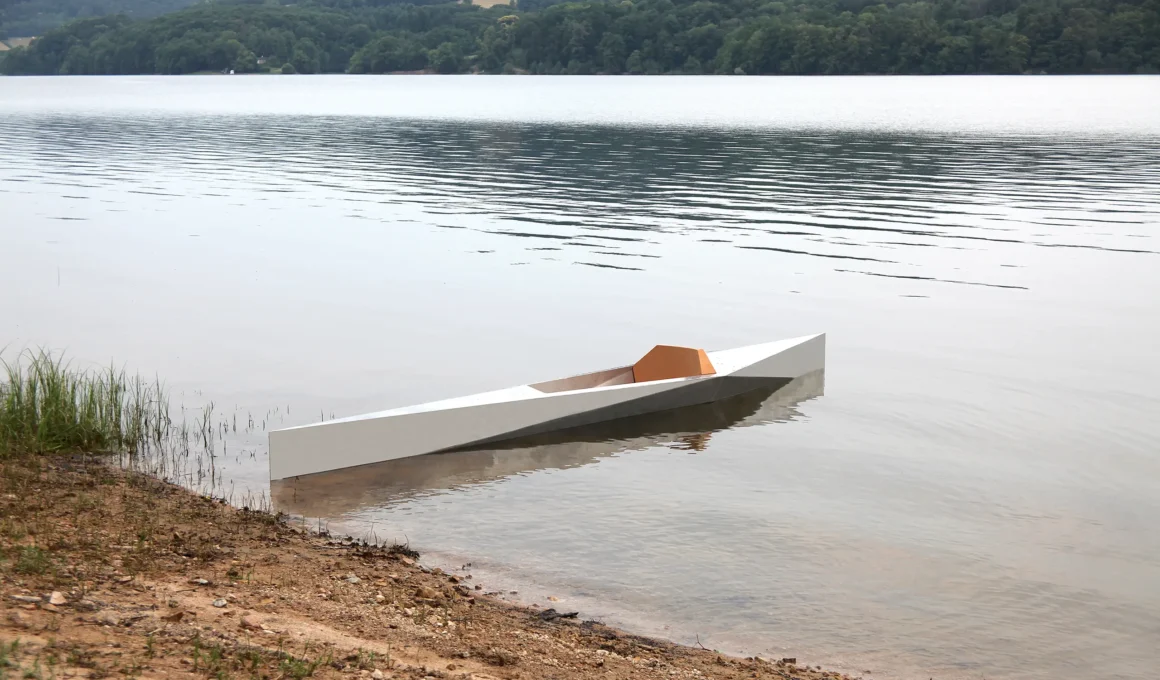
A press brake arrived at the workshop, and Guillaume Bloget designed a kayak whose folds are not a finish but the entire structure. The Paris-based industrial designer conceived Sharp during a residency at Rhizome, in France’s Morvan region, working in folded aluminum sheet and cork. The lakes surrounding the workshop supplied the subject; the new machine supplied the method.
Structured solely by folding, the hull carries no internal frame. A double wall, formed by the folds themselves, gives the shell its rigidity and makes the Sharp kayak unsinkable without any added flotation. Most small craft separate skin from structure and pay for both. Here the two are the same operation, performed once.

The performance brief was narrow. Bloget set out to convert the force exerted while paddling into a gliding sensation with minimal loss, which meant the geometry had to answer to water before it answered to anything else. “The kayak’s shape had to offer a high-quality feel,” he said. Every bend in the folded aluminum hull is doing hydrodynamic work as well as structural work.
Half-scale models came first. Rather than resolve the form on screen, the team built reduced versions and put them in the water, iterating until the profile behaved. “To find the ideal shape, we proceeded iteratively, building half-scale models that we tested in the water before creating the final full-scale hull,” Bloget said. The hydrodynamic hull design was arrived at by floating, not by rendering.

A cork seat is the only soft element in the vessel. It sits as an intermediary between the curves of the body and the angles of the cockpit, which is a precise way of describing what a seat in a hard-edged boat has to do. Cork and aluminum are an unlikely pairing until you consider that one is warm, compressible and buoyant and the other is none of those things.
Production stayed local. The kayak is made on demand by craftsman Antoine Rivière, who built the first prototype, so the object never left the workshop logic that produced it. There is no tooling to amortize and no minimum run, which is what on-demand production means when it is a principle rather than a constraint.

A studio founded in 2018 followed graduation from ENSCI-Les Ateliers, and the stated aim of Guillaume Bloget has been to establish economical relationships between material, technique and use, an approach he has also pursued since 2016 with Typologie, the collective examining ordinary objects that reached the Vitra Design Museum in 2019. Human-powered watercraft rarely receive this kind of attention as designed objects, which is why the few that do stand out, as with a pedal boat built to the standards of a 1950s runabout. What separates Sharp is method: nothing here is molded, laminated or veneered.
Aluminum’s sheen plays with the reflections on the water, which is the one property of the material that has nothing to do with structure and everything to do with what it is like to be out on a lake in an aluminum kayak. The folds that hold the boat together also break the light differently along every facet.