



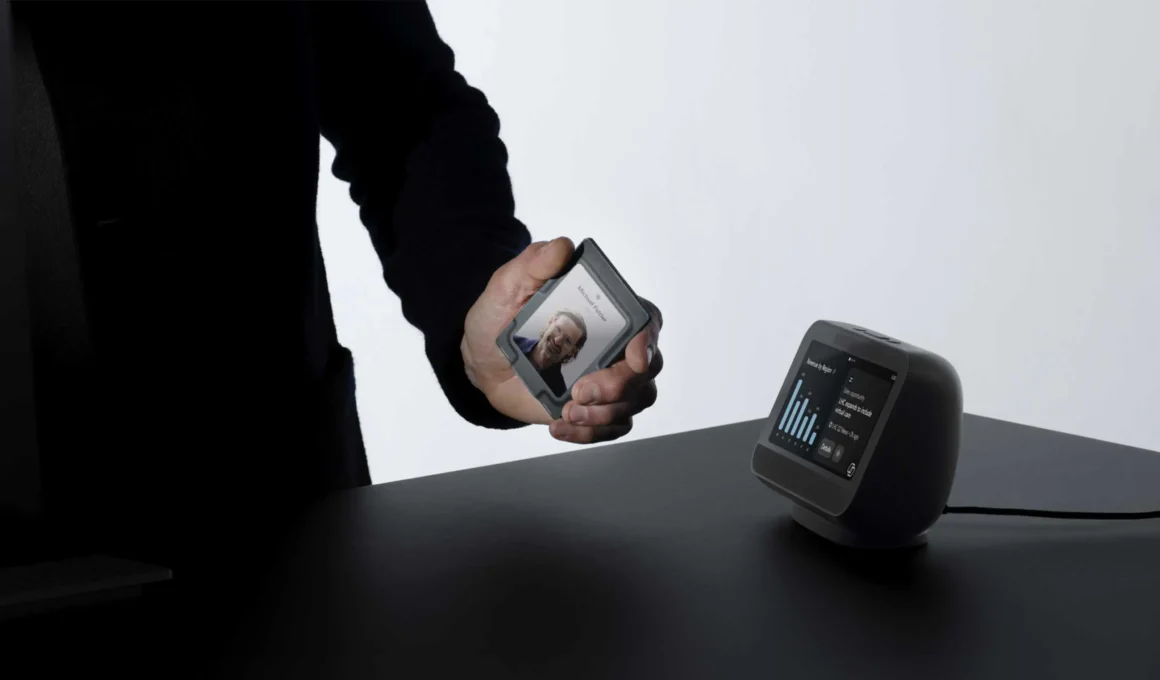
Microsoft’s Project Solara badge device is not the most technologically ambitious wearable computer announced in the last three years — it is the most precisely designed one, and the difference is that Microsoft chose an object nobody ever looks at.
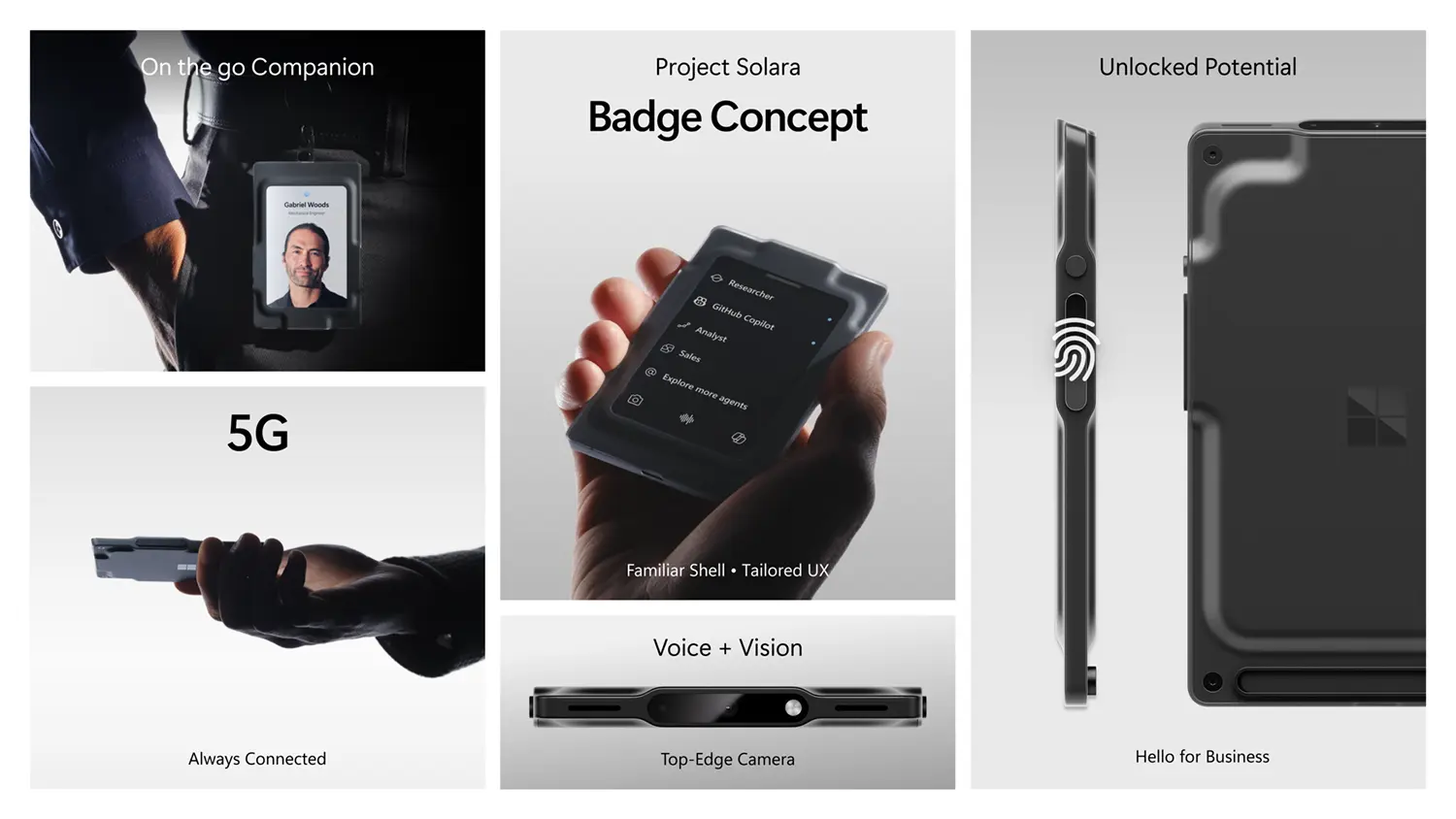
The access badge is the most visually ignored object in the modern workplace. It hangs from a lanyard, clips to a pocket, carries a photograph that flatters nobody, and opens doors. Hundreds of millions of people wear one every day without registering it as a designed object at all. When Microsoft’s Applied Sciences Group unveiled Project Solara at Build 2026 on June 2nd, the first hardware concept built on the new agent-first device platform was not a watch, not a pair of glasses, not a lapel pin with a glowing ring. It was a reimagined access badge — with a touchscreen, a fingerprint sensor, a side-facing camera, 5G connectivity, and Qualcomm wearable silicon inside. The choice of form factor is the most consequential design decision in the announcement, and almost nobody has discussed it as such.
Every previous attempt at post-smartphone wearable computing arrived with a declared aesthetic. The Humane AI Pin projected a laser display onto a palm and wore its ambition visibly — a brooch-like object that announced itself as the future of computing from across a room. The Rabbit R1 was a bright orange slab with the visual confidence of a toy from a more optimistic decade. The Meta Ray-Ban smart glasses hid their technology inside a familiar eyewear silhouette but still required the user to adopt a specific object they would not otherwise wear. Each of these devices asked the user to accept a new visual identity along with the technology. Microsoft’s badge concept asks for nothing. It fits into an object the user already carries, already wears, already accepts as part of the workplace uniform — invisibly.
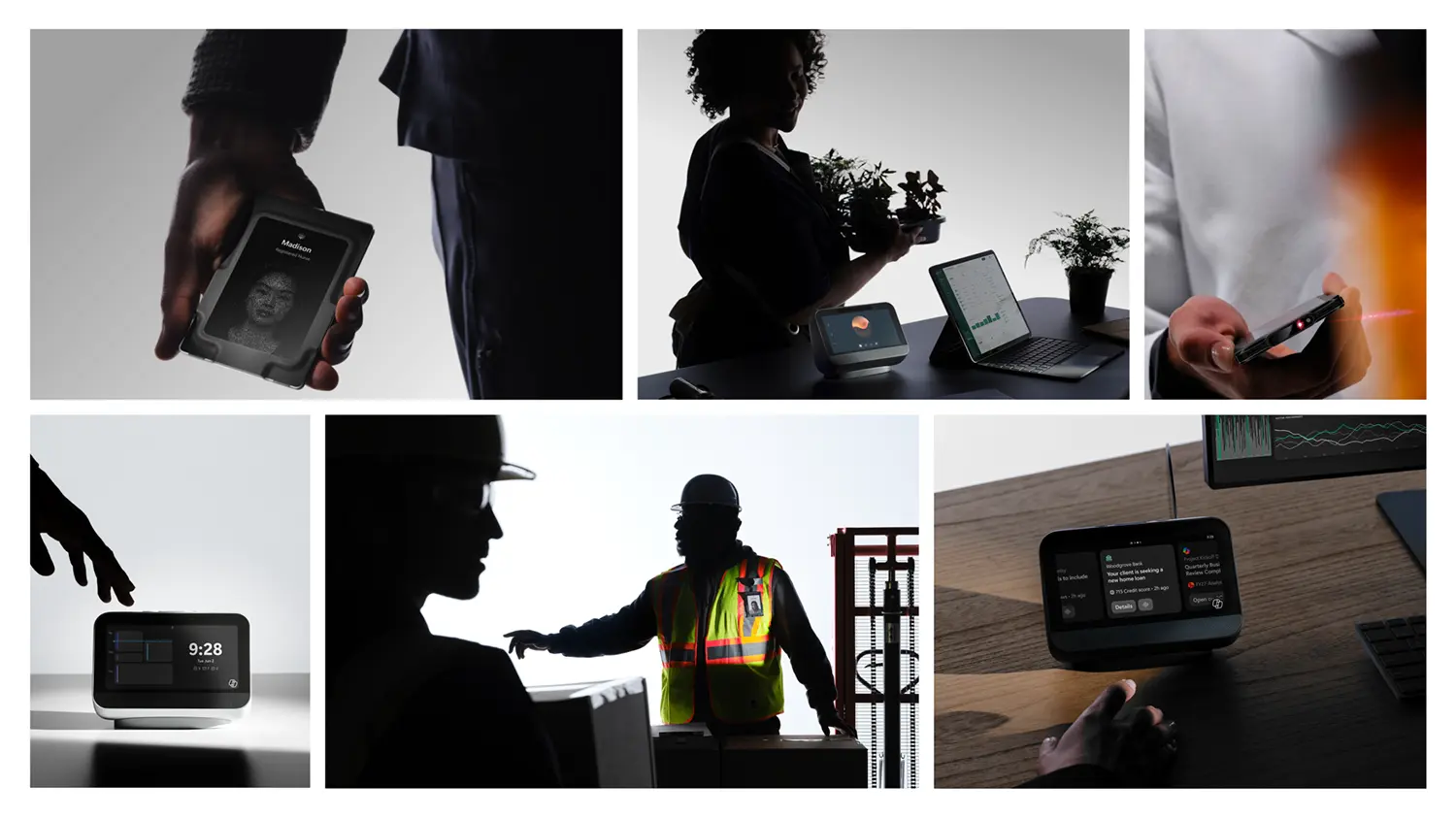
The strategic logic behind that choice becomes clearer when read against the platform it sits on. Project Solara is not a hardware product — it is a chip-to-cloud software platform, built on AOSP via Microsoft’s Device Ecosystem Platform, designed specifically for agent-first computing: the proposition that agents, not apps, are the new unit of human-machine interaction. The badge is a concept reference device, one of two — the other being a desk companion — designed to prove what the platform can do across different form factors. The hardware is provisional; the argument is structural. And the argument is this: when the interface is no longer fixed — when “just-in-time UI” allows an agent experience to adapt across screen sizes, modalities, and contexts without the developer redesigning everything — the device itself is freed from carrying the interface as its primary design burden. It can be shaped around the environment and the workflow instead.
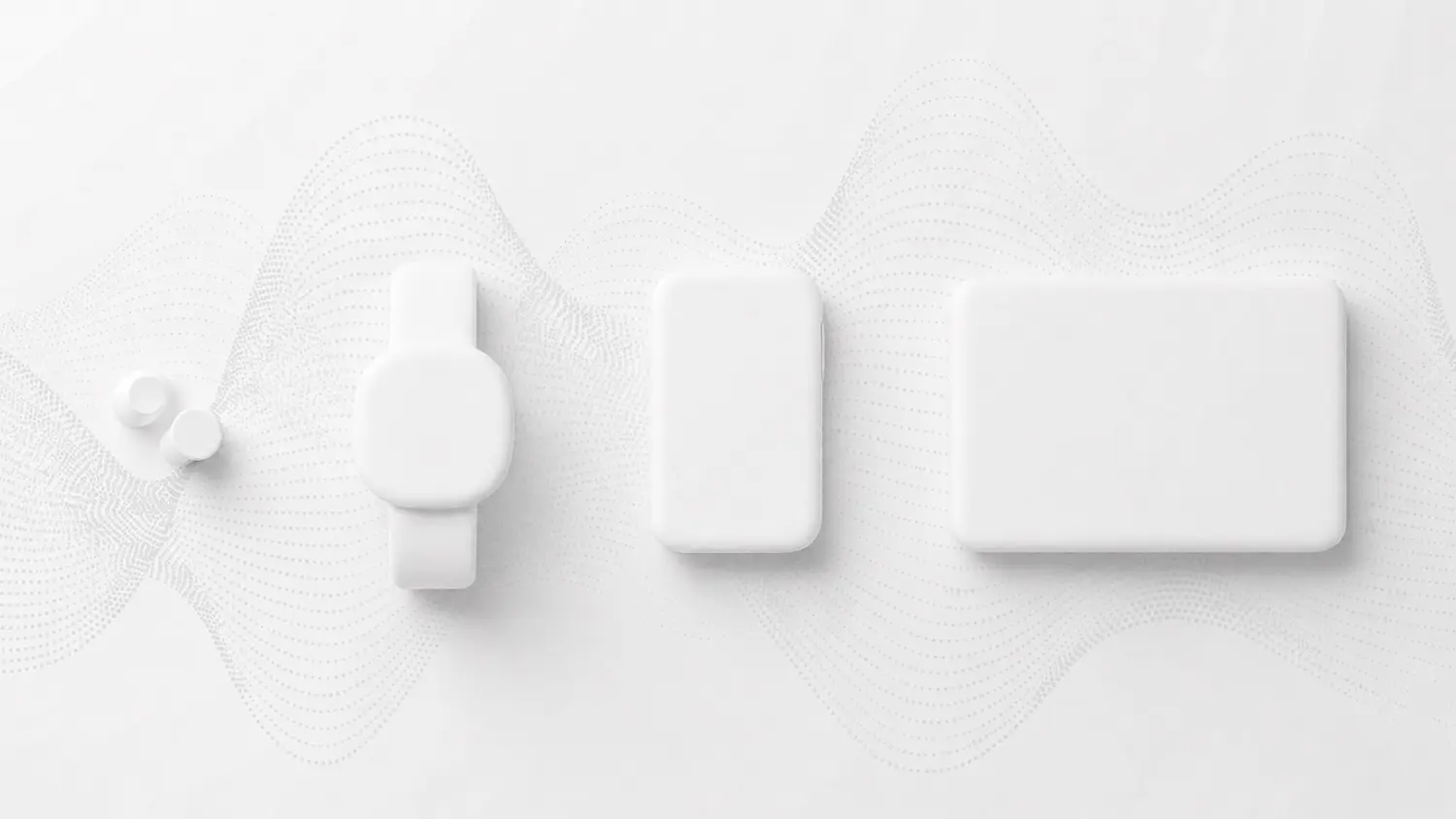
This is the inversion that distinguishes Solara from every previous attempt at ambient computing. The Humane Pin needed a projector because it had no screen; its form was a consequence of its interface limitations. The Rabbit R1 needed its distinctive shape to communicate that it was a new kind of device, because the interaction model required user education. Solara’s badge needs none of that. The agent adapts to the device; the device does not need to advertise the agent. The result is an object that could pass unnoticed in any enterprise corridor in the world — which is precisely the point. Microsoft is not asking workers to adopt a new aesthetic. It is asking them to look down at something they are already wearing and find it has become more capable.
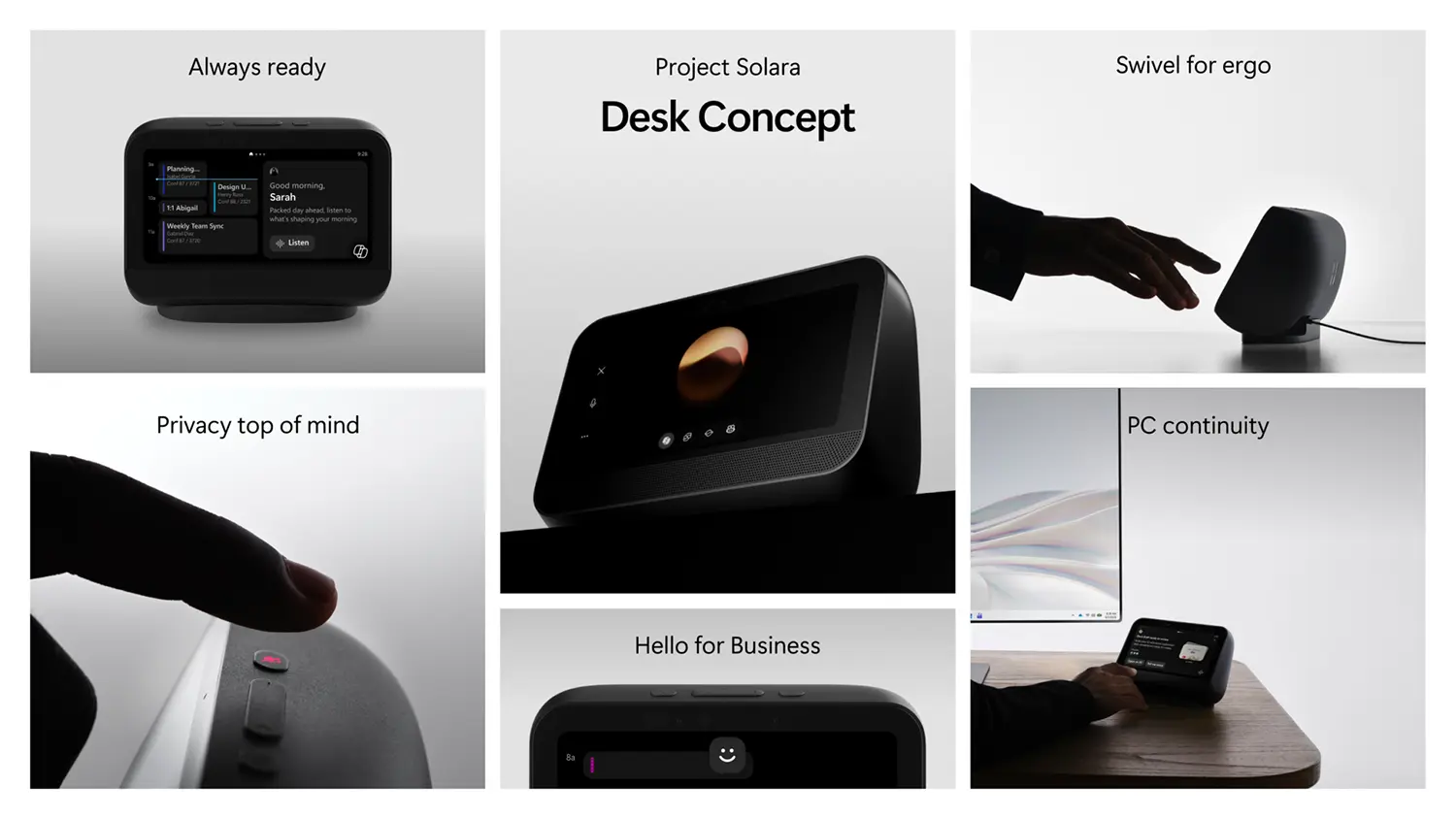
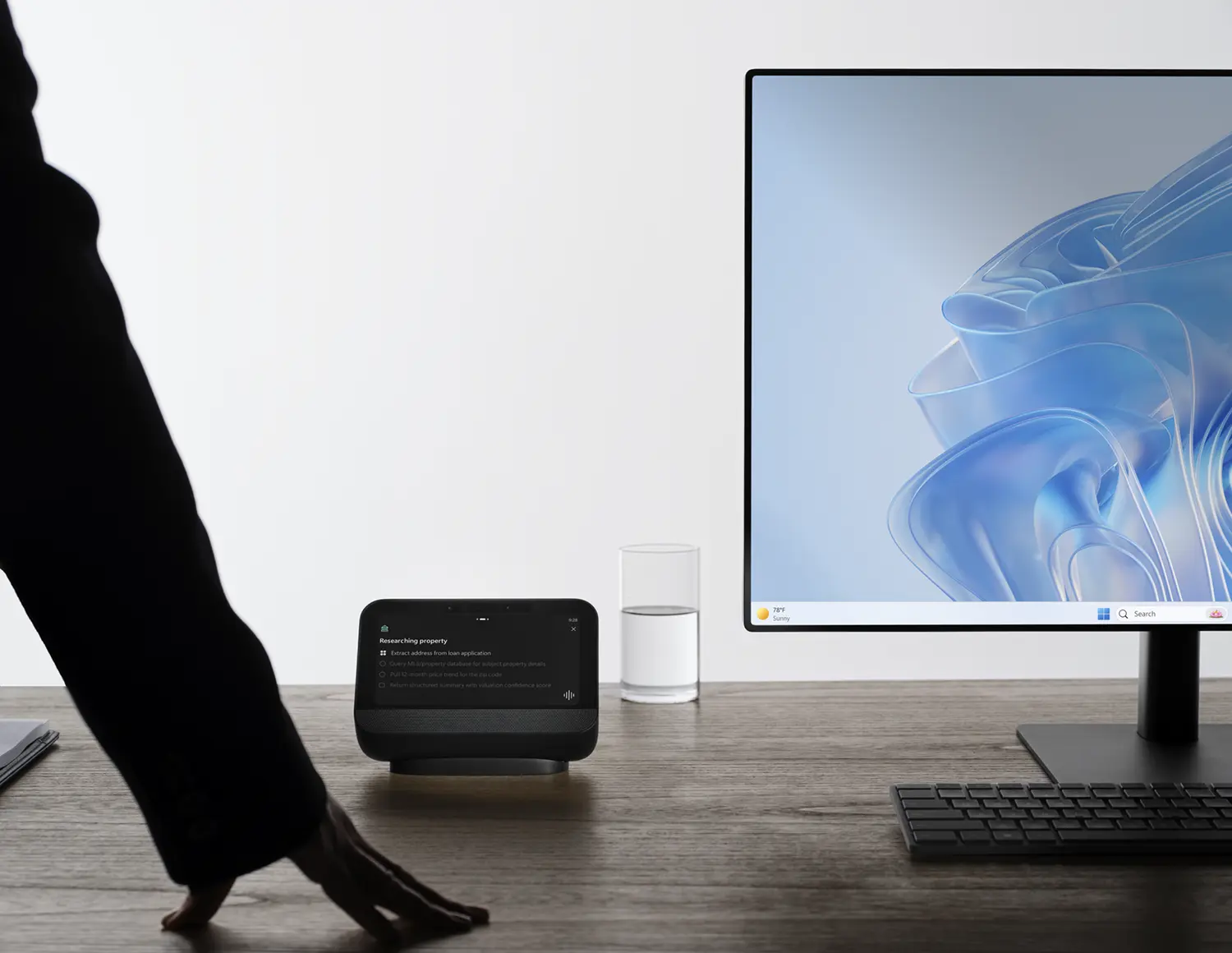
The second concept device extends this argument into space rather than onto the body. The desk companion — a stationary touchscreen unit with face authentication, UWB presence sensor, dual microphones, and MediaTek silicon — is designed to sit on a desk as a permanent access point to your agents, pairing with a Windows PC via Bluetooth or transforming into a full Windows 365 client when connected to an external display. It is not a monitor, not a phone dock, not a smart speaker. It occupies a category of object that does not yet have a name, which makes it interesting from a workplace design perspective: a device that assumes a specific spatial relationship with its user, that responds to presence rather than touch, and that is designed to be glanced at rather than engaged with. The architecture of the contemporary office was not designed around this kind of object. It will need to be.
The parallel with Apple’s iOS 27 is instructive here. As urdesign noted when Liquid Glass landed, the most significant design decisions are sometimes the ones that look like retreat from a strongly held position — Apple backing away from rigid surface opacity, Microsoft backing away from distinctive hardware identity. In both cases, the apparent concession is actually a repositioning: Apple towards an interface that admits the environment, Microsoft towards hardware that admits the existing environment of work. The broader wellness and technology trajectory for 2026 points in the same direction — towards technology that integrates into daily life without demanding visible accommodation, rather than technology that requires the user to reorganise their habits around it.
The platform ambition behind the badge concept is considerably larger than the device itself suggests. Project Solara’s three pillars — enterprise security via Microsoft Intune and Entra ID, agent-driven interaction with just-in-time UI, and an open multi-agent extensibility model — are designed to lower the cost of hardware specialisation dramatically. Historically, creating a new computing form factor required rebuilding almost the entire technology stack: hardware, OS, developer tools, UI patterns, security model. Solara’s proposition is that agents reduce that burden sufficiently to make purpose-built devices viable across healthcare, retail, financial services, hospitality, and industrial settings. The badge and the desk device are the first two form factors; reference designs for portable, ultra-portable, wearable, and desktop categories are in development with silicon partners Qualcomm and MediaTek. What starts as a workplace badge could become the template for an entire ecosystem of objects that bring agent-first computing into places where a laptop or a phone has always been too general-purpose, too expensive, or too disruptive to use.
The question Project Solara leaves open is the one that the Apple foldable smartwatch patent and every other speculative computing form factor also leaves open: whether the reduction of visible technological ambition is a design maturity or a design abdication. An access badge that runs your agents is a more useful object than one that does not. Whether it is a more interesting object — whether the invisibility Microsoft is pursuing is a genuine design position or simply the path of least resistance through an enterprise procurement process — is the question the concept devices do not yet answer. Project Solara is a platform looking for its objects. The badge is the first guess at what those objects might look like. It is a very deliberate guess, and a very quiet one.