



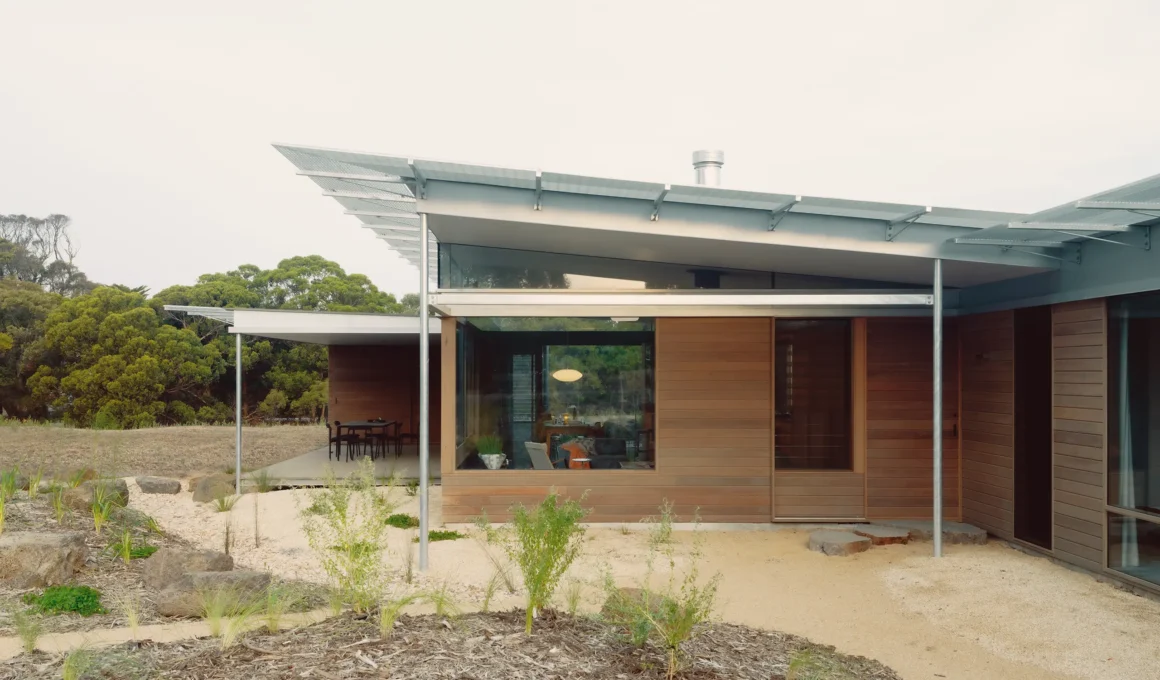
The house that remains habitable through a heat peak without mechanical cooling is not a house that resists the climate — it is one that was designed in conversation with it from the first sketch. This distinction matters more than it might appear. A house that resists heat does so through energy expenditure: thicker insulation, lower thermostat settings, air conditioning units running at capacity through the hottest hours of the day. A house designed in conversation with its climate does something different. It intercepts heat before it reaches the interior, channels air through its geometry, and uses the thermal behavior of materials as a buffer between outdoor conditions and the rooms where people sleep, cook, and sit. The difference is not a matter of technology. It is a matter of when in the design process the climate was considered. Ironbark House by Not All Architecture on Victoria’s Great Ocean Road coast makes this position visible in every photograph.
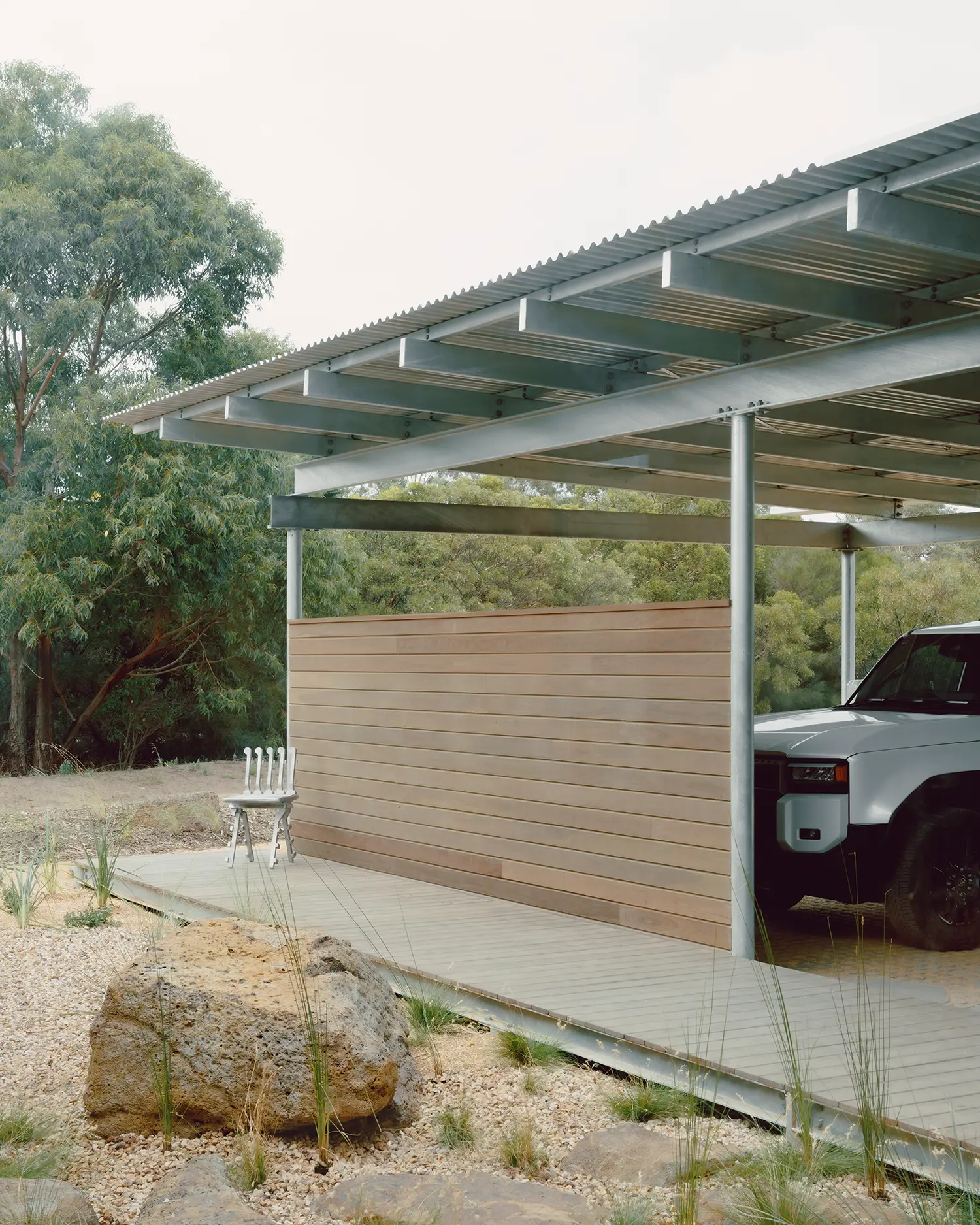
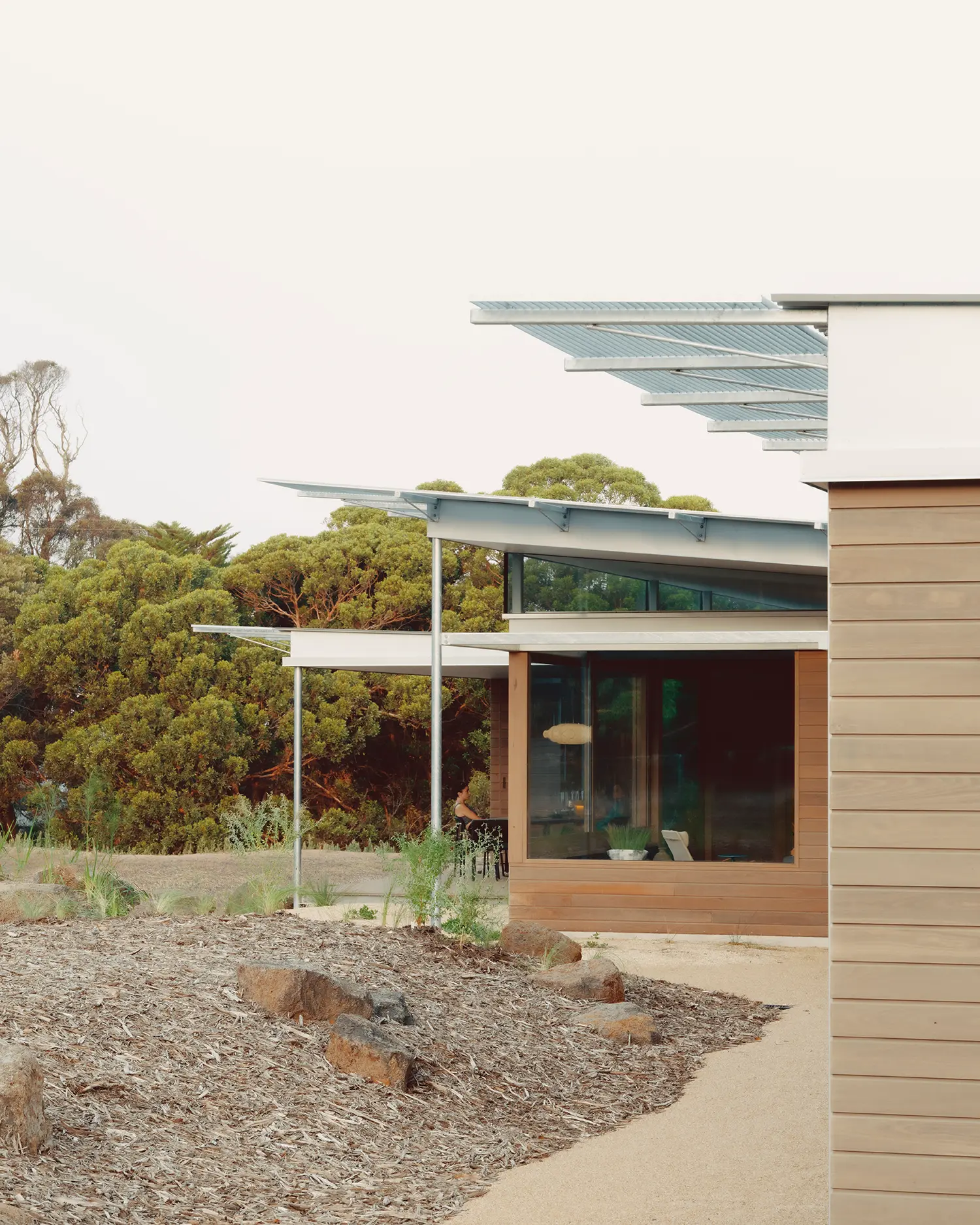
The most legible element is the galvanized steel roof — not because it is visually dominant, but because of what it is doing. The corrugated metal sheet sits above the inhabited volume on a separate steel frame, elevated off the structure below by a continuous air gap. This gap is not incidental. Hot air that accumulates under the roof surface is not trapped against the ceiling of the rooms below: it rises through the cavity and exits at the ridge. The roof is performing stack ventilation without a single moving part, without any mechanical component, without energy expenditure. In climates where roof surfaces can reach 70°C or more in direct summer sun, the difference between a roof that conducts that heat directly into the ceiling and one that vents heat before it reaches the inhabited plane is the difference between a room that stays at 26°C and one that climbs to 34°C by mid-afternoon.
The ironbark timber cladding that wraps the exterior walls contributes a second layer of passive thermal regulation. Dense hardwood has a significantly higher thermal mass than lightweight timber framing or rendered masonry — it absorbs heat slowly through the morning and releases it slowly through the evening, damping the amplitude of the interior temperature curve rather than transmitting it directly. The same density that gives ironbark its bushfire resistance rating gives it its thermal inertia. These two properties — fire resistance and heat buffering — are not coincidental in the same material. They are both expressions of the same physical characteristic: a wood so dense and tightly grained that it responds slowly to whatever the environment throws at it. As we explored in our analysis of low-carbon and bio-based material strategies, material choice and climate management are not separate conversations — they are the same conversation conducted at the specification stage.
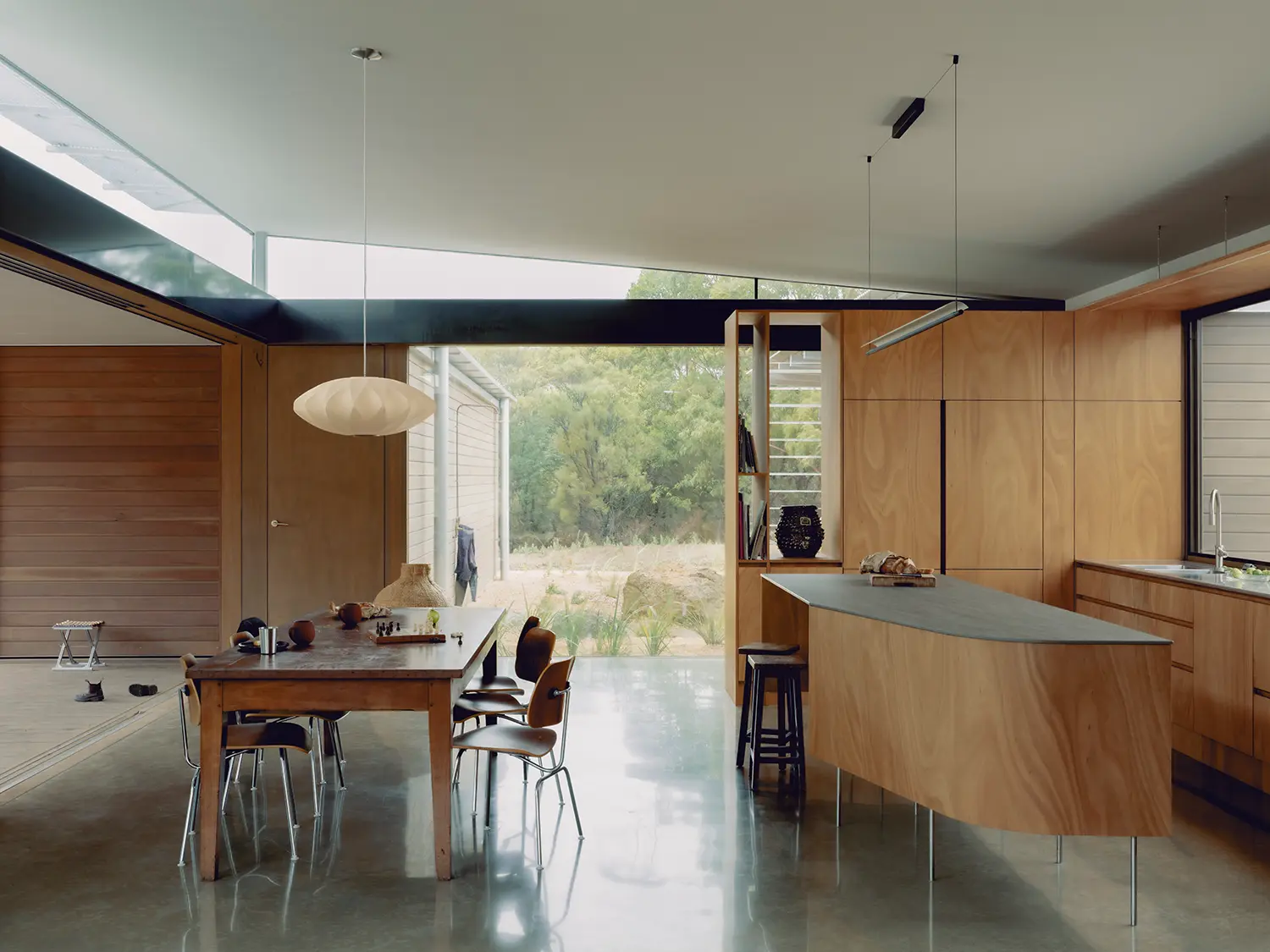
The interior confirms what the exterior promises. The polished concrete floor that runs through the open-plan living and kitchen zone is the third component of the thermal strategy. Concrete has one of the highest heat storage capacity of any common construction material — roughly four times that of timber by volume. A polished concrete slab of typical residential thickness, shaded from direct sunlight by the overhanging roof, absorbs heat from the interior air through the day and releases it slowly through the night, behaving as a thermal flywheel that smooths out the peaks and troughs of the daily temperature cycle. The effect is most pronounced in climates with a significant diurnal temperature range — the difference between daytime highs and nighttime lows. On the Victorian coast, that range can exceed 12°C on a summer day. A concrete floor charged with cool night air maintains a surface temperature several degrees below the ambient air temperature well into the following afternoon. This is the same logic that drives passive heating and cooling strategies in low-tech architecture across climates far more extreme than coastal Victoria.
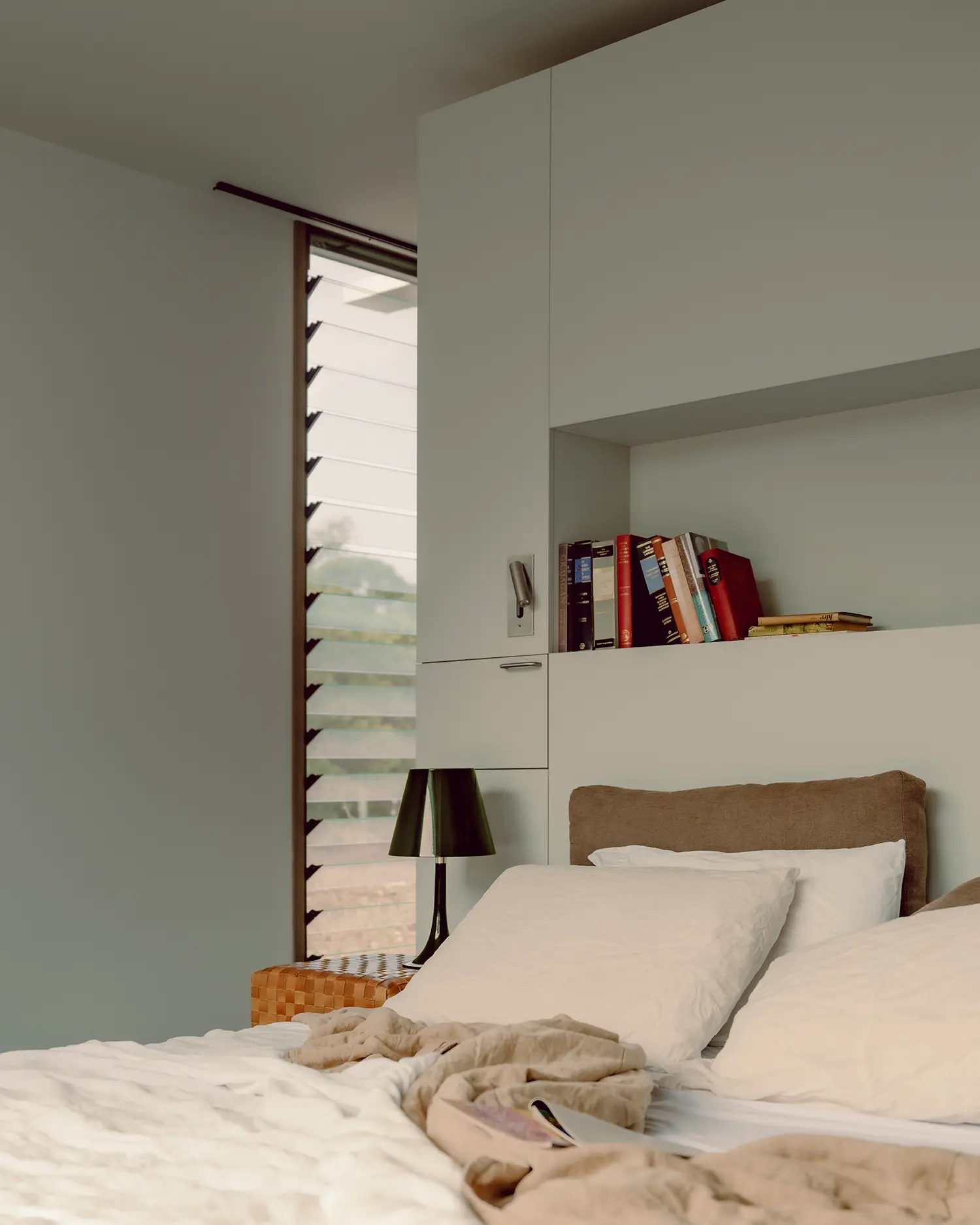
The louvered glass windows visible in the bedroom — adjustable glass blades set into a timber frame — represent the most deliberately controllable element of the natural ventilation strategy. Where the roof vents heat passively and automatically through convection, the louvered windows give the occupant direct control over cross-ventilation at room level. Tilted open at night, they admit cool coastal air at low velocity without the pressure differential that full-width sliding doors would create. Tilted closed during the hottest afternoon hours, they maintain privacy and reduce solar heat gain while still admitting diffused light. The mechanism is the same one used in Queensland vernacular architecture for more than a century — the Queenslander house elevated on stumps with louvered verandahs on every face was essentially a machine for catching coastal breezes — reinterpreted here in a contemporary residential language without losing any of its functional precision. The connection between vernacular climate response and contemporary residential design is one that courtyard typologies and adaptive patio design have been reestablishing across different scales and geographies.
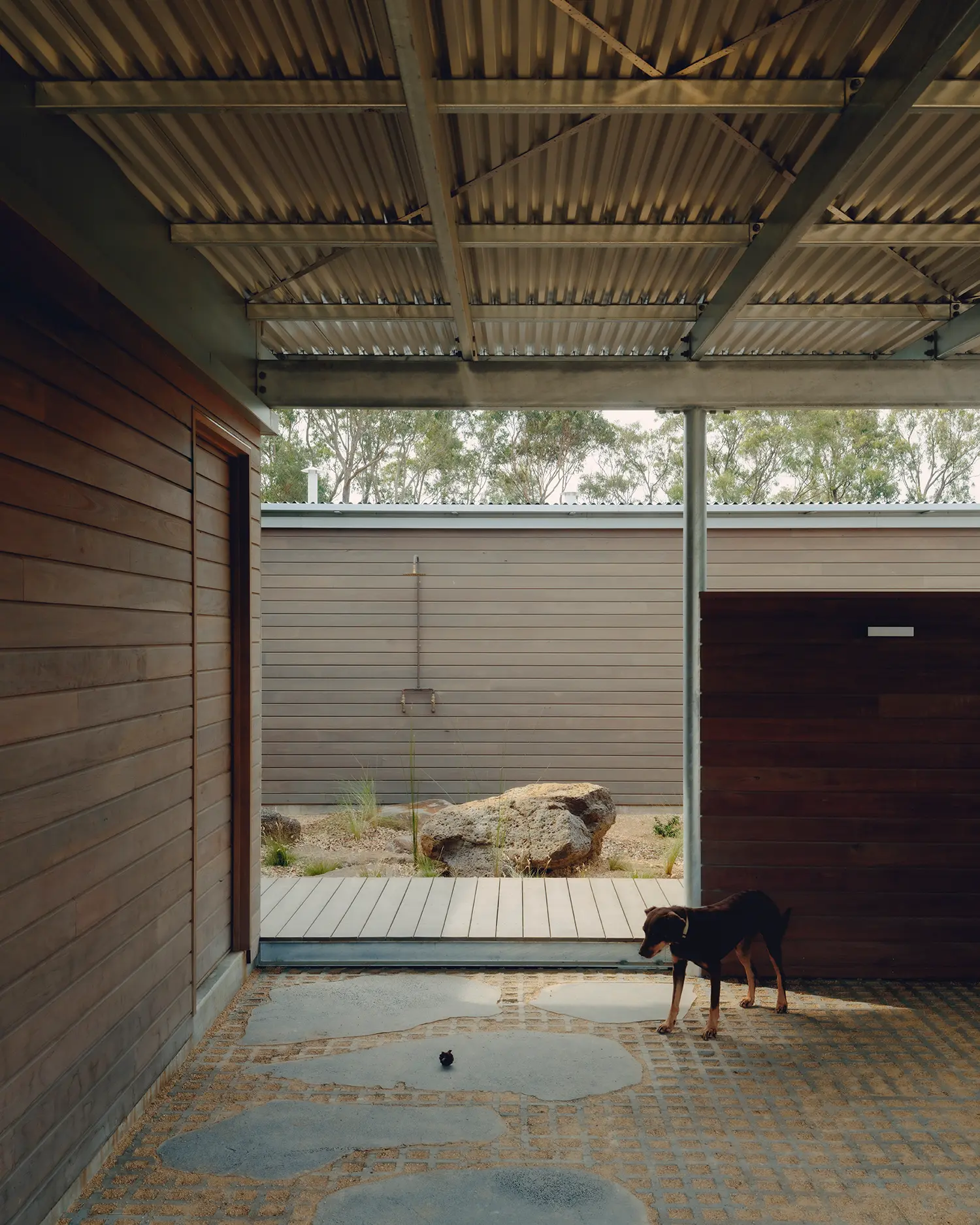
The modular additive layout of the house — separate pavilions connected by covered walkways rather than a single consolidated volume — serves the passive ventilation strategy as much as it serves the programmatic brief. A single large volume traps heat at its center: the further you are from an exterior wall, the harder it is for natural airflow to reach you. A dispersed plan keeps every room close to the exterior, maximizes the ratio of exposed wall to floor area, and allows prevailing breezes to pass through and between volumes rather than being deflected by a solid mass. The covered connections between pavilions create transitional thermal zones — spaces that are neither fully inside nor fully outside, shaded from direct sun but open to air movement, functioning as pressure-equalizing chambers that pull cool air through the interior as warm air rises and exits through the roof ventilation cavity above. This approach to outdoor living and tectonic durability treats the spaces between rooms as climatically active, not merely circulatory.
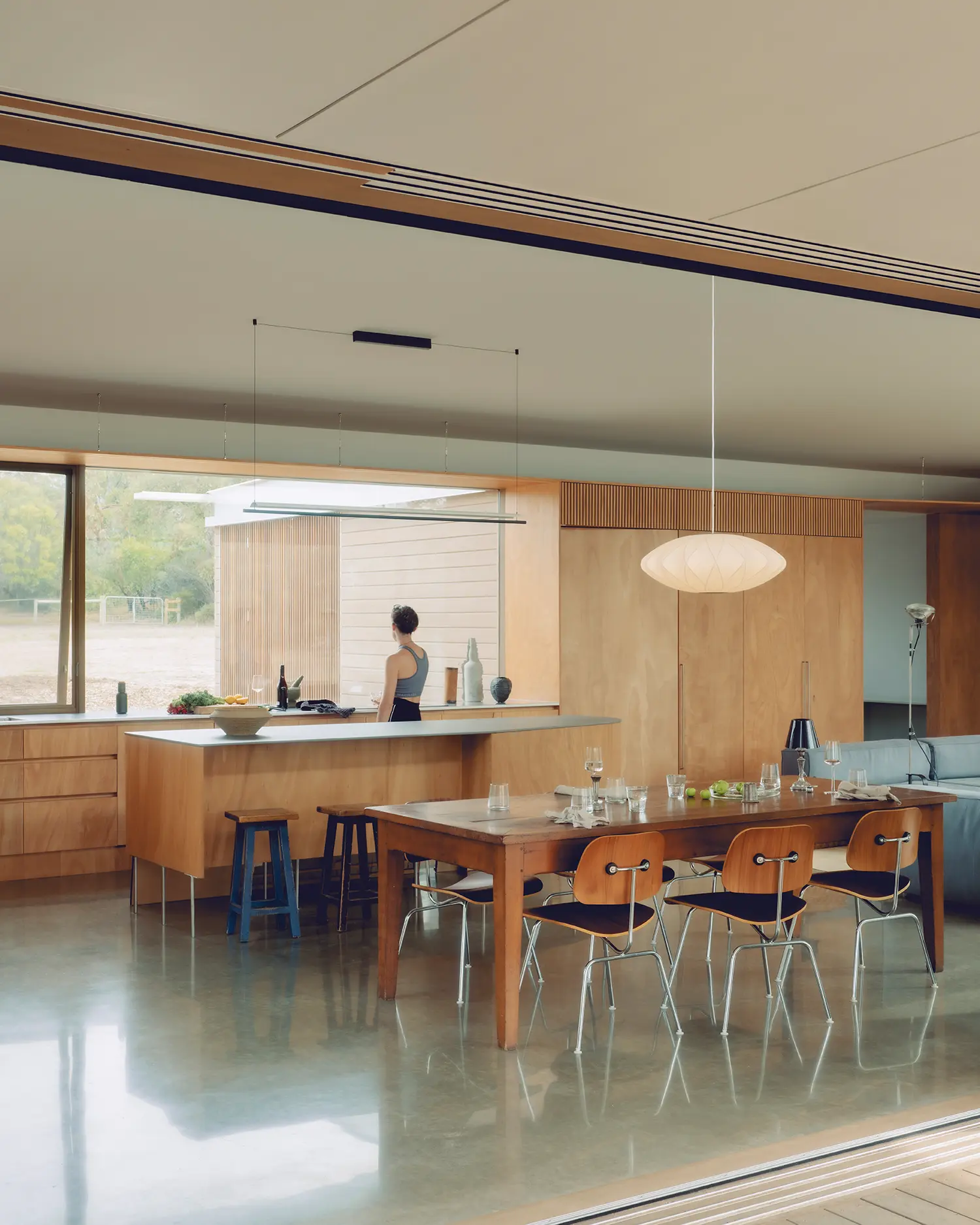
The relationship between the house and the coastal landscape is not incidental to the thermal performance strategy — it is constitutive of it. The site on the Great Ocean Road coast is exposed to prevailing south-westerly winds that arrive off the Southern Ocean having crossed hundreds of kilometers of open water. These winds are cooler and more consistent than inland breezes, and a house oriented to catch them does not need to manufacture cooling — it needs only to not obstruct it. The native coastal landscape around the house — rough gravel and scrub rather than hard paving or dense lawn — minimizes radiant heat re-emission from ground surfaces. Dark paving or dense lawn in full sun can raise the ambient temperature around a building by several degrees through reradiation. Gravel and mulch do not. The thermal logic of Ironbark House extends to the ground beneath it. As the research on dark-finish pool surfaces and thermal sustainability demonstrates, every surface around a building participates in its thermal balance — not just the walls and roof.
The question this house poses, quietly and without manifesto, is why passive cooling design is still treated as a specialist interest rather than a standard of practice. The components are not exotic: a ventilated roof assembly, a dense timber skin, a concrete floor, adjustable louvered openings, a dispersed plan oriented to prevailing breezes. None of these requires advanced engineering, proprietary systems, or significant cost premium over conventional construction. What they require is that the thermal design brief be addressed at the beginning of the process rather than delegated to the mechanical engineer at the end. The Passivhaus standard has demonstrated that the economics of envelope-first designare compelling even in cold climates, where the argument is primarily about heating loads. In warm climates, where cooling loads are growing fastest and where the energy and carbon cost of mechanical air conditioning is most acute, the case is stronger still.
A house that stays cool without asking permission from the grid is not a technical achievement. It is a design decision made early enough to matter. Ironbark House demonstrates that this decision does not require the sacrifice of spatial quality, material warmth, or connection to landscape. The steel roof floats. The timber breathes. The concrete remembers the temperature of the night before. The house does not fight the climate. It reads it.