



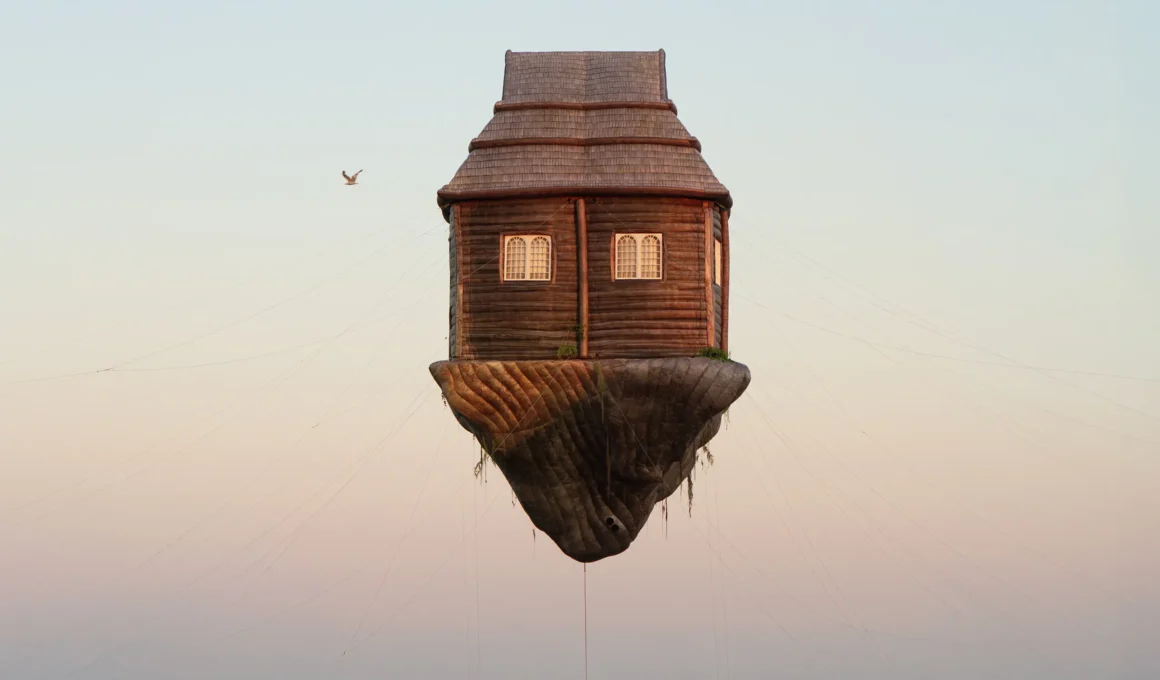
Anna Kamyshan, the London and New York–based Ukrainian artist and architect, sends a synagogue over Venice’s Arsenale Nord that never touches down — Nabatele, a floating temple held aloft by a helium balloon so that no single patch of ground can claim it. Presented as a Collateral Event of the 61st International Art Exhibition of La Biennale di Venezia, the installation reworks the confined, upper-floor synagogues of 16th-century Venice into an open, airborne temple — a floating synagogue visible to everyone below. In a season defined by conflict and displacement, Nabatele treats homelessness not as an absence but as a form of belonging that keeps moving.
Built as a double-membrane helium-filled balloon, Nabatele can rise up to 25 metres (82 feet) above the lagoon. The upper volume, a suspended synagogue, is built with the presence and precision of real architecture, evoking a genuine place of worship simply lifted into the air; below it, the floating rock carries roots and fragments of stone, a simulacrum of land the structure never actually rests on. Its behavior shifts with the weather — settling low toward the water on windy days, climbing freely into open sky when conditions calm — an instability that functions as the helium-filled balloon structure’s defining logic rather than a flaw to correct.

The image draws directly on René Magritte’s 1959 painting The Castle in the Pyrenees, in which a colossal stone surmounted by a castle levitates above stormy waves — a scene critics have long read as hope without a fixed place to land. Even the title carries that same tension: Nabatele is a Yiddishized word of Slavic and Semitic origin, combining a root meaning roughly “to call attention to” or “sound an alarm” with a Yiddish diminutive suffix, reframing the raised, glowing synagogue as both a warning beacon and a term of affection.

Historically, Venice’s own synagogues were confined to the upper floors of ordinary buildings, required by law to stay inconspicuous and unseen from the street. Nabatele repeats that elevation but inverts its logic, raising the synagogue into open sky as this year’s Venice Biennale Collateral Event, visible day and night across the Arsenale. “Nabatele explores the tension between gravity and buoyancy, the gentle effort of existing uprooted… The constant light from the synagogue windows symbolizes for me that inner flame that is not extinguished by any turbulence, and that persists in instability,”Anna Kamyshan says.

Curators Maria Veits and Yevgeniy Fiks frame the piece around Yiddishland, a conceptual homeland built from language and inherited memory rather than borders or political sovereignty. “Nabatele does not simply represent Yiddishland — it embodies it, materializing its diasporic form of belonging and giving presence to a peoplehood untethered from territory,” Veits and Fiks say. Kamyshan’s own biography runs through the piece just as directly, including her contribution to the conceptual vision for Kyiv’s Babyn Yar Holocaust Memorial Center, developed under the artistic direction of Ilya Khrzhanovsky — memory-driven installations that Nabatele extends into a single, physically unresolved object.

Conceived from the start as a traveling piece, Nabatele will continue beyond Venice to other cultural institutions and public spaces internationally. The Montreal Jewish Museum, which organized the installation as this year’s Collateral Event, has also positioned itself as the piece’s future North American host. What stays behind once the balloon eventually moves on is the detail Kamyshan keeps returning to in her own account of the work: the synagogue’s windows, still lit, holding their light steady no matter how far the structure drifts.
Nabatele by Anna Kamyshan | Where: Arsenale Nord, Castello District, Venice, Italy — When: 16 July – 16 September 2026
Also on view this season: Haus der Kunst’s own trajectory of atmospheric and collective practice — Fujiko Nakaya’s fog work is now showing in Paris at the Bourse de Commerce, on view through 14 September — sits alongside a wider season of installations working with light, land, and memory: James Turrell’s newly opened permanent Skyspace at ARoS Aarhus, Leandro Erlich’s retrospective at the Grand Palais, running through 6 September, Cartier and Studio Sabine Marcelis at NGV Melbourne, open until 4 October, Joshua Vides at the Petersen Automotive Museum, on view into next year, and Carsten Höller’s “Two” at UCCA Beijing, on view until 31 January 2027. Saraceno himself last appeared on urdesign in 2020, with his moving-atmosphere installation at the Garage Museum in Moscow.